
Xu Xun, Luo Hanbin, Wei Ran, Zhao Chengguang
(School of Civil Engineering and Mechanics, Huazhong University of Science and Technology, Wuhan 430074)
Abstract: This paper addresses the limitations of traditional BIM practices within construction enterprises and proposes a solution centered on a private cloud platform. The article outlines the framework of the private cloud platform, detailing its design philosophy, core principles, and fundamental architecture. It further evaluates platform usability through a comprehensive risk analysis. Finally, a practical implementation case is presented to illustrate the platform’s functional modules and operational outcomes, demonstrating the effectiveness of the BIM private cloud platform and underscoring its significant application value and promising development prospects.
Keywords: Building Information Modeling (BIM); Information Technology Promotion; Enterprise Private Cloud; Information Center Construction Classification Code: TU17
Construction and Implementation of the BIM Private Cloud Platform in Construction Enterprises
XU Xun, LUO Hanbin, WEI Ran, ZHAO Chenguang
(School of Civil Engineering & Mechanics, Huazhong University of Science & Technology, Wuhan 430074)
Abstract: This paper presents a BIM (Building Information Modeling) private cloud platform (BIMPCP) as a solution to the challenges of traditional BIM application in construction enterprises. The platform is introduced from the perspectives of design concepts, establishment principles, and basic framework, with usability assessed through risk analysis. A detailed case study is provided to showcase the functional modules and application results, reflecting the broad application value and future prospects of the BIMPCP.
Key words: building information modeling; informationization; enterprise private cloud; information center construction
0 Introduction
BIM, or Building Information Modeling (Building Information Modeling), is an engineering data model based on 3D digital technology that integrates all relevant information of construction projects. It provides a digital representation of the physical and functional characteristics of project facilities, enabling comprehensive information sharing throughout the entire project lifecycle【1】. This is crucial for addressing the implementation and management challenges posed by the vast amount of information and complex relationships inherent in construction projects.
As a key topic in China’s current construction industry, BIM is attracting increasing attention. The national “Twelfth Five-Year Plan” for the construction industry has repeatedly highlighted that the informatization level of the sector is relatively low, making the “comprehensive improvement of industry informatization” a primary task. To facilitate the practical application of BIM technology in construction projects, developing an enterprise-level private cloud platform is an effective approach.
1 Background
1.1 Traditional BIM Application Modes
In recent years, BIM has become a focal point in the domestic construction industry. Beyond the strong promotion by software vendors, government bodies, industry associations, and experts, design units, construction companies, and research institutions have also begun to prioritize and advance BIM technology.
Organizations such as the Commercial Real Estate Professional Committee of the Real Estate Industry Association, the Engineering Construction Quality Management Branch of the China Construction Industry Association, the Engineering Management Research Branch of the China Architecture Society, and the Computer Application Branch of the China Civil Engineering Society have released the “China Commercial Real Estate BIM Application Research Report 2010” and “China Engineering Construction BIM Application Research Report 2011”. According to these reports, BIM awareness rose from 60% in 2010 to 87% in 2011. In 2011, 39% of surveyed units reported using BIM-related software, with design units being the primary adopters【2】. Currently, BIM application in China is largely confined to the following two modes:
1) Standalone mode. Each user operates a dedicated graphics workstation with BIM software installed locally. BIM model data is typically stored and controlled individually on the local machine.
2) Product Data Management (PDM) based mode. The enterprise deploys a centralized BIM data management platform to store and manage all BIM design models. Each user still runs BIM software on their local graphics workstation. The key difference is that upon completing a task, the user uploads the BIM model to the PDM server via the network for unified storage and management, facilitating subsequent work.
1.2 Challenges of Traditional BIM Application Models
The primary issues associated with traditional BIM application modes are summarized as follows:
1) High Cost
In both traditional modes, since the software runs on local workstations, graphics processing and computation are performed locally, and model data is mostly stored locally. Consequently, each user requires a high-performance graphics workstation, leading to high initial hardware investment. Moreover, due to the rapid updates of BIM software and continuously rising hardware requirements, ongoing hardware upgrade costs will steadily increase, placing significant economic pressure on enterprises.
2) Data Security
In these traditional modes, BIM data remains stored on the user’s local workstation, where it can be freely controlled, backed up, and disseminated. This makes it difficult for enterprises to guarantee data security.
3) Complex Management
IT management personnel must maintain each user’s workstation, BIM software, and data. Effectively managing this software and hardware during use presents a significant challenge.
Characteristics and Advantages of the Enterprise-Level BIM Private Cloud Platform
2.1 Private Cloud Platform
The earliest prototype of cloud computing was proposed by renowned computer scientist John McCarthy in the 1960s, who suggested that “computation may someday be organized as a public utility.” This implies that cloud computing, as a virtual resource, could become as accessible as water and electricity【3】. Prominent scientist Ian Foster defines cloud computing as: “a large-scale distributed computing paradigm that is driven by economies of scale to provide a set of abstract, virtualized, dynamically scalable, and manageable computing resources, storage, platforms, and services to external users over the Internet”【4】. The University of California, Berkeley’s “Cloud Computing White Paper” describes cloud computing as comprising Internet-based service applications and the data center hardware and software that support them. These services are known as Software as a Service (SaaS), while the data center facilities constitute the “cloud”【5】. In China, many experts in grid and cloud computing have offered their own definitions, with Liu Peng’s being representative. He states that “cloud computing distributes computing tasks across a resource pool composed of numerous computers, enabling application systems to obtain computing power, storage space, and various software services on demand”【6】. Synthesizing these viewpoints, cloud computing can be defined as a service established by specialized network companies to provide computer storage and computing centers. Users can easily access the resources they need via a network connection and a browser, paying only for the resources they consume.
Cloud storage, a branch of cloud computing, extends and evolves from the cloud computing concept【7】. When the core of cloud computing—the computing and processing center—focuses on the storage and management of massive data, it requires a large number of storage devices. At this point, the cloud computing system becomes a cloud storage system. Therefore, a cloud storage system is a cloud computing system optimized for storing and managing large amounts of data. A private cloud platform uses virtualization technology to integrate hardware resources and provide them for internal enterprise use. Compared to public cloud platforms, private cloud platforms offer higher security and reliability. Enterprises can build their own private cloud platforms according to their specific needs to mitigate operational risks.
2.2 Enterprise-Level BIM Private Cloud Platform
2.2.1 Overview
The enterprise-level BIM private cloud platform is, first and foremost, a private cloud platform, and secondly, it is built specifically for enterprise BIM applications. Enterprises can deploy the necessary graphics workstations, high-performance computing resources, high-capacity storage, and BIM software within the cloud. BIM data models, applications, and analysis results are generated and managed within the cloud. Local users do not need to install professional BIM software or possess powerful local graphics processing capabilities. They only require a standard terminal computer connected to the cloud platform via the network to perform BIM-related work.
2.2.2 Basic Principles
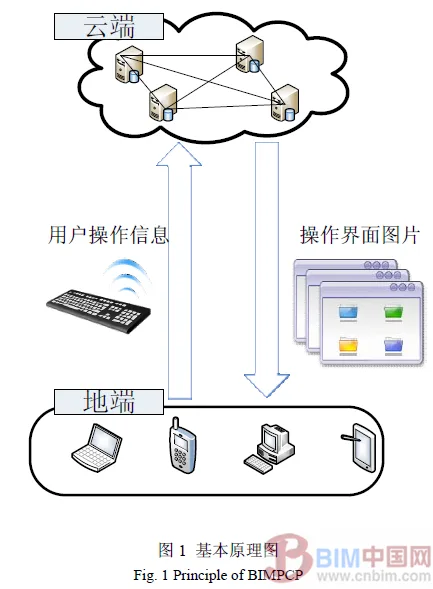
The basic principle of the enterprise-level BIM private cloud platform can be simply described as the process of transmitting commands—such as mouse movements and keyboard inputs—from a local computer to a cloud server over the network. After processing by the cloud server, the user’s visual output is optimized and compressed before being transmitted back to the local display. The local computer does not participate in the computation, which is why private cloud platforms have minimal hardware requirements for local endpoints. In this process, in addition to focusing on cloud hardware performance, attention must also be paid to the network speed required for transmission. When using a local computer, the experience can be equivalent to or close to that of a server, and the optimized image transmission consumes significantly less network bandwidth than transmitting raw model data.
2.2.3 Platform Advantages
1) High Performance
The cloud hardware resources, integrated and built as a pool, offer powerful graphics processing and computational performance, greatly reducing the time spent on data calculation and analysis. This resource integration ensures that every BIM user receives efficient graphics and computing services.
2) Secure and Controllable
Enterprise private cloud platforms store data on the enterprise’s own workstations, typically located behind the corporate firewall, making them less vulnerable to attacks【8】【9】.
3) Universality
The enterprise-level BIM cloud platform is not limited to a specific BIM application; the same platform can support the operation of different applications【10】.
4) Cost Savings
The shared use of software and hardware resources delivers integrated resources to enterprise users as a service over the network, achieving efficient and rational resource utilization. This not only simplifies the desktop computer, reducing hardware and software procurement costs, but also lowers management and maintenance costs.
5) High Scalability
Cloud servers are not composed of a single server but can integrate multiple servers in parallel, making future expansion easy to meet the needs of growing applications and users.
3 BIM Cloud Platform Framework
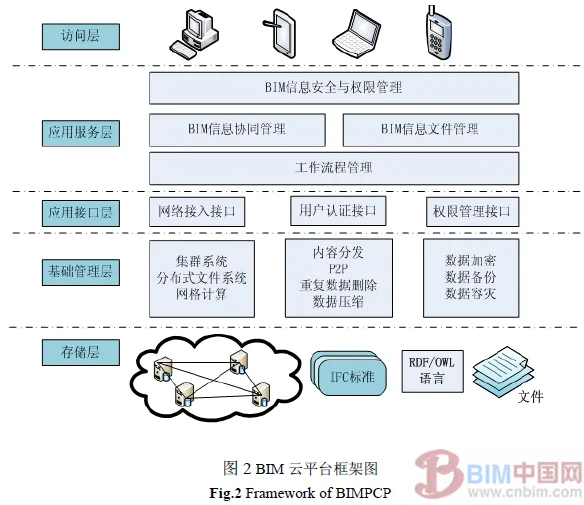
The infrastructure of the BIM private cloud platform for construction enterprises is divided into the storage layer, basic management layer, application service layer, application interface layer, and access layer, as illustrated in Figure 2.
3.1 Storage Layer
The integrated management of massive building information is the first challenge to be addressed throughout the entire building lifecycle. The storage layer is the most fundamental component of BIM cloud storage, serving as the data foundation of the entire system where BIM building information is aggregated. The storage devices that constitute the storage layer can be FC Fibre Channel storage devices, IP storage devices like NAS and iSCSI, or DAS storage devices such as SCSI or SAS. Cloud storage devices are interconnected via WAN, the Internet, or FC Fibre Channel networks. A unified storage device management system is installed on each storage device, enabling logical virtualization, centralized management, multi-link redundancy, as well as hardware status monitoring and maintenance upgrades.
3.2 Basic Management Layer
The basic management layer is the core of BIM cloud storage throughout the project lifecycle and also the most challenging part to implement. This layer uses cluster systems, distributed file systems, and grid computing technologies to enable collaborative work among multiple storage devices, allowing them to provide unified services and deliver greater, stronger, and more efficient data access performance.
The cloud storage system implements cluster-based operation of backend storage devices through a cluster file OS, managing the entire system via control and management units, including data distribution, processing, and feedback of results. CDN content distribution systems, P2P data transmission technology, and data compression technology are utilized to ensure more effective data storage, using less space and bandwidth, thereby providing more efficient services.
The basic management layer also ensures security in the data storage and transmission of BIM files. Data backup and disaster recovery technologies guarantee that multiple copies of data are maintained, preventing data loss and ensuring the security and stability of the BIM data itself.
3.3 Application Service Layer
After authorization, users can log in to the BIM cloud platform system through network access, user authentication, and permission management interfaces to access services such as BIM information security and permission management, workflow management, BIM file management, and BIM collaborative management.
3.4 Application Interface Layer
The application interface layer is the most flexible and versatile part of BIM cloud storage. Development units can create different application service interfaces and provide tailored services based on actual business types. This allows applications like cost management, schedule management, facility management, and property management to be continuously developed and expanded according to customer needs without altering the underlying BIM cloud storage system.
3.5 Access Layer
For all project stakeholders, the cloud access layer is the direct entry point for accessing cloud services. Access devices can include PCs, tablets, virtual desktops, and mobile phones, encompassing cloud terminal programs and devices. Cloud terminal technology focuses on communication protocols and terminal security between the terminal and the cloud. By using different access terminals, all project participants can work remotely at any time and from any location. Remote work enhances the business capabilities and efficiency of all parties, as remote workers in different regions can ensure 24-hour operation of the construction project.
Risk Analysis of the BIM Cloud Platform
4.1 Availability Risks
1) Whether the informatization level of enterprise management personnel meets the standard. Given the current informatization level of the construction industry, whether the relevant management personnel possess the necessary standards to operate the private cloud platform is a fundamental prerequisite.
2) Whether the working mode of platform service objects can be changed promptly. BIM users need to invest time in learning and mastering the operation and usage of the cloud platform, which is a challenge for traditional BIM users.
3) Whether the enterprise training mechanism can keep pace. To achieve the expected platform usage effect, it is necessary to regularly organize relevant personnel for training and timely evaluate the training effectiveness to ensure that platform use does not become an obstacle to BIM design.
4.2 Information Security Risks
Compared to public clouds, private cloud platforms have lower information security risks. However, no system is perfect, and certain risks remain, primarily as follows:
1) Data loss. This is a risk faced by most cloud platforms. The common practice is to regularly back up the same data on different servers. If one server fails, data can be recovered from other backups.
2) Data leakage. There is a risk of data leakage involving enterprise secrets: first, through network attacks, but data on private cloud platforms is protected by enterprise firewalls, so the risk is relatively low; second, through direct physical access to the computer room to steal from cloud platform facilities, which requires enterprises to strengthen security measures. In general, the information security risks of private cloud platforms are much lower than those of traditional BIM application models. As the model matures, these risks can be reduced to a controllable range.
4.3 Financial Risk
Financial risk is essentially an assessment of whether the funds invested in cloud platforms can generate greater value for the enterprise. The risks involved are mainly evaluated based on the availability risks mentioned above. For example, if a small business has only a few BIM users but builds a private cloud platform, it is clearly not cost-effective. The recommended customers for the enterprise-level BIM private cloud platform are medium and large enterprises with a large number of BIM users. If each user requires a high-performance computer, the cost is high. In this case, using a cloud platform to solve this problem yields better results with essentially no financial risk. Therefore, enterprise management needs to have a thorough understanding of the company’s situation and whether a cloud platform matches the enterprise’s actual needs. Otherwise, blindly introducing a cloud platform will bring significant financial risks.
5 Implementation Cases of the BIM Cloud Platform
5.1 Introduction to the Implementing Enterprise
This implementation case details an enterprise’s attempt to develop a private BIM cloud platform for the M project. The enterprise is a large construction company in China, with over 10,000 employees and an annual construction production capacity exceeding 10 billion yuan. Its business scope covers dozens of provinces and cities in China and more than ten countries overseas. The M project is an exhibition project with a total investment of over 10 billion yuan and a planned total land area of several thousand acres. Upon completion, the project will be a multifunctional, composite international exhibition city integrating exhibitions, technology, culture, business, leisure, tourism, and residential areas.
The leader in charge of the cloud platform management department in Project M is the enterprise’s Deputy General Manager. The department includes 1 department manager, 1 deputy department manager, 1 manager assistant, 1 technical consultant, 4 cloud platform maintenance and management personnel, and 12 BIM users.
5.2 Hardware Construction of the BIM Cloud Platform
The specific hardware configuration of the BIM cloud platform solution in Project M is summarized as follows: One cloud platform software system was purchased. This system meets the requirement of supporting approximately 16 concurrent users running large 3D software like Revit, and about 30 concurrent users running 2D software like AutoCAD. One cloud workstation was purchased. Given the significant amount of BIM modeling work in the M project, a high-performance graphics workstation is required to ensure the efficiency of BIM design and application personnel during platform modeling. The workstation is equipped with two latest-generation E5-2687W eight-core processors (3.1GHz), 84GB of 1600MHz RAM (totaling 64GB), two 300GB SAS hard drives, and one Quadro K5000 graphics card. One management server was purchased. The management server is used to install platform management software and requires application interfaces that can support at least 4 or more management personnel simultaneously. It uses an E5-2609 (10M Cache, 2.40 GHz, 6.40GT/s Intel® QPI) server with 12GB memory, including two 300GB near-line SAS hard drives. One shared cluster storage unit (8T) was purchased. The shared cluster storage server is used for data storage and sharing, adopting a cluster storage system consisting of two E5-2430 (2.2G 6-core) processors, 12GB of memory, a 750W redundant power supply, two 300GB SAS hard drives, and four 2TB 7.2K 3.5in near-line SAS hard drives.
Network connection. This includes the enterprise’s internal and external networks. The internal network features a 1GB network from the cloud management server to other servers, and a 10GB network from the storage server to the cloud workstation. The external network connects the enterprise data center to the 1GB fiber optic network of the external project department, ensuring smooth information transmission.
5.3 Introduction to BIM Cloud Platform Functions
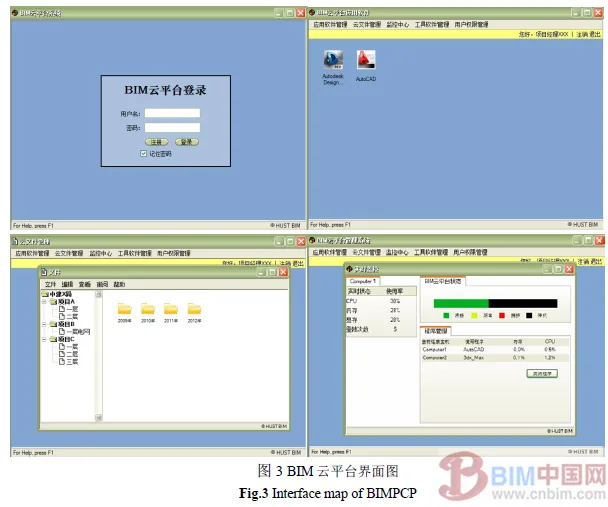
The BIM cloud platform mainly includes five functional modules: application software management, cloud file management, monitoring center, tool software management, and user permission management. After authorization, platform users can enter the cloud platform system through the login page shown in Figure 3. Based on user authorization, operations can be performed on the relevant functional modules.
5.3.1 Application Software Management
In the application software interface, various BIM software such as Revit Architecture, Revit MEP, and Bentley Structural are available. Users can double-click to open the corresponding application software for operation, just like on a desktop.
5.3.2 Cloud File Management
To facilitate user operation of data in the cloud, a web-based graphical file management software has been designed for the cloud computing platform, as shown in the following figure. The operating habits are very similar to the resource manager in the local Windows environment.
5.3.3 Monitoring Center
To help users understand the hardware operation status of the platform, the system provides a dedicated monitoring center module, allowing users to clearly view the status of all hosts and users of the cloud platform services. By clicking on a corresponding host, users can easily check the current load status, including CPU, memory, GPU, and other load conditions.
5.3.4 Tool Software Management
In the tool software module, the system lists the various application software installed on each server of the current platform, including the number of software licenses and the software status.
5.3.5 User Permission Management
The user management module allows for easy addition, deletion, and editing of users, or temporarily disabling a user. It grants users corresponding software and file access permissions, while also providing basic statistical information about users.
5.4 Implementation Guarantee
For a cloud platform that is rarely used in the industry and has not yet become mainstream, the implementation effect of this attempt in Project M must be taken seriously. To achieve the expected usage effect of the enterprise-level BIM private cloud platform, the following implementation guarantee measures were taken:
1) The enterprise established a separate platform management department, which is administratively subordinate to the enterprise information center but directly supervised by the enterprise’s deputy general manager. The department includes 4 platform maintenance personnel, 1 technical consultant, 1 manager, 1 deputy manager, and 1 manager assistant. (Note: The responsible leader holds a bachelor’s degree in computer science and a master’s degree in engineering management.)
2) The department developed relevant management systems, including platform resource allocation and platform permission management.
3) The department established a continuous and effective training mechanism, with technical consultants as the main trainers, supplemented by external technical talent. Training is organized every two weeks to familiarize employees with platform operation and use, and to improve work efficiency.
4) The department adopted a temporary green channel for new BIM designers, organizing separate training within 3 days to ensure their work proceeds smoothly.
5) The enterprise regularly evaluates the familiarity of BIM designers with platform usage and uses this as one of the factors in performance evaluations.
6) BIM designers provide feedback or suggestions at bi-weekly training sessions, which are discussed internally within the department. Platform functionality is promptly improved or modified, and important and effective suggestions are rewarded.
7) The responsible leader is required to undergo at least one individual training session per month, with the content to be discussed and determined in advance by the technical advisor.
8) For temporary employees, temporary accounts can be issued with limited functions. These accounts have time limits and will expire. If an employee becomes a regular employee, they will be treated as such and given a long-term use account.
6 Conclusion
Currently, BIM private cloud platforms are rarely used in construction enterprises. However, with the rapid development and popularization of information technology in the construction industry, this technology holds broad development prospects. This article proposes an implementation plan for building a BIM private cloud platform center for construction enterprises, provides theoretical explanations, and introduces the implementation of this plan by an enterprise in the M project. It can be seen that in the M project, the use of this technology successfully saved 30% of costs and brought more immeasurable economic benefits in the later stage. This fully reflects the broad application value and development prospects of the BIM private cloud platform. The next step will be to further explore and improve the implementation guarantee mode and application incentive mechanism of the cloud platform, and to apply the BIM private cloud platform more deeply in enterprises to create higher value returns.
[References]
[1] Goldberg, H.E. The Building Information Model[J]. CADalyst, 2004, 21(11): 56-58.
__AI_T_SC_0_ He Lingtong. The current application status of BIM worldwide. Engineering Quality, 2013, (3): 12-19
[3] Wikipedia. John McCarthy (computer scientist)[OL]. [2008-10-7]. http://en.wikipedia.org/wiki/John_McCarthy(computer_scientist).
[4] Foster I, Zhao Y, Raicu I, et al. Cloud computing and grid computing 360-degree compared[A]. Grid Computing Environments Workshop, 2008. GCE’08. [C]. Austin, TX 2008. 1-10.
[5] Fox A, Griffith R, Joseph A, et al. Above the clouds: A Berkeley view of cloud computing[OL]. [2009-2-10]. https://en.bimii.com/wp-content/uploads/2023/02/dd5111ba84f69b6.pdf
__AI_T_SC_0_ Liu Peng. Cloud Computing (Second Edition) __AI_T_SC_1_. Beijing: Electronic Industry Press, 2011
__AI_T_SC_0_ Kong Jun. Research and Design of Resource Allocation for Enterprise Private Cloud Computing Platform-AI-BT_SC_1__. Changsha: Hunan University, 2012
__AI_T_SC_0_ Xu Diwei. Exploration of Key Technologies in Cloud Computing. Modern Computer (Professional Edition), 2010, (7): 41-43
__AI_T_SC_0_ Zhang Yanhua. Implementation and Performance Analysis of Private Cloud System-AI-BT_SC_1__. Beijing: Beijing University of Posts and Telecommunications, 2012
__AI_T_SC_0_ Qiuqunye. Research and Design of Private Cloud Computing Infrastructure for Enterprises. Guangzhou: South China University of Technology, 2012
Fund Project: Special Research Fund for Doctoral Disciplines in Higher Education Institutions (20100142110061)
Author Bio: Xu Xun (1961-), male, senior engineer, engineering management
Communication contact person: Luo Hanbin (1963-), male, professor, engineering management














Must log in before commenting!
Sign Up