
According to the “Intelligent Building Design Standard” GB/T50314-2006, buildings are classified into ten categories: office buildings, commercial buildings, cultural buildings, media buildings, sports buildings, hospitals, schools, transportation buildings, residential buildings, and general industrial buildings.
When planning intelligent building systems, it is important to strike a balance between “commonality” and “individuality.” Designs should not simply copy previous projects. For integrated cabling system engineering, the “commonality” must adhere to the “Code for Design of Integrated Cabling System Engineering” GB50311-2007. “Individuality” refers to the designer’s assessment of the unique features and requirements of each project, including its scale and opportunities for design optimization.
The following is an overview of the key design considerations for integrated cabling systems across these ten building types:
1. Office Buildings
Office buildings must support business information applications and can be categorized as commercial, administrative, or financial office buildings.
The integrated cabling design should accommodate both rental and self-owned office spaces (including general and production-oriented offices).
For rental office buildings, cabling systems are usually managed by property management, with construction and investment responsibilities falling to the developer. Major strategies include:
– Conventional scale estimation: Allocate a workspace for every 5–10 m², with at least two information points per workspace. Use this as a basis for configuring horizontal and backbone subsystems.
– Area wiring for flexible spaces: Area-based wiring is recommended due to uncertain tenancy and frequent changes:
1. Run optical or electrical cables from the telecom room to primary customer zones, providing two fiber optic sockets (for Ethernet switches) and two voice sockets (for phone systems) per area. After moving in, customers complete their own internal wiring.
2. Set up CP (Consolidation Points) along horizontal cable routes. Horizontal cables run from the telecom room to CPs; users then extend cabling from CPs to their information points as required.
3. Install multi-user information sockets within each area.
4. Pre-install backbone-only wiring, reserving ductwork for future horizontal cabling once tenants finalize layouts.
Rental office buildings often feature a mix of Category 5e (voice), Category 6 (data), and fiber optic cabling.
In self-owned office buildings, especially government agencies, networks are separated into internal, external, confidential, and backup networks. Each network type may require separate information points, resulting in a higher overall density. Furthermore, equipment rooms, conduits, and cables must be physically segregated.
For confidential projects, horizontal wiring may be handled by system integrators, while backbone wiring is managed by institutions with security clearance. Self-owned office buildings often require high-level cabling, such as Category 6 and fiber optics.
For open office areas, using network flooring is advantageous for extensive horizontal cabling. However, fire-retardant ratings for cables must match whether metal conduits are used.
2. Commercial Buildings
Commercial buildings include malls, hotels, and similar facilities. These require integrated management platforms that combine operations and customer service for business information management.
Malls are large open spaces with uncertain shop sizes, locations, and densities. The CP method is suitable, with information points kept at moderate density. Fiber optic points can be reserved in public areas. Since shop locations are uncertain, horizontal cables may exceed 90 meters; therefore, multiple telecom rooms or fiber optic cables per floor are recommended. If booth locations are fixed, ground sockets can be installed for work areas ranging from 20–100 m².
Hotels generally require fewer information points, allocated by suite type (standard, deluxe, presidential, etc.) rather than area. Telephone and data cabling are often separated: hotels typically use their own PBX systems, so telephone points connect directly to exchanges, while internet/data points use integrated cabling. To reduce cables per suite, home information distribution boxes can be implemented.
3. Cultural Buildings
Cultural buildings such as libraries, museums, exhibition centers, and archives require cabling systems to support storage, display, retrieval, research, and public information dissemination.
The complexity of cabling varies with function: reading rooms require high-density information points for users, while archives need fewer points. Exhibition centers have large, complex spaces; news centers within them require multiple points, but general halls do not, making the CP method suitable. Museum cabling should also prioritize security. For aesthetics and cleanliness, ground-embedded sockets are preferred.
Archives, libraries, and museums benefit from high-performance cabling. Where cable and staff density is high, fire-resistant and low-toxicity cables should be used. Hybrid solutions combining wired and wireless cabling (with access points) facilitate information access during movement.
4. Media Buildings
Media buildings include theaters, cinemas, and broadcast/TV facilities. Their cabling systems must support media information flow and management requirements.
Due to high frequency and field strength needs, and multiple sources of interference, shielded and fiber optic cabling is preferred to minimize signal disruption. Image transmission often requires coaxial cables, so pipelines must ensure adequate spacing between different signal services, especially broadcast lines.
Theater staff are often mobile, so fewer information points are needed. Broadcasting and television buildings, with specialized production, require cabling tailored to professional needs.
5. Sports Buildings
Sports buildings include stadiums, gyms, and pools. Cabling must meet competition and facility management needs, as well as adapt to multifunctional use after events.
Sports buildings are divided into functional zones for sports and public services, including competition venues, spectator stands, and public buildings. Alongside facilities like news and information centers, drug test labs, and shops, cabling must support operational equipment such as clocks, scoring systems, flagpoles, and displays.
Key cabling considerations for competition venues:
1. Outdoor venues require equipment resistant to moisture, dust, and vibration, with protection ratings like IP67. Publicly installed connectors need damage and lightning protection.
2. Large venues should feature multiple telecom rooms interconnected with optical cables in a ring topology for improved network management.
3. Outdoor cables are exposed to weather, risking aging and degraded performance. Sealed metal conduits are recommended, especially for outdoor and fiber optic cables.
Network-based equipment (such as displays and monitoring) can be included in the integrated cabling design, combining both wired and wireless options.
6. Hospital Buildings
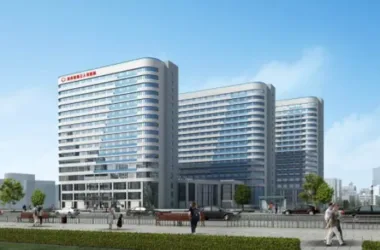
Hospitals (secondary level and above) require cabling for efficient, standardized, and information-based management, with a focus on infection control, energy savings, environmental protection, and patient-centered care.
Hospitals demand high bandwidth due to extensive equipment use and must address electromagnetic interference from medical devices. Shielded and fiber optic cabling are ideal for areas such as operating rooms and X-ray rooms.
Hospitals are typically large and complex, with diagnostic, inpatient, healthcare, and living areas. They should be treated as multi-building complexes, with cabling planned accordingly—optical fiber is recommended. Consider remote transmission and interoperability with public distribution networks.
7. School Buildings
School buildings encompass universities, high schools, vocational schools, primary and secondary schools, daycare centers, and kindergartens. Cabling must support teaching, research, administration, and daily life for staff and students, ensuring efficient learning and working environments.
Campus structures are diverse—teaching blocks, labs, lecture halls, libraries, science museums, dormitories—often spread over a large area. Cabling should radiate from a central information center to all buildings, with a strong backbone. Distribution and extension loops connect individual buildings.
Placement and density of information points must be tailored to specific scenarios rather than just building area. Integration with multimedia teaching setups is common, and campus networks aim to unify multiple business wiring systems. Like hospitals, schools should plan for remote transmission and external connections.
8. Transportation Buildings
Transportation buildings include airport terminals, railway stations, urban rail stations, public parking lots, and more. Cabling must support all transportation and operational business needs, ensuring efficient facility management and meeting the requirements of modern information systems.
These buildings are large, with cabling reflecting an extended star topology: the farther from the main distribution point, the fewer cables. Main cable runs are long, so fiber optic cabling is recommended.
Passenger and freight halls are large open areas that can use the CP method. Service areas rely on wired connections; public areas are better served with wireless extensions. Cable shielding is important due to potential electromagnetic interference from mechanical equipment.
9. Residential Buildings
Residential buildings include homes and villas. Their cabling systems must prioritize safety, energy efficiency, comfort, convenience, and support for green building standards. Standardized management is encouraged.
Residential cabling differs from public buildings and can take two main forms:
1. A home wiring box provides telephone, data, and TV services but does not process information (exchange, storage, etc.), covering “triple play” integration.
2. A home information distribution box handles both wiring and information exchange/transmission.
Residential cabling must also support functions like emergency calls and smart home controls, including appliance status monitoring. Home wiring can be divided into indoor, in-building, and community park cabling. It must support diverse telecommunication services and varying resident needs, making construction more complex.
10. Industrial Buildings
Industrial buildings require cabling for energy supply, environmental control, production, and office management. The system must support energy conservation and cost reduction.
Industrial sites are generally divided into production and office/control areas, with some equipment installed outdoors. Industrial-grade connectors are necessary to withstand harsh environments, offering protection against water, dust, vibration, corrosion, and electromagnetic interference. In better environments, such as control rooms or offices, standard cabling practices can be used.
It is notable that many modern buildings integrate large displays, monitoring, access control, garage management, and building automation systems—all operating over network protocols. Their transmission lines can be included in the comprehensive cabling system for unified pipeline design.
In conclusion, while the infrastructure for integrated cabling systems may appear straightforward, developing an optimized and practical plan requires careful analysis and ongoing exploration.
Designers must always consider practical application, future development potential, and the intended functionality of the building to create reasonable and effective solutions.












Must log in before commenting!
Sign Up