
1 Overview
1.1 From Manual Drafting to Computer-Aided 2D Drawing: The First Revolution
In 2000, CAD (Computer-Aided Design) technology became widely adopted, transforming architectural design by shifting from manual drafting to electronic 2D data-based drawing. Often described as “shaking the drawing board,” this shift marked the first revolution in architectural engineering design. 2D CAD technology fundamentally overhauled traditional design methods and production models. It freed engineering designers from manual calculations and hand-drawn plans, allowing them to focus more time and energy on scheme optimization, refinement, and review. Simultaneously, it boosted design efficiency, significantly shortened design cycles, and enhanced overall design quality.
1.2 The Application of 3D Renderings
2D drawings have clear limitations, as they cannot intuitively convey various details of architectural design. To address this, complex projects began using solid modeling to communicate design intent throughout the entire process, compensating for the shortcomings of 2D-only approaches. With the widespread availability of computers, designers started conducting 3D modeling and solid modeling. However, early models were overly simplified, only meeting basic geometric shape and size requirements. Later, software such as 3DS and FormZ emerged for 3D modeling and rendering. These tools enabled designers to assign different colors to building surfaces to represent various materials and, combined with optical effects, generate photo-realistic building renderings.
1.3 BIM: Enabling Full-Lifecycle Informatization and Advancing the Second Revolution in Construction Engineering
BIM (Building Information Modeling) technology involves creating and using digital models for project design, construction, and operational management. According to the U.S. National BIM Standard (NBIMS), BIM is defined in three parts: (1) BIM is a digital representation of the physical and functional characteristics of a facility; (2) BIM serves as a shared knowledge resource, enabling information sharing about a facility to provide a reliable basis for all decisions throughout its lifecycle—from concept to demolition; (3) At different project stages, various stakeholders collaborate by inserting, extracting, updating, and modifying information in BIM to support and reflect their respective responsibilities.
BIM has driven a second revolution in architectural engineering design, transitioning from 2D drawings to 3D design and construction. For the entire construction industry, BIM also represents a true information revolution. Initially, BIM was used only in large-scale landmark projects. Beyond the Shanghai Center project—a classic example of BIM application—BIM was also used in venues for the Shanghai World Expo. Within just two or three years, BIM has expanded to small and medium-sized projects. For instance, at the Fujian Architectural Design and Research Institute, 70% to 80% of projects are now completed using BIM. Reports indicate that three years ago, the U.S. led China by seven years in BIM application; today, that gap has narrowed to three years.
The comprehensive application of BIM in China will deliver substantial benefits to the construction industry, significantly improving the quality and efficiency of design and the entire project lifecycle. BIM will directly promote transformation and development across all sectors of the industry, reshape thinking patterns and work methods, and create new organizational models and industry rules for design, construction, and operation.
2 Technical Characteristics of BIM __AI_S_SC0__
(1) Visualization and Parametric Design
Visualization follows the principle of “what you see is what you get.” In BIM, visualization technology displays components previously represented by lines as 3D graphics. Unlike static renderings, these 3D graphics are automatically generated based on component information, demonstrating interactivity and feedback. With BIM’s full-process visualization, users can not only display 3D effects and generate reports automatically but also conduct communication, discussions, and decision-making during design, construction, operation, and maintenance in a fully visualized environment.
(2) Coordination and Component Correlation
The full lifecycle of a construction project is complex. When issues arise during implementation, all parties must hold coordination meetings to identify causes, propose solutions, and issue changes. For example, in HVAC systems, pipeline layouts may overlap with structural components like beams and columns—a common construction collision problem. BIM’s coordination services address these collision issues during the design phase and generate coordination data for discussion among all construction stakeholders. BIM also resolves other coordination challenges, such as aligning elevator shaft layouts with other design elements and clearance requirements, coordinating fire zones with other layouts, and aligning underground drainage layouts with overall design plans.
(3) Simulation and Execution
BIM enables the extraction of building model data for simulation calculations and exercises. In the design phase, BIM supports simulations of building models, including energy efficiency, sunlight exposure, thermal conduction, and emergency evacuation. During bidding and construction, 4D simulation (adding a time dimension to 3D models for construction control) can be conducted to simulate actual construction based on construction plans, optimizing the construction schedule. 5D simulation (adding a cost dimension to 3D models) enables cost control. In the operational phase, BIM supports simulations of emergency response methods, such as earthquake and fire evacuation drills.
(4) Collaborative Design and Optimization
As construction projects become increasingly complex, interdisciplinary collaboration has become a key trend in architectural design. BIM provides a robust technical collaboration platform for traditional construction professionals, offering detailed building information—including geometric, physical, and rule-based data—as well as real-time updates on the building’s status after changes. For example, if a structural engineer adjusts a column’s size, the column in the building model updates immediately. BIM also facilitates collaboration across different production and management departments. Construction companies can add time parameters to the building model for virtual construction and progress control, while government departments can conduct electronic drawing reviews. BIM not only transforms the traditional collaboration between architects and structural engineers but also enables owners, government bodies, manufacturers, and construction companies to work together using the same 3D building model parameters.
BIM and its optimization tools make optimizing complex projects possible. Currently, BIM-based optimization supports the following work:
1) Project scheme optimization: By combining project design with investment return analysis, BIM can calculate the impact of design changes on investment returns in real time, helping owners comprehensively evaluate design schemes and achieve optimal design outcomes.
2) Design optimization for special projects: Projects like podiums, curtain walls, roofs, and large spaces often use irregular designs. Optimizing these construction plans can deliver significant improvements in project duration and cost.
(5) Documentability
BIM can generate not only conventional architectural design drawings and component processing drawings but also:
1) Comprehensive pipeline diagrams (with collisions inspected and design errors corrected).
2) Comprehensive structural opening diagrams (pre-embedded casing diagrams).
3) Collision inspection reports and improvement plans.
Standardization Status of BIM
3.1 Developed Countries Prioritize BIM Research and Release Application-Level Standards
In recent years, BIM technology has achieved extensive application results in the construction engineering fields of the U.S., U.K., Japan, Hong Kong, and Singapore, with these regions also leading early research on BIM-related standards. In January 1997, the IAI (Industry Alliance for Interoperability) released the first complete version of the IFC (Industry Foundation Classes) information model, named AI_S_SC_0_. After over a decade of development, the coverage, application scope, and model framework of the IFC information model have been greatly enhanced and recognized by the ISO standardization organization. The IFC standard is an object-oriented 3D building product data standard widely used in building planning, design, construction, and e-government.
The U.S. has developed BIM application standards based on IFC—NBIMS (National Building Information Model Standard) [3-4]. NBIMS is a comprehensive BIM guidance and normative standard that specifies requirements for information exchange between different industries using the IFC data format, aiming to promote business process informatization. This series of standards was upgraded in 2011.
Japan’s construction informatization standard is the CALS/EC (Continuous Acquisition and Lifecycle Support/Electronic Commerce) standard. Japan has made significant efforts in standard formulation, including establishing construction informatization frameworks, developing corresponding standards and systems, conducting demonstration applications, and implementing practical use. The core of Japan’s construction informatization framework includes online release of engineering project information, electronic bidding, electronic signing, electronic submission of design and construction information, reuse of engineering information during operation and maintenance, and application of engineering project performance databases. Corresponding standards and systems have been largely completed and put into use, with phased goals achieved on schedule. The establishment of BIM standards has not only enhanced industrial competitiveness but also generated significant economic benefits.
3.2 BIM Standard Research in China
China has also conducted foundational research on BIM application and development. In 2007, the China Academy of Building Standards Design and Research proposed the JG/T198-2007 standard, which non-equivalently adopted the international IFC standard (“Industrial Foundation IFC Platform Specification”) __AI_S_SC0_. This standard defines general requirements for the digital definition of building objects, covering the resource layer, core layer, and interaction layer. It applies to information exchange and sharing within and between stages of the building lifecycle, including architectural design, construction, and management. Information exchange in fields like water conservancy, transportation, and telecommunications can also reference this standard. In 2008, the “Industrial Foundation Platform Specification” (a national guiding technical document) was jointly drafted by the China Academy of Building Research and the China Institute of Standardization. This standard is equivalent to IFC, with technical content fully consistent with it; adjustments were only made to the writing format to comply with China’s national standard requirements. BIM application in the Hong Kong Housing Department has been vigorously promoted, with bidding documents explicitly requiring BIM-based document submission and in-depth supporting research. The Housing Department has also formulated internal BIM standards.
In 2012, the Ministry of Housing and Urban-Rural Development assigned the task of compiling the national standard “Unified Standard for Application of Building Engineering Information Modeling,” with the China Academy of Building Research as the lead editor. This standard provides strong support for advancing major technological progress in China’s construction engineering field and lays a solid foundation for developing BIM system engineering with independent intellectual property rights in China. The Unified Standard covers the four stages of planning, survey and design, construction, and operation and maintenance across the entire building lifecycle. It involves the development of BIM standards, BIM Technology, application of BIM Technology, and BIM project management, including professional data standards and databases, workflows and support systems, professional application software, data exchange and collaboration, and interdisciplinary research and development.
To develop the Unified Standard, the concept of P-BIM was introduced, dividing BIM into three levels: Professional BIM, Phase BIM (covering engineering planning, survey and design, construction, and operation and maintenance stages), and Project BIM or Lifecycle BIM. These three levels are collectively referred to as P-BIM. The core idea is to closely integrate Chinese construction engineering application software with BIM technology. First, research on professional BIM technology and standards will be conducted, transforming professional software with BIM technology to form Professional BIM; then, Professional BIM will be integrated to form Phase BIM; finally, BIM from each phase will be connected to form the BIM of the entire project lifecycle, achieving BIM implementation in China. On the basis of ensuring full feasibility of the BIM project results (technology and software), the “Unified Standard for Application of Building Engineering Information Modeling” will be formulated, and other BIM standards at various levels will be developed under its guidance.
4 BIM Support Software
4.1 Classification of BIM Software
The Associated General Contractors of America (AGC) categorizes BIM and related software into eight types:
(1) Preliminary Design and Feasibility Tools;
(2) BIM Core Modeling Software (BIM Writing Tools);
(3) BIM Analysis Tools;
(4) Shop Drawing and Fabrication Tools for processing drawings and prefabrication;
(5) Construction Management Tools;
(6) Quantity Takeoff and Estimating Tools;
(7) Scheduling Tools;
(8) File Sharing and Collaboration Tools.
4.2 How to Select BIM Support Software
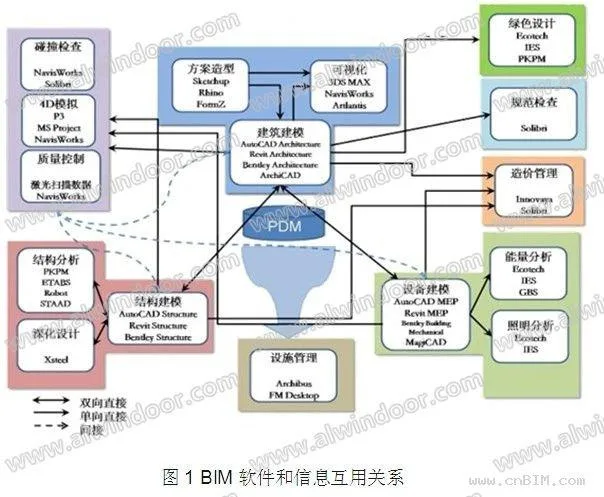
BIM support software includes scheme design software, geometric modeling software, sustainable analysis software, mechanical and electrical analysis software, structural analysis software, visualization software, model checking software, detailed design software, comprehensive model collision detection, cost software, operation management software, and publishing and review software. General selection guidelines are as follows:
① For civil buildings, use Autodesk’s Revit series.
② For factory design and infrastructure, use Bentley Corporation’s Bentley Architecture series.
③ For a single-professional architectural firm, Graphisoft’s ArchiCAD, Revit, or Bentley may be suitable.
④ For completely unconventional projects with ample budgets, Gehry Technologies’ Digital Project or CATIA can be chosen.
Visualization software can be Autodesk’s 3D visualization and solid simulation software, Autodesk Inventor Professional (AIP).
Sustainable or green analysis software can use BIM model data to analyze projects in terms of sunlight, wind environment, thermal engineering, landscape visibility, noise, and other aspects. Major software includes foreign options like Exotect, IES, and Green Building Studio, as well as domestic software like PKPM (which enables information exchange). BIM electromechanical analysis software includes plumbing and electrical equipment and electrical analysis tools. Domestic products include Hongye and Bochao, while foreign options include Designmaster, IES Virtual Environment, and Trane Trace, all of which support information exchange.
The basic functions of comprehensive model collision detection software include integrating models created by various 3D software (including BIM software, 3D factory design software, and 3D mechanical design software) for 3D coordination, 4D planning, visualization, and dynamic simulation. Common collision detection software includes Autodesk Navisworks, Bentley ProjectWise Navigator, and Solibri Model Checker, which integrate design results from multiple software and present them visually.
5 Successful BIM Application Cases
In the Shanghai Center Building construction project, appropriate BIM software was used at different stages, supporting design and construction. China Construction International has applied BIM technology to several major design projects, such as the Hangzhou Olympic Sports Center Stadium and the Tianjin Tuanbo Lake Tennis Center. The renovation project of Yinchuan Railway Station used BIM-based visualization technology to build a spatial solid model, which informed construction planning and effect display. In the 2010 Shanghai World Expo Germany Pavilion project, a series of 3D software like Revit and Navisworks were successfully applied to resolve complex challenges related to spatial relationships, 3D collaborative design, and pipeline integration. Meanwhile, through Building Information Modeling, data sharing and transmission among multiple project participants in design and construction were improved, enhancing the application level of BIM concepts in typical Chinese projects. Tsinghua University has introduced BIM-based 4D technology into the safety analysis of time-varying structures during construction, providing feasible approaches for the practical application of time-varying analysis theory.
6 Follow-Up Suggestions for the Construction Curtain Wall Industry
The construction industry’s “Twelfth Five-Year Plan” compiled by the Ministry of Housing and Urban-Rural Development explicitly proposes promoting BIM collaborative work and other technologies, popularizing visualization, parameterization, and 3D model design to improve design levels, reduce engineering investment, and achieve integrated application across design, procurement, construction, production, and operation.
BIM elevates the construction industry’s information technology to a higher level, and its comprehensive application will have an immeasurable impact on technological progress in the industry, greatly improving the integration level of construction projects. This presents both good opportunities and huge challenges for the development of the building doors, windows, and curtain wall industry. First, the industry must be able to read BIM data and complete detailed curtain wall and window design, significantly improving design quality management and project efficiency while reducing costs—this is a key challenge. Second, the curtain wall industry should provide feedback on improved designs to BIM, complete collaborative design, and enhance the overall design level and engineering quality of buildings.
To improve BIM application levels and share BIM data, the curtain wall industry should act immediately and embrace the wave of BIM applications. Current measures include:
(1) Actively participate in BIM standard development: Stay informed about BIM trends and engage in the formulation of BIM rules.
(2) Establish an industry development team: Develop a professional curtain wall BIM system, implement supporting software for all stages of design (including scheme design, structural calculation, thermal calculation, sunlight calculation, etc.), processing and manufacturing, installation and construction, and operation and maintenance, and develop interface systems with mainstream BIM building design systems.
(3) Strengthen BIM designer training: Cultivate a ladder-style talent team, with experienced senior technical personnel handling BIM conceptual design and BIM draftsmen completing specific input work.
(4) Promote and adapt BIM applications to evaluation and mandatory review projects: As government departments and high-demand property owners increasingly require BIM application, the curtain wall industry should adapt to this trend promptly.
[References]
[1] Eastman C. Teicholz P. BIM Handbook. New Jersey, USA: John Wiley & Sons, Inc., 2008.
[2] IFC Model. Industrial Foundation Classes, International Alliance for Interoperability, 2008.
[3] NBIMS (2006), National BIM Standard Purpose, US National Institute of Building Sciences Facilities Information Council, BIM Committee.
[4] NBIMS (2007), National Building Information Modeling Standard Part 1: Overview, Principles and Methodologies, US National Institute of Building Sciences Facilities Information Council, BIM Committee.
__AI_T_SC_0_ Liu Zhan Province, Li Zhancang, etc. The Application of BIM Technology in the Construction and Management of Large Public Building Structures. Construction Technology, 2017.7, P177
__AI_T_SC_0_ Standard Quota Research Institute of the Ministry of Construction. Digital Definition of Building Objects (JG/T198-2007). China Standard Press, 2007
__AI_T_SC_0_ China National Institute of Standardization. Specification for Industrial Basic Platforms. China Standard Press, 2009














Must log in before commenting!
Sign Up