
Original link: __AI_S_TURL_0__
Construction Managers Embrace 4D BIM for Safety
By Tom Sawyer, Translation:@BIM_for_Future
Ensuring on-site safety remains a constant and pressing challenge for construction project managers.
Successful construction planning demands the dynamic integration of multiple factors, including workflows, work zones, personnel, machinery, equipment, and site layout. Throughout the construction phase, project managers must operate as astute analysts, risk evaluators, agile coordinators, skilled communicators, and effective safety trainers to protect both work areas and public safety. Contractors emphasize that visualizing the construction process clearly is key to reducing safety risks, and 4D building information modeling (4DBIM) is the tool that makes this visualization possible. The 4D model adds project scheduling as the fourth dimension, animating the installation sequence of project elements—covering permanent and temporary structures, major equipment, and unloading zones.
Planners point out that 4DBIM models improve coordination, resolve conflicts and uncertainties, enhance training outcomes, and elevate overall project safety. These models help detect and eliminate spatial collisions and potential safety hazards that were often missed in the past. However, regular model updates are essential to maintain their effectiveness. “It’s no easy feat,” admits Scott Kerr, a BIM engineer (BIM integrator) at Balfour Beatty’s London office. Scott oversees the maintenance of a 4D model for a complex terminal building as part of the London Heathrow Airport expansion, set to open on June 4th this year. The company uses Autodesk Revit for modeling and Autodesk Navisworks Timeline for animation. Timeliner assigns specific tasks or equipment to “occupy” designated areas (exclusion zones) in the model to represent objects.
Balfour Beatty consistently updates its models and schedules, generating 14-day and 42-day forecast views for target tasks weekly via 4D simulations. Timeliner’s collision detection tool pinpoints and displays spatial and temporal conflicts among processes, disciplines, and equipment. Task locations are color-coded—for instance, steel structure installation and concrete pouring—and marked as “area-occupying.” When a conflict occurs, the “steel structure installation” task is flagged. “When we sync the schedule into the model, it triggers this flag,” Scott explains. “You immediately know there’s an issue—one discipline has to step back.” “The effort invested in modeling and maintenance is absolutely worth the value it delivers,” Scott adds. “You have to manage the construction process, the changes that arise, and everything moving on and off site. The model gives you a clearer grasp of all that—but it’s a constantly evolving entity.”
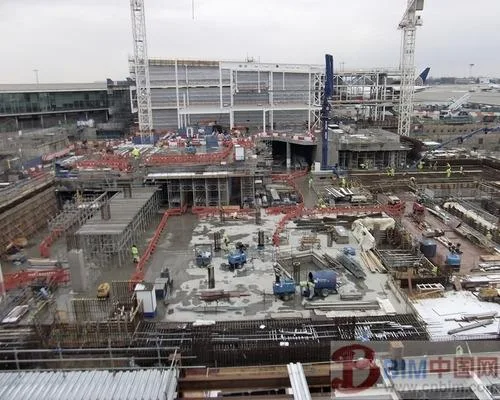
Balfour Beatty’s London terminal project: conflict identified by the 4D model checker.
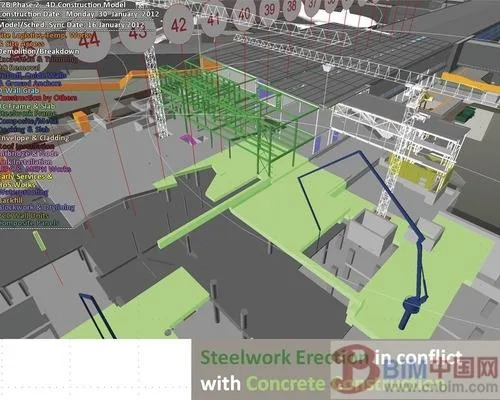
Balfour Beatty’s London terminal project: conflict identified by the 4D model checker.
Technological Innovation
Contractors, engineering management firms, academics, and software developers are continually advancing 4D program technology. This technology uses animation to review 4D models against regulatory standards—such as clearance dimensions, equipment specifications, and labor allocation—to spot safety risks and compliance gaps. In New York, architect Jennifer Downey, who provides technical support for Turner Integrated Building Solution, is working with government construction authorities, the Fiatech research group, and software firm Solibri to develop a tool called Model Checker. This software analyzes design models for dimensional compliance with codes and flags construction safety hazards. Model Checker operates on BIM models containing thousands of objects, typically numbered using OmniClass or Uniformat. Objects are identified via the numbering system—for example, a men’s restroom labeled 13-23 17 11—and matched against relevant regulatory requirements, such as those under the Disability Act. The software highlights unclassified items and objects that fail to meet specification standards.
Jennifer modified Solibri’s templates to enable Model Checker to run at different project stages, such as excavation or steel installation. She mapped various site elements in the model—including board edges, reserved openings, door leaves, safety signs, material storage, temporary toilets, fire extinguishers, and life safety systems—each linked to specific regulatory requirements. “The list of on-site safety regulations is extensive, covering international, regional, and Turner’s internal standards,” Jennifer notes. “I built on standard safety rules and identified 137 objects that can be checked within the model environment.” During model analysis, users can quantify safety materials, such as the length of edge protection netting needed.
An early success of the software was optimizing fire extinguisher placement across different levels. Codes require that fire extinguishers be spaced no more than 23 meters apart on a level, cover the entire floor, and be positioned within 3 meters of stairwells. “Even a seemingly simple task like verifying fire extinguisher placement requires referencing numerous regulations,” Jennifer says. Model Checker enables compliant fire extinguisher layouts by analyzing the BIM model. Mojtaba Taiebat, formerly at Georgia Tech and now with DPR Engineering, is developing compliance rules for tools like Solibri to detect on-site safety risks. Through 4D simulation of reserved openings, potential fall hazards are identified in the model. Mojtaba advocates applying these rules during the conceptual design phase, collaborating with designers and contractors to embed “Security Design” into project planning. He emphasizes that detailed planning isn’t necessary at this stage—the focus is on mapping work zones, scaffolding, formwork, material routes, openings, and board edges. “The model itself captures all the factors that can lead to a fall,” he explains. Once risks and their causes are identified, the team can mitigate them through design changes, process adjustments, or experience-based planning.
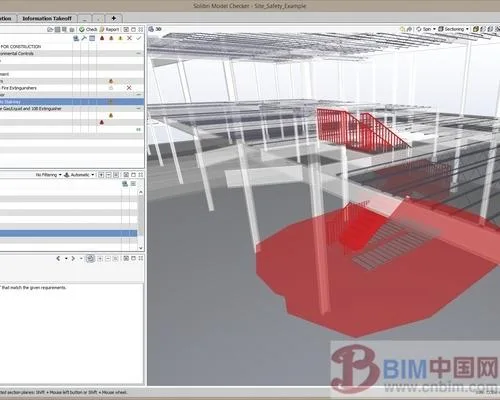
Turner Company’s compliance check revealed that no fire extinguishers were installed within 3 meters of the staircase.
A Superior Coordinator?
One project manager noted that when designers, general contractors, and subcontractors see the project simulated on screen, it motivates the entire team. As model objects representing equipment or materials assemble over the timeline, project managers not only uncover hidden conflicts between unrelated processes but can also resolve them proactively. “In a meeting, if you say, ‘Here’s what we’re doing next week—here’s the project state next week,’ people are engaged because they’re watching an animation, and it’s compelling,” says Ken McBroom, Chief Planner at McCarthy Construction. Ken cited a hospital project where he used Synchro for 4D project management, presenting the critical path as an animation. At the meeting, the pipeline subcontractor realized a planned road construction would block his work and adjusted the schedule immediately. “Pipeline work wouldn’t be seen as part of the road crew’s plan, since it seems unrelated,” Ken explains. “But under 4D visualization, the connections become clear.”
“Traditional communication and coordination of complex construction plans are time-consuming and inefficient,” adds Steve Moore, Planning Manager at TIC South, a Kuwaiti contractor. “Safety teams don’t have time to review stacks of drawings and 5,000-line schedules. As the site changes daily, imagining plan execution gets harder.” However, 4D allows everyone to quickly grasp complex projects through detailed visuals. Steve noted that the safety team plays a critical role in pre-construction planning. He was struck by how they reviewed the 4D plan from a completely different perspective than other departments. “They immediately spot where fall protection is needed, identify overhead falling hazards, and where eyewash stations must be placed,” Steve says. “Now, during planning, we get detailed, actionable feedback from safety that helps us chart the path to project completion.”
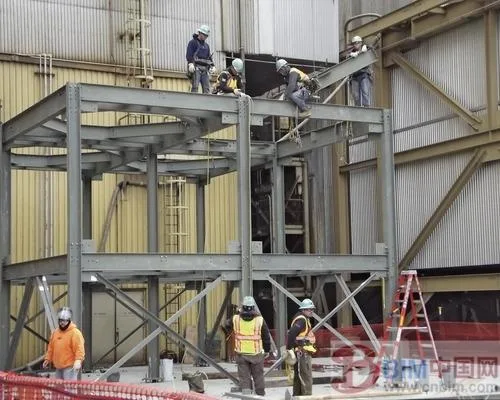
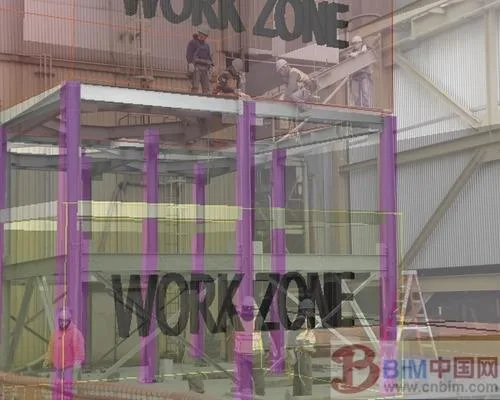
TIC company used 4D simulation to identify a vertical cross-operation conflict.
Steve discussed a recent nuclear power plant project by TIC that used Synchro for 4D modeling. “The 4D model revealed that the plan gave insufficient attention to safety,” he said. Tasks were scheduled linearly, and the project was significantly delayed after necessary changes. “If we had run 4D safety checks at the start, we could have planned and controlled processes and cycles better,” Steve notes. “With 4D, we can identify issues years in advance, allowing evidence-based plan adjustments for greater realism.” Jay Mezher, head of design and construction visualization at Parsons Brinckerhoff, has seen 4D BIM combined with computational fluid dynamics for safety analysis—a technique previously used for wind calculations or tunnel evacuation simulations.
Doug Rowe, a project manager at Lend Lease, notes that 4D BIM is now standard for construction simulation and site management in their projects. He predicts that as the technology becomes more user-friendly, 4D BIM will be widely adopted for detailed construction simulations, making all projects safer and more efficient. Ken from McCarthy adds that 4D planning not only boosts safety but also enables smooth communication among all stakeholders, including owners and the public. “A plan that exists only on paper is no plan at all,” he says. “When plans are discussed in abstract terms, problems arise.”
Ken highlighted the effectiveness of 4D modeling for safety management in multi-story buildings with complex facades. His company recently completed such a project, where daily facade work by different teams—masonry, light steel framing, panels, and glass curtain walls—was marked with colored pencils on 2D axonometric drawings. He realized that as the building envelope progressed, a 4D model would confirm compliance with the company’s safety rule against vertical cross-operations—ensuring no one works below a team above. “4D is perfect for this. I don’t have to imagine where each team is in the CPM schedule; I can check the model at any point to see who’s where. It’s a textbook example of using 4D for safe construction inspection,” Ken says.
Safety Without Language Barriers
Experts emphasize that visualization is highly effective for life-safety communication, especially for non-English-speaking workers. Ricardo Khan, director at Mortenson Engineering, is collaborating with Caroline Clevenger, an assistant professor at Colorado State University, to develop bilingual training tools based directly on 4D models for projects and assignments. They started with scaffolding operations, demonstrating serious fall risks and practical procedures to train non-English-speaking scaffolders—a group with significantly higher on-site accident rates. Caroline notes that Hispanic workers’ occupational accident rate is double that of non-Hispanic workers, partly due to language and cultural barriers on site.
“I hope 4D modeling will focus more on the micro level in the future,” says Ryan Poropat, a Mortenson on-site manager who recently used 4D tools on a Buffalo sports and entertainment project. This aligns with the work of Jason Reece, who has long studied communication failures in conveying critical safety knowledge in construction. Like Caroline and Ricardo, Jason sees the potential of BIM’s visualization to tell stories. Combining videos with real accident cases creates a “sticky” mix of text, audio, and visuals that keeps information in the audience’s mind. Pairing engineering practice with real high-risk accident footage, then showing how to mitigate risks, is a powerful application ofBIM technology in safety, Jason says. He recommends that safety trainers useBIM technology to deliver visual lectures and training, enhancing effectiveness. “When information is sticky, people remember it—and that’s how we change safety culture,” Jason explains.
Stories are a form of information. “If you want to use BIM to improve safety, you need to learn how to tell a compelling story and make it memorable.”














Must log in before commenting!
Sign Up