
The wave of informatization is transforming the engineering survey and design industry. From digital modeling to applications spanning the full building lifecycle, BIM technology has matured significantly. Design is both the source and the essential foundation for integrating design and construction. As leaders in the construction industry chain, design enterprises are responsible for the effective implementation of BIM Technology. With society increasingly focused on energy conservation, environmental protection, and sustainable development, architectural design firms must rise to the challenge, broaden their perspectives, actively employ information technologies such as BIM and cloud computing, and seek breakthroughs in building quality, industrialization, green construction, and comprehensive project services.
1. Introduction to BIM
1.1 BIM Concepts and Significance
Building Information Modeling (BIM) has become one of the most widely recognized terms in the global construction and engineering industry. Searching for “BIM” or “Building Information Modeling” online yields millions of results, reflecting attention from government agencies, the construction sector, research institutions, and more. The term “BIM” was initially introduced by a leading international software vendor as a commercial concept. However, the theoretical framework for building information modeling has been under development in Europe and America for over 30 years. Manufacturing giants like Toyota and Boeing have improved production efficiency via information modeling, laying the groundwork for commercial success.
Early adoption of building information modeling was concentrated in manufacturing and aerospace, such as industrial, automotive, and aircraft design. It was not widely popularized at the time due to environmental limitations. In recent years, with breakthroughs in 3D engineering drawing software and the timely appearance of the BIM concept, the industry sees hope for transformative change.
Many organizations—including software vendors, construction firms, industry associations, and encyclopedias—have interpreted the concept of BIM. The NBIMS (National Building Information Modeling Standard), led by the Joint Facilities Information Committee of the American Academy of Building Sciences, defines BIM as: “A Building Information Model is a digital representation of physical and functional characteristics of a facility. As such, it serves as a shared knowledge resource for information about a facility forming a reliable basis for decisions during its life-cycle from inception onward.” This widely recognized definition highlights BIM as a digital model that encapsulates a facility’s physical and functional traits, serving as a source of shared information throughout the entire project lifecycle, thus supporting sound decision making.
The emergence of BIM is significant in enhancing both vertical and horizontal communication, and enabling multidimensional collaboration across management systems and workflows throughout the construction industry, from upstream to downstream. BIM achieves lifecycle information management and bridges the gap between design and construction. As a new technological tool, BIM’s capabilities in information sharing, collaborative work, and specialized tasks are increasingly evident. Compared with traditional CAD design, BIM Technology offers several key advantages:
First, it enables design coordination, effectively managing clashes between different disciplines, coordinating conflicts early in construction, and supporting visual collaborative design changes.
Second, BIM facilitates construction process simulation. By simulating construction activities virtually, stakeholders can determine reasonable plans and guide actual construction.
Third, BIM supports building performance optimization. It allows for energy-saving simulations, sunlight studies, emergency evacuation analysis, as well as 4D and 5D simulations for cost control. Through project optimization, design schemes and investment return analyses can be integrated to calculate the real-time impact of design changes on costs, thereby minimizing financial risk.
2. Overview of the BIM Industry
2.1 International Overview
Countries such as Australia, Japan, the United States, South Korea, Norway, Hong Kong, Singapore, the United Kingdom, and Finland have established their own national, industry, and enterprise BIM standards.
The U.S. General Services Administration (GSA) mandated BIM technology for large federal projects in 2007, creating guidelines to promote its widespread adoption. The American Academy of Building Research has spearheaded the development of the national BIM standard, which has now reached its second edition.
The UK government organized over 200 experts to develop a BIM application framework and mandated that, since 2016, all government projects must implement BIM according to this framework. The framework includes: (1) BIM protocol, specifying required models and participant obligations; (2) Employer information needs, detailing the owner’s BIM management requirements, including software, data, and security standards; (3) Scope of information management services, equivalent to BIM contract standards; (4) Liability insurance guidelines, clarifying responsibilities; and (5) Information management standards for project delivery, including data delivery at various stages.
2.2 Domestic Overview
BIM technology was first introduced to the construction industry in 2002, with its entry into China traced back to 2004. At that time, literature on BIM was just emerging. Later, with the implementation of national technology plans, BIM was applied in several demonstration projects. Notably, its use in the 2006 Olympic venue projects garnered attention from the domestic design sector, and since 2009, BIM adoption in design firms has accelerated. In 2011, the Ministry of Housing and Urban-Rural Development released the “Outline for the Development of Informationization in the Construction Industry (2011–2015)”, which set the acceleration of Building Information Modeling and network-based collaboration as primary goals, establishing BIM as a key development direction.
According to 2010 data from the Ministry of Construction, there were 12,375 survey and design enterprises in China. Among the top 100 design firms of 2010, 80% had implemented BIM, indicating its rapid growth. Large design institutes have set up BIM centers to advance BIM application and even provide IT services for the entire building lifecycle. For example, Shanghai Modern Architectural Design Group has used BIM for collaborative design in major projects such as the Shanghai World Expo, Bund SOHO, and other landmark buildings. Other leading organizations and developers, such as Greenland and Vanke, have also begun experimenting with BIM.
2.3 Current State of the Domestic BIM Industry
Despite signs of prosperity, the extent, depth, and level of high-end BIM applications in China’s design and construction sector remain limited. Like any new technology, BIM faces obstacles in its development and popularization, requiring reflection and active response. Current characteristics of BIM in China include:
(1) Large enterprises have begun using BIM, but internal personnel adoption remains low.
(2) BIM promotion is regionally specific: widespread in developed cities, less so in smaller cities.
(3) Misunderstandings about the BIM concept still exist.
(4) Government and large project owners are starting to require BIM in design and construction.
(5) Many projects have substantially implemented BIM in design and construction.
3. Design and Construction Based on BIM Technology
The design and construction phases differ in focus and content. In design, BIM is used for scheme comparison, adjustment, performance analysis, and visualization. In construction, BIM models are applied deeply in execution and operation, usually not involving graphical representation. The construction phase is where design drawings become reality, and it represents the largest owner investment. The purposes, depth, and tools differ between phases, which means the designer’s BIM model cannot always be directly transferred to construction. Bridging this gap requires clarifying roles and responsibilities and enhancing information transfer and processing capabilities for timely problem-solving. Common BIM applications in design and construction include scheme demonstration, visual design, performance analysis, collaborative design, pipeline integration, site coordination, quantity statistics, progress simulation, construction organization, material tracking, prefabrication, and as-built model delivery.
Recently, as BIM technology has advanced, some domestic projects have succeeded not only in design but also in construction and even management. For example, Bund SOHO implemented 4D, 5D, and cloud technologies; Ningbo City Exhibition Center used 3D collaborative design; Shanghai Jade Buddha Temple’s renovation employed point cloud and installation simulation; Shendu Building achieved green three-star and FM with BIM; and the Zhengda Damalaya Center conducted integrated analysis and automatic model drawing based on BIM. Below are brief introductions to new BIM technologies in design and construction:
(1) 4D Construction Progress Control
During construction, BIM is used for intuitive project progress control. By integrating BIM models with quantity lists, progress is monitored and compared to schedules, providing early warnings and dynamic risk control. Different plans can be flexibly compared, and risks identified. Design changes can be instantly reflected in the project schedule.
Shanghai Modern Architectural Design Group’s Digital Technology Research and Consulting Department, in partnership with SOHO China, implemented cross-platform project progress BIM for Bund SOHO. The 4D model visually tracks construction progress, linking quantity lists to engineering models in real time, with color coding to reflect status.
(2) 5D Construction Progress and Cost Linkage
5D technology connects project progress with costs, enabling dynamic cost control. 5D simulation allows for more accurate and flexible plan analysis and optimization, precise management, and monitoring of design and construction progress. Applications include progress comparisons, payment control, and cost analysis. The Digital Technology Research and Consulting Department also implemented 5D BIM for the Bund SOHO project.
(3) GIS+BIM Large-Scale Collaboration and Analysis
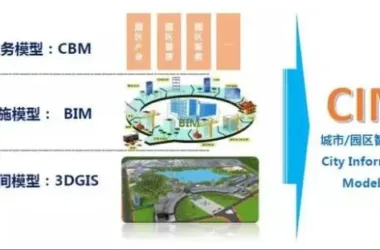
This technology enables 3D collaboration on large parks and towns (over one million square meters), covering municipal, road, and other facilities. The group is researching its use for future headquarters projects, where 3D digital park models will support performance analyses (sunlight, earthquake, wind, traffic, evacuation, fire, flood, energy, environment, etc.), optimizing planning before construction to minimize environmental impact and maximize building function.
(4) 3D Collaborative Design and Drawing
Multi-disciplinary 3D collaborative design results in comprehensive models from which project drawings can be generated. This has been applied in projects such as the Ningbo City Exhibition Hall.
(5) Green FM
The integration of BIM and FM (facility management) optimizes green building operations, enabling automatic detection and control of subsystems and intelligent monitoring of operational data.
(6) Integrated Performance Analysis
High-performance computing platforms enable integrated analyses, including solar radiation, daylighting, shading, wind, thermal, and structural performance, providing an optimization basis for design and improved project quality.
(7) 3D Point Cloud
Combining 3D laser scanning and BIM, this technology captures and archives comprehensive building data, supplying reliable information for design and construction, and supporting communication and management across project stakeholders. It is widely used in construction and renovation.
(8) Cloud Technology
Cloud technology, based on distributed computing, divides large programs into smaller subroutines processed by multiple servers, delivering results rapidly to users. The combination of BIM and cloud mainly aims to reduce hardware costs and enable cross-platform collaboration. Cloud services accelerate visualization, support large-scale rendering, and allow for the fast sharing and annotation of project documents from anywhere and on any device.
4. Application Strategies for Design and Construction Based on BIM Technology
4.1 The Role of Government
Government agencies should focus on three main areas in promoting BIM: (1) Support in project supervision and review processes to foster a sustainable development model for BIM application; (2) Adjust national laws and regulations on design and construction management to accommodate new production and management modes; (3) Guide and invest in BIM development, conducting demonstration projects and creating successful application models.
In recent years, various government levels have made substantial progress. For example, the Ministry of Housing and Urban-Rural Development included BIM promotion in its 2011–2015 IT development outline, while provincial and municipal authorities have issued BIM policies. Work on national BIM standards was launched in 2012, including unified standards for application, storage, delivery, and coding of building information models. These standards aim to provide consistent specifications for BIM use throughout project lifecycles. However, as BIM is relatively new in China, national standards will require ongoing development and improvement.
The Hong Kong Housing Authority has issued regulations and guidelines requiring BIM documentation in tender documents, reducing new project costs by 20%. From 2014 to 2015, all its housing projects adopted BIM as the design standard, supported by guides, databases, and references to facilitate model building and management.
Taipei’s Construction Engineering Management Office mandates BIM models for building projects to improve approval efficiency and planning. By adopting BIM and leveraging advanced GIS technology, Taipei promotes paperless, fully electronic building management and administrative procedures.
Shanghai’s Planning and Land Resources Bureau promotes 3D reviews, specifying standards for content, level, and modeling requirements, aiming to enhance administrative efficiency and urban competitiveness through 3D modeling.
Shenzhen’s Construction and Engineering Bureau has gained experience through BIM pilot projects, developed standards, and is actively exploring collaborative approaches to BIM standard development, with pilot projects including the University City International Conference Center and Talent Park.
4.2 Role of Industry Associations
Industry associations are essential for promoting and supporting BIM: (1) Organize the development of industry standards to standardize resources and promote information sharing and integration; (2) Facilitate experience exchange and technical training, and promote informatization; (3) Offer training to popularize and apply BIM technology.
Since 2010, the China Association for Surveying and Mapping has held four Innovation Cup BIM Design Competitions, drawing over 400 entries from more than 150 design units. The Engineering Construction Quality Management Branch of the China Construction Industry Association organized the first National BIM Competition for the construction industry in 2013, receiving 570 applications. The international organization buildingSMART’s China branch was established in 2013, reflecting improved domestic conditions for BIM promotion.
Standardization is key in informatization. With the rise of BIM, many countries and organizations have developed BIM standards. In China, four BIM standards for large civil and industrial buildings were established in 2012. These include standards for application, storage, delivery, and coding of building information models, developed by leading institutions such as the China Academy of Building Standards Design and Research and Shanghai Modern Architectural Design Group, demonstrating the important role of industry associations.
4.3 Challenges and Suggestions for the Application of BIM in Enterprises
4.3.1 Challenges
At the enterprise level, companies must assess their strengths and strategic positioning to determine appropriate timelines and strategies for BIM adoption. For small and medium-sized firms, careful consideration of potential high investment is essential. Promoting BIM requires investments in (1) professional and technical training; (2) collaboration with research institutes and software vendors for innovation; and (3) developing internal BIM standards. However, several significant challenges remain:
(1) Internal Transformation Costs and Risks:
BIM deliverables may not align with current submission requirements. Without updated payment models from clients, sustainable BIM development is difficult. Competing design tasks and short durations, combined with simultaneous design and construction, create pressure. Large-scale adoption requires significant investment in software, hardware, and training, which is not quickly achievable.
(2) Imperfect Software Technology:
BIM software often lacks localization, with limited component resources, templates, and workflows tailored to local standards. Generated drawings may not meet construction depth requirements. Complex building modeling and performance analysis require advanced skills and hardware, and may reduce efficiency for large projects.
(3) Misunderstanding of BIM:
Due to the broad scope of BIM, many personnel misunderstand its essence, sometimes considering simple 3D modeling or use of mainstream software as sufficient for BIM application.
(4) Lack of Upstream Design Models:
Some projects use BIM only in construction or cannot obtain design models due to intellectual property concerns, requiring duplicate model creation and extra work.
4.3.2 Suggestions
BIM is an integrated, collaborative approach that needs to be developed and applied throughout the design process. Its adoption in architectural design should be gradual and aligned with collaborative design technology. Recommendations based on Shanghai Modern Architectural Design Group’s experience include:
(1) Gradual Promotion:
BIM adoption should proceed step by step, respecting traditional methods and integrating BIM workflows as appropriate.
(2) Customized Work Modes:
Work modes should be tailored to project type, duration, complexity, and function. For example, complex buildings may involve BIM from the outset, while standard projects may integrate BIM later.
(3) Performance-Based Design:
With urbanization and the drive for ecological civilization, BIM analysis tools can help improve building quality, energy conservation, and sustainability.
(4) Active Technical Exchange:
Organize regular industry exchanges, invite experts for lectures, and participate in domestic and international BIM competitions.
(5) Multilevel Team Building:
Establish teams led by BIM project managers, supported by architectural, structural, and equipment designers, as well as assistant engineers for visualization and report generation, and a technology center for standards and technical support.
(6) Pilot Projects:
Start with pilot projects and small teams, accumulate experience, and expand BIM implementation gradually.
(7) Secondary Development:
Since most BIM tools originate abroad and may lack localization, secondary development should be conducted using internal and external resources.
(8) New Application Development:
Encourage innovation by integrating new technologies (cloud, laser scanning, GIS) with BIM to expand application areas.
5. Summary and Outlook
Since its introduction to engineering construction in 2002, BIM technology is still in its early stages, especially in China. Although originating in Europe and America, China’s fast-growing construction industry shows strong potential to catch up. Currently, BIM adoption in China is moderate to low. Main obstacles include (1) insufficient external motivation for change, (2) imperfect software and localization, (3) tolerance for current 2D design methods, (4) uneven acceptance of BIM concepts, (5) high project progress requirements, and (6) stakeholder interest conflicts.
The understanding of BIM in China’s engineering sector has evolved from “What is BIM?” and “Why use BIM?” to “How do we apply and implement BIM?” Many leading firms have pioneered BIM applications, resulting in notable projects such as the Shanghai Center, Beijing CBD Z15, Changchun Planning Hall, and Bund SOHO. However, challenges remain, including insufficient investment, lack of unified standards, software/hardware mismatches, data sharing difficulties, and inadequate industry education.
For government and industry, effective guidance and coordination are essential—issuing opinions, guidelines, and reports, developing laws and standards, and leading by example in government projects. This will reduce BIM application costs and improve adoption.
Enterprises should adapt to market trends, adjust business strategies, and invest in advanced productivity. When implementing BIM, companies must consider practical local needs and ensure feasibility, rather than blindly pursuing technology or clinging to outdated methods. Both advantages and challenges must be weighed.
All stakeholders—government, industry, and enterprises—must recognize that BIM brings both opportunities and challenges. Successful promotion requires greater investment from all parties, including associations, research institutes, owners, application units, and software developers. In the context of economic globalization, market diversification, and competition, project competition has evolved into competition across the entire industry chain. For China’s engineering and construction industries to develop rapidly, information technology must be used to integrate resources, achieve collaborative operations, and build industry-specific information models for sharing and collaboration. As a new generation of information technology, BIM plays a unique bridging role between design and construction, meeting these emerging needs.














Must log in before commenting!
Sign Up