
People often draw on the question, “How was Rome built?” to envision the complex and arduous process of creating a great city-state. In a similar vein, the story of how “The World’s Best Skyscraper” was constructed through scientific and rigorous management has become a case study worthy of in-depth exploration. Leveraging today’s increasingly mature international communication platforms, the introduction of technical expertise from the Pioneer Standards Institute, centered on BIM, enables more professionals to gain valuable insights. By understanding BIM technology, they can explore how information technology adds charm to a 6-star building, as exemplified by the project: Sydney’s “1 Bly Street.”
A Globally Acclaimed Project Garnering Prestigious Awards
Sydney’s “1 Bly Street” is a commercial building that has achieved Australia’s highest green rating of 6 stars (equivalent to the platinum level of the U.S. LEED green rating standard). The building stands 28 stories tall, covering a construction area of 42,000 square meters, and is classified as a national Grade A office building. The 1 Bly Street project is a flagship initiative in Australia and globally, having won numerous awards, including the Best Tall Building Award in Australia, the Urban Design Award, the Sustainable Building Award, and the Best Building Award in New South Wales. It has also been hailed by the Council on Tall Buildings and Urban Habitat (CTBUH) in the United States as “The World’s Best Skyscraper.”
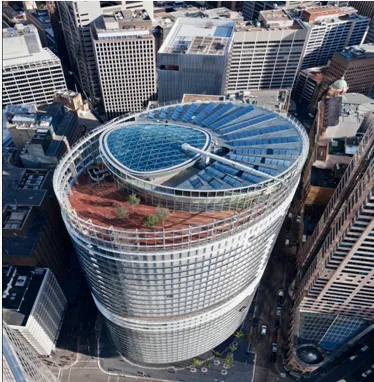
As a global benchmark for green buildings, 40% of 1 Bly Street is constructed with renewable concrete, and over 90% of its steel bars incorporate more than half renewable materials. The project also utilizes renewable wood, along with solar cooling systems, black water treatment systems, and rainwater and wastewater collection and treatment systems. The design features a unique naturally ventilated atrium structure, combined with an exterior double-layer curtain wall system. This not only enhances the building’s aesthetic appeal but also significantly reduces its energy consumption.

“BIM plays a pivotal role throughout the entire project, especially in the areas of sustainable development, collaborative coordination, and facility management. It has enabled the realization of this super-tall building, which features complex systems and facilities, as well as ultra-high energy-saving and environmental standards,” said Rodd Perey, Chief Information Model Management Chair at the Sydney Architect, during his speech at the 3rd BIM China Forum, co-hosted by the China Building Standards Design and Research Institute and the buildingsMART Council China Branch.
The 3rd BIM China Forum Presents Practical Insights from the World’s Best Skyscraper
“BIM must be international, whether it’s about full industry chain collaboration in an international context or information sharing based on global big data,” stated Mr. Patrick MacLeamy, Chairman of buildingsMART International Headquarters, at the annual meeting of the buildingsMART International Council held in May this year. As the world’s largest neutral promoter of BIM Technology, buildingsMART comprises branches from many countries and regions worldwide. This meeting marked the first important gathering held in China to vote on and decide annual affairs. Over 30 executive committee members from branches around the globe, along with top BIM experts from various countries, attended the event. They also participated in the BIM China Forum held in Beijing at the same time.
“BIM is globally rooted and has the power to connect the world. The theme of this forum is ‘Global Informatization Supports China’s Real Estate Practice.'” During the process of hosting these two major conferences, Wei Lai, Director of the BIM Architecture Design Institute at the China Building Standards Design and Research Institute and Secretary General of the buildingsMART China Branch, deeply appreciated the significance of the events. “1 Bly Street is a highly representative BIM application project. We once organized an on-site observation to comprehensively examine the project from design to construction and management. It’s a project with profound applications and a very robust practical system. Therefore, taking advantage of the China BIM Forum, we invited Rodd Perey to personally share the BIM practical experience behind the world’s best skyscraper project with industry elites and interested individuals across the country.”
The 1 Bly Street project is a typical example of the end-to-end implementation of BIM Technology concepts. The project’s implementation philosophy stems from the exploration of information engineering practice and management, rather than relying on a genius proficient in BIM applications or special software and hardware configurations. As the project’s BIM management unit, the architect’s understanding of BIM development can be divided into four stages, based on the traditional work mode challenges and contradictions that BIM aims to address: in terms of resource information, it progresses from traditional 2D design to 3D modeling, then to collaborative work, and finally to resource integration. In terms of work mode, BIM technology has driven the entire construction industry from a fragmented and independent division of labor to collaborative and highly integrated development, as illustrated in Figure 1.
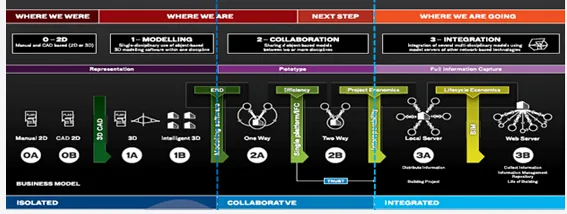
Figure 1: Project BIM Management’s Understanding of the BIM Technology Development Model at “1 Bly Street”
Furthermore, this project essentially demonstrates and validates the application value of BIM technology throughout its entire lifecycle. From planning and design to sustainability analysis, construction, and property management, all parties involved in the entire process of 1 Bly Street consistently use BIM technology, setting it apart from traditional engineering models.
The Optimal Design Solution Powered by BIM
During the design and development phase, the models for architecture, structure, and plumbing and electrical engineering are integrated. By simulating and analyzing the integrated model and information, a series of evaluations and assessments can be conducted early on to support and optimize decisions during the design phase, as shown in Figure 2.
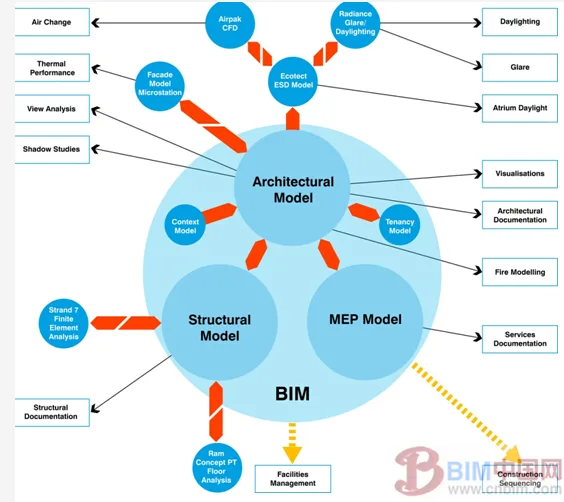
Figure 2: Full Professional BIM Application System for the “1 Bly Street” Project Design
For instance, in architectural design, the double-layer glass curtain wall is a key feature of 1 Bly Street. It not only offers building users the best vantage point to enjoy Sydney’s unique landscape from the city’s core business district but also combines various passive energy-saving technologies with temperature, brightness, and humidity sensing devices. These provide comprehensive automatic feedback regulation for the entire building’s green building energy utilization.
The curtain wall system features a unique louver design that automatically adjusts according to the angle of sunlight, maximizing solar energy use without compromising the viewing experience. Based on a complete BIM model, specialized analysis software for sunlight, shading, ventilation, and energy consumption can obtain accurate calculation results to optimize every detail of the design. Ultimately, the shading coefficient of the entire curtain wall system reached 0.15, which is twice as effective as the best solution in a standard curtain wall system. In structural design, finite element analysis of complex and asymmetrical challenging parts within the BIM models helps identify key areas for designers to repeatedly check until the final optimized results are achieved.
To find the best design that meets the many complex functions mentioned above, simulation analysis based on BIM models and data plays a crucial role. In this project, the analysis of BIM models also covers heat transfer effects, lighting and reflection, airflow paths, viewing effects, and more. Information technology and methods assist designers in accurately analyzing the impact and effects of each plan, evaluating the optimal green measures, and ultimately helping the project achieve Australia’s highest 6-star green building rating.
Managing Massive Construction Goals: BIM Provides a Common Working Language
During the construction phase, all involved parties, including the general contractor, subcontractors, suppliers, and consultants, work and collaborate in a BIM-driven manner from top to bottom. The management scope of the project construction process is so vast that the collaborative approach enabled by BIM technology becomes even more critical.
First, the implementation and management plan based on BIM applications has played a key role in training technical personnel who are not yet familiar with BIM. The definition of project requirements, standards, protocols, and the development plan for project-related guidance documents are also determined accordingly. These tasks set clear work objectives for the team, thereby defining the tasks to be addressed and the challenges to be solved.
Second, various conflicts are inevitable during the construction process. These include both coordination gaps between different parts of the building model itself and differing understandings of the same work object among participating parties. Through an effective BIM collaborative work platform, all participants can view the latest progress of the building, ensuring everyone is on the same page. Regularly released summary reports are promptly delivered to representatives of all parties, making thorough preparations for the next coordination meeting. This collaborative model enables all project team members to reach a consensus and form a habit of regular meetings. Moreover, all collaborative achievements are recorded in electronic or paper form, and the content and conclusions of coordination meetings at each stage are fully preserved. In the event of future disputes or lawsuits, these shared historical records by all involved parties will contribute to the fairest and most objective judgment.
Unlike many other BIM engineering cases, the BIM practice at 1 Bly Street did not end with the project’s completion. From planning to design and construction, the information and data of the 1 Bly Street project were gradually enriched and highly integrated into the BIM model. The developers recognized that this comprehensive construction project information is not only a complete record of the project but also the most reliable data for building operation and maintenance. Therefore, when delivering the final results, the project team also established a comprehensive database of all internal information. Owners and property management can easily access information from the database and coordinate it with other management information, thereby improving operational efficiency and further realizing the full lifecycle application value of BIM technology.
32 Disciplinary Models Boost Efficiency and Quality for All Participants
The owners of 1 Bly Street are fully committed to supporting the application of BIM technology and are dedicated to implementing and managing the entire project using BIM. As a result, the BIM application in the entire engineering project is not only thorough but also comprehensive. From the earliest conceptual design to preliminary design, sustainability analysis, building optimization, subsequent construction, and all parties involved in building operation and maintenance, BIM technology has been utilized. The project’s BIM model integrates data and information from a total of 32 units. The entire project team has developed its own work mode based on the concept of BIM collaboration, and all general contractors, subcontractors, and consultants also use BIM.
Due to its location in the heart of Sydney’s prime commercial district, the developer imposed many strict requirements on the 1 Bly Street project. With the assistance of BIM technology and other modern building information technologies, the project was successfully completed in 2011, and the final model and information can easily serve customers. After the full BIM practice of this project, all project participants have highly praised the application of BIM technology. Grocon Construction Company, the general contractor, summarized: “The BIM Project for 1 Bly Street integrated models from over 30 disciplines,” which “significantly reduced on-site conflicts, improved construction quality, enhanced product supply, and greatly saved time spent on coordination work.” The project developer, Dexus Group, stated bluntly: “BIM has enabled us to reduce waste, save time, and improve quality.”
Pursuing an Information-Driven Future: The Standards Institute Actively Promotes a Global Collaborative Strategy
“Some developers now refer to a single application as BIM, such as an innovative design tool, but this is not true BIM. Projects like 1 Bly Street, which involve the entire process and all parties, have fully realized the value of BIM,” Wei Lai commented on the current misunderstandings surrounding BIM application. The application of BIM throughout the entire process can not only improve efficiency and reduce costs but also achieve: 1. higher efficiency and controllability in fund usage; 2. higher overall project quality; 3. a higher level of management refinement. “From a long-term perspective, BIM technology also has a profound impact on technological innovation, management innovation, and the transformation and development of enterprises.”
Currently, the external environment for BIM technology application in China is gradually maturing, and the Standards Institute has been supporting developers’ information transformation. Countries such as the United States, the United Kingdom, and Australia have early applications and relatively mature systems, with more than half of projects utilizing BIM. Drawing on these successful experiences can help Chinese real estate companies accelerate their information technology transformation.
The first step is to address the issue of a universal language across the entire industry, which involves the development of standards. At present, two important national standards in the BIM industry, the “Delivery Standard for Building Engineering Design Information Model” and the “Classification and Coding of Building Engineering Design Information Model,” are under preparation. As the chief editor, the Standards Institute is expected to complete them in the second half of this year. “Improving standards is urgently needed,” Wei Lai introduced. The preparation of the above two standards is an important social responsibility undertaken by the Standards Institute and a key measure to promote the localization of BIM technology in China. Therefore, the process is extremely cautious. Since the establishment of the staffing team, it has taken a year and a half to organize dozens of participating units for multiple rounds of discussions. “First, we hope the standards have foresight and lead the industry’s development; second, the standards must align with the current basic national conditions of BIM engineering practice; third, the standards must be international.”
Based on the buildingsMART platform, the Standards Institute can bring advanced foreign experience to China and integrate it into China’s BIM standards. At the same time, China’s accumulated experience and achievements can be integrated into international organizations. The BIM China Forum has been successfully held for three sessions under the promotion of the Institute of Standards and has become an important platform for promoting the popularization and international exchange of BIM in China. Wei Lai revealed that the buildingsMART international organization has reached a consensus with regional branches such as South Korea, Japan, and Singapore to assist in developing appropriate standards and solving BIM application problems in different countries, projects, and enterprises. “These are all renowned top BIM technology experts from around the world. In the future, we will also see successful projects in China that apply BIM comprehensively, becoming classic cases worldwide.”
















Must log in before commenting!
Sign Up