
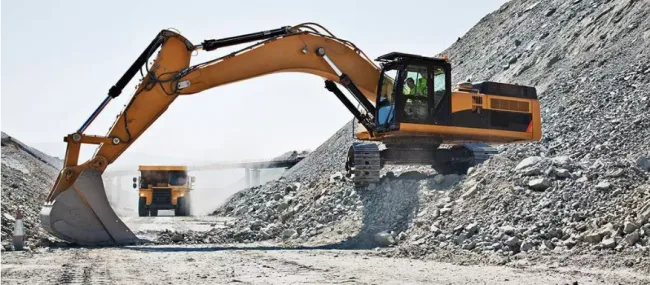
Currently, the design and installation of safety passages on construction sites often lack standardization. In many cases, these passages are created based on the personal judgment of the on-site technical leader without a formal design process. This approach can lead to safety passages that are shorter than the radius of potential falling objects, thereby compromising their protective function.
Design Considerations
When designing and installing safety passages, several key factors must be taken into account:
- Accessibility: Safety passages should be unobstructed, allowing workers easy and quick access to the work area.
- Prevention: The primary purpose of a safety passage is to prevent falling objects from injuring pedestrians within the potential fall radius.
- Stability: The structural stability of the safety passage is crucial and must not be overlooked.
Design Dimensions
Generally, if a building reaches a height of 2 meters or more — or is at least one story high — a safety passage should be designed and installed. The design standards primarily reference GB3608-2008 “Classification of High Altitude Operations” and JGJ80-1991 “Technical Code for Safety of High Altitude Operations in Construction”.
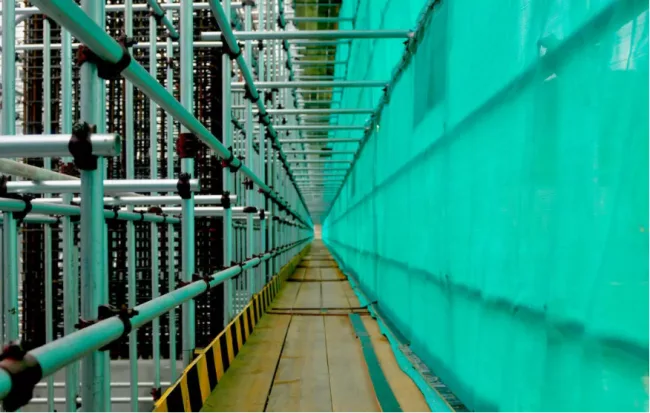
Safety passages are typically constructed using steel pipes and fasteners, topped with rigid protective boards. The dimensions of the passage are determined based on the following criteria:
The length of the passage should correspond to the building’s height as follows:
- For heights between 2 m and less than 5 m, the passage length must be at least 3 m.
- For heights between 5 m and less than 15 m, the passage length must be at least 4 m.
- For heights between 15 m and less than 30 m, the passage length must be at least 5 m.
- For buildings taller than 30 m, the passage length must be at least 6 m.
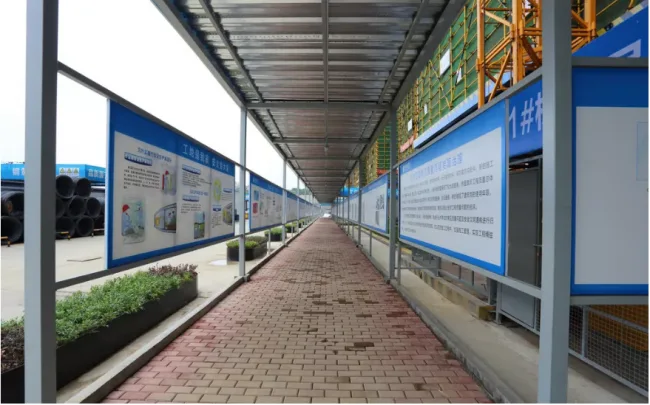
The width of the passage depends on the site environment but must allow two streams of foot traffic or two carts to pass simultaneously in opposite directions. Typically, pedestrian passageways should have a minimum clear width of 1.5 meters.
The height should not exceed 3 meters, with a minimum clear height inside the passage of 2.5 meters.
Additional Requirements
- A double-layered rigid protective board must be installed on top of the safety passage. The spacing between the two layers should be no less than 0.6 meters. The protective material should be tough; preferred materials include bamboo scaffolding or 50mm thick pine wood boards.
- The steel pipes used must comply with JGJ130-2011 “Technical Code for Safety of Steel Pipe Scaffolding with Fasteners in Construction”. Fasteners must meet the standards of GB15831-2006 “Steel Pipe Scaffold Fasteners”. The spacing between vertical supports should not exceed 2 meters. A horizontal sweeping rod must be installed along the inner side of the supports, extending along the entire length of the passage. Additionally, the passage should include a ramp.
- Install scissor braces or zigzag braces on both sides of the passage’s facade. Horizontal steel pipe braces should be placed atop the vertical poles on both sides to ensure overall structural stability.
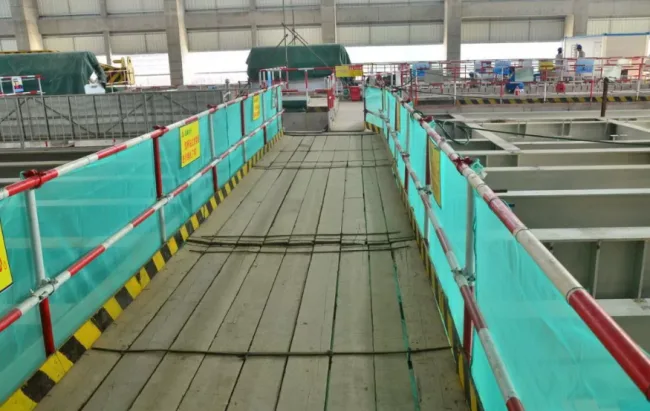
- The facades on both sides of the passage must be enclosed with dense safety nets. A “Safety Passage” warning sign should be displayed prominently at the entrance.
Source: Architectural Technology Magazine














Must log in before commenting!
Sign Up