
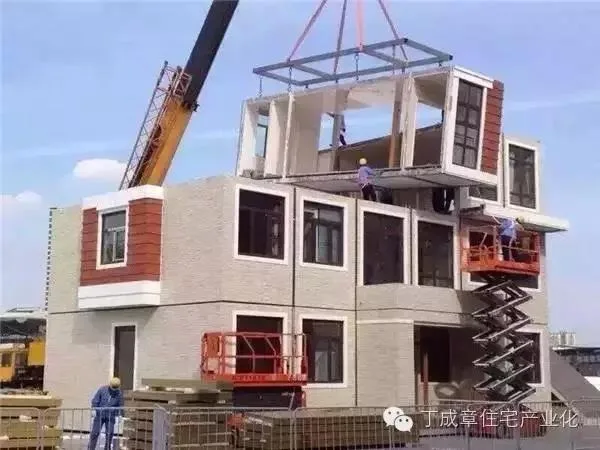
The slogan of “housing industrialization” has been echoed for more than 20 years. Initially, it was championed by a few enthusiasts like myself, often working alone. However, the movement gained momentum in 1998 during President Clinton’s visit to China, accompanied by a large delegation focused on housing industrialization. Around the same time, the Japanese government also sent a sizable group to China, eager not to fall behind. This drew significant attention from industry regulators.
In that year, the Chinese government established housing industry promotion centers at all levels, creating a unique and comprehensive system unprecedented in the history of housing industrialization worldwide. This clearly demonstrates the high priority the Chinese government places on advancing housing industrialization.
Despite these efforts, progress in China’s housing industrialization over the past two decades has been disappointing and nearly stagnant.
Back in 1998, when the Japanese delegation visited China, they diplomatically praised China’s efforts but privately believed that meaningful progress in housing industrialization would not occur until a decade later, around 2008.
In reality, the Japanese underestimated China’s progress by 18 years (up to 2016). Due to the steel industry’s inefficiencies—characterized by overcapacity and widespread losses—and the construction industry’s significant contribution to environmental pollution throughout the entire lifecycle of materials and activities, housing industrialization has once again become a focal point for the Party Central Committee, the State Council, and the National People’s Congress. A new wave of residential industrialization is sweeping across the country.
But what exactly is residential industrialization? Many people still do not fully understand the complexities involved. Often, it is reduced to slogans, hoping to achieve superficial success rather than substantial progress.
Unfortunately, misinformation and misconceptions continue to spread online. For example, it is often claimed that housing industrialization was first proposed by the Japanese in 1968, frequently accompanied by the statement “Build a house like a car”—a phrase taken out of context. The follow-up phrase, “Design a house like a car,” is rarely mentioned and seldom pursued.
One key difference lies in the demand for personalization. Houses require a strong degree of customization. Although Chinese homeowners may not be able to personalize the exterior or spatial layout extensively, they do have the right to determine the interior decoration style. Thus, even units within the same building and on different floors rarely have identical interior designs.
Cars, on the other hand, have little demand for personalization. It is acceptable for many cars to be identical in design and production.
This distinction means that while cars can be mass-produced with ease, houses are much more challenging to replicate on a large scale.
Moreover, even if homeowners accept identical houses, regional differences such as wind load, snow load, earthquake resistance, lighting, and geological conditions make it impossible to simply replicate residential buildings in bulk without adjustments.
Given these challenges, achieving industrialized manufacturing of residential properties is extremely difficult.
To circumvent these complexities, many domestic companies have simplified the concept, narrowing housing industrialization to merely “housing structure industrialization” rather than embracing the comprehensive “housing system industrialization.”
Steel structures inherently possess industrialization characteristics. However, there is little to boast about regarding steel structure industrialization itself; the real strength lies in the industrialization of steel-structured residential buildings.
In conclusion, it is nearly impossible to explain the issue of housing industrialization clearly in just a sentence or two, a single article, or even dozens of pages of slides.
The current challenges facing residential industrialization are not only historical but also stem from numerous practical difficulties that are hard to overcome.
In the future, I plan to organize the historical data and development status of international housing industrialization that I have collected over more than ten years. Along with my insights and understanding, I will publish a series of articles on my WeChat official account for your reference.


















Must log in before commenting!
Sign Up