
Tujia Diaojiaolou
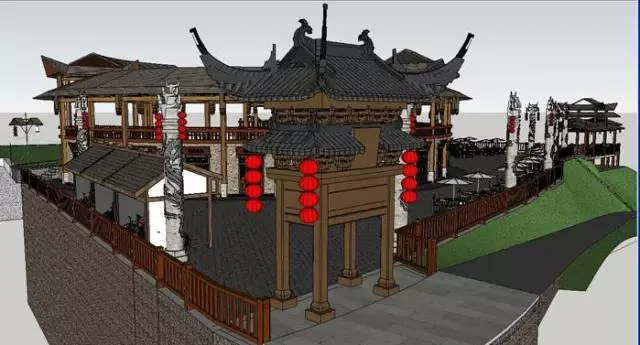
Diaojiaolou is a traditional dwelling of the Tujia people, characterized by its unique combination of land and water elements. The structure is designed in the shape of a tiger sitting on a mountain, featuring the “Green Dragon on the Left and White Tiger on the Right” layout. The central part serves as the main industrial building hall, while the left and right wings, called Raojian, are used for living and cooking.
Raojian is divided into two sections by a central pillar: the front houses a heated kang (a traditional warm bed), and the back contains the bedroom. Surrounding the suspended building is a curved corridor equipped with railings. The layout follows the traditional principles of “Vermilion Bird in front, Xuanwu at the rear,” which is considered the best orientation, usually facing either west to east or east to west.
Structure and Design:
Typically, a Tujia household dwelling measures as follows:
– Small households: 4-row fan 3-bedroom buildings or 6-row fan 5-bedroom buildings.
– Medium households: 5-storey 2-seater or 5-storey 4-seater buildings.
– Large households: 7-pillar 4-seater buildings with a four-courtyard layout.
The 4-row fan 3-bedroom design includes a central main hall with adjacent rooms on both sides for living and cooking. As mentioned, Raojian is split by a central pillar with a heated kang at the front and a bedroom at the rear. The surrounding corridor offers both functionality and aesthetics.
Environment 1
Historically, Tujia stilt houses were roofed with thatch or cedar bark, with some using stone slabs. Often covered with mud tiles, the construction of these houses was a significant cultural event. The Tujia call the preparation of wood materials “cutting green mountains,” favoring trees like the Chinese toon or purple tree due to their auspicious homophonic meanings — symbolizing spring and prosperity for offspring.
Two
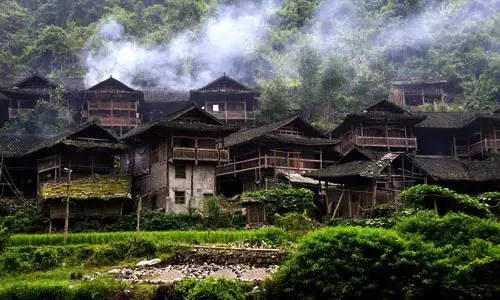
The Tujia people often plant flowers, grass, and fruit trees around their homes but avoid mulberry trees in front and peach trees in the back, as they are considered unlucky due to their homophones meaning “mourning” or “escaping.”
Suspended buildings offer many advantages. Their elevated floors promote ventilation and dryness, while also protecting inhabitants from venomous snakes and wild animals. Beneath the floor, residents can store miscellaneous items.
These stilt houses exhibit distinct ethnic features, including elegant “silk eaves” and wide railings that give them a unique charm. They represent a cultural advancement beyond primitive structures and are often called the “living fossil” of Bachu culture.
Most Tujia houses are wooden constructions, adorned with small green tiles, lattice windows, suspended eaves, wooden railings and handrails, horse running corners, antique fences, and courtyards paved with bamboo shavings and bluestone. Wooden boards decorate the interiors, illuminated by sunlight filtering through pine trees, reflecting a peaceful rural lifestyle marked by the rhythms of sunrise and sunset.
The fundamental design features a ground-level main house with wing houses suspended on three sides, supported by pillars. One side connects directly to the ground and main house. This design enhances ventilation, dryness, and safety from wildlife, while also providing storage space below.
Located on mountainsides, these suspended buildings are supported by wooden pillars on flat ground and typically have two floors. This layout saves land and is cost-effective. The upper floor serves as the living area, while the lower floor functions as a pigsty or storage space.
Some stilt houses reach three stories high and are constructed entirely of cedar wood except for the roof tiles. Large cedar pillars are chiseled and joined with cedar wood braces of varying sizes, secured without using any iron nails. The houses also feature hanging towers with eaves and corners gracefully upturned like wings ready to take flight.
The walls are made from carefully grooved and inlaid cedar boards, coated inside and out with tung oil for a clean, shiny finish.
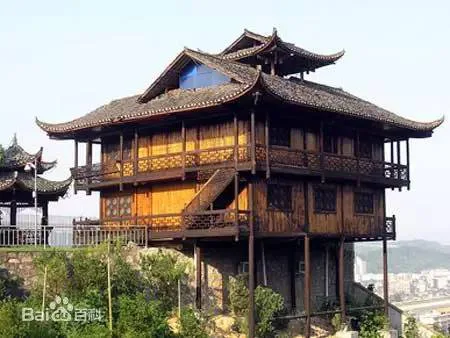
The single hanging style is the most common form, also known as “one head hanging” or “key head.” Its defining feature is that only one side of the main house extends outward, supported by wooden pillars beneath.
Single Hanging Style
The double hanging style, also called “double head hanging” or “basket mouth,” is an evolution of the single hanging type. It features suspended sections at both ends of the main room. The choice between single and double hanging depends mainly on the household’s economic status and needs rather than regional differences. Both types often coexist in the same area.
Double Hanging Style
The “four in one water” style, also known as the suspended foot building, develops from the double hanging style. It connects the upper parts of the suspended sections at both ends of the main house, forming a quadrangle courtyard. The lower floor serves as the main entrance, accessible via stone steps leading to the main house.
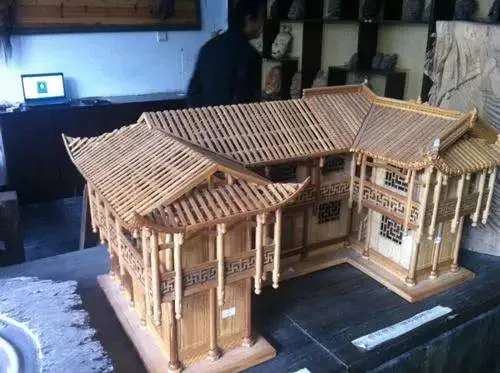
Four in One Water Style
The Legend of Diaojiaolou
According to legend, the Tujia ancestors migrated to western Hubei after a flood devastated their homeland. The area was dense with ancient trees and overgrown with thorns, inhabited by jackals, wolves, tigers, and leopards. Their original “dog claw sheds” were frequently attacked by wild beasts.
To protect themselves, they lit fires and buried bamboo sections inside their shelters, using flames and firecrackers to scare away predators. Despite this, venomous snakes and centipedes remained a threat.
One elderly Tujia man proposed a new solution: the young men were instructed to use whole trees as frames, tie them with wood, lay bamboo strips on top, and build a canopy overhead. This aerial shelter, where people could eat and sleep safely, protected them from snakes and wild animals.
This innovative construction method gradually evolved into the stilt houses known today as Diaojiaolou.













Must log in before commenting!
Sign Up