
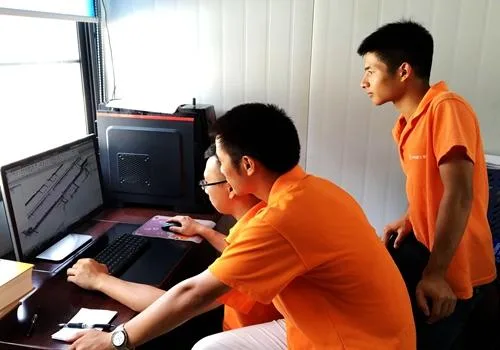
During the expansion and renovation of Chengdu Railway Station, the project team from China Railway Construction Engineering Group Southwest Branch formed a dedicated BIM technology research group. This team focused on integrating BIM with the actual construction demands of the project. To date, they have implemented 18 BIM application points on site, detected 14,031 clash points, and identified 49 drawing discrepancies, contributing significantly to both the project’s timely completion and high-quality standards.
In terms of construction technology, the team utilized BIM 5D technology to automatically simulate brick layouts based on design specifications. This approach enabled quick calculation of brick dimensions, simplifying the process while preventing errors such as misplacement, material waste, and rework. As a result, work efficiency improved markedly.
The mechanical and electrical systems within large railway station buildings involve complex and extensive piping networks, constrained by limited building space. To address this, the project team developed a comprehensive 3D pipeline model, conducted thorough clash detection, examined pipe connections, and adjusted spatial layouts. They also optimized pipe fittings and equipment placements through a secondary design refinement. This intuitive and efficient method maximized space utilization and streamlined the comprehensive pipeline design.
For green construction management, the technical team created a three-dimensional model based on building spatial data. They dynamically installed solar road studs according to model positions and analyzed the deployment of automatic spraying systems to control dust at various locations. Additionally, they evaluated the most cost-effective and practical placement of fire protection equipment on site, maximizing conservation of energy, land, water, and materials.














Must log in before commenting!
Sign Up