
On August 2nd, the basement of the main tower of Chengdu Greenland 468 Center—the tallest building in western China constructed by the China Construction Third Engineering Bureau—was topped out, officially surpassing the zero elevation mark. Early in the construction phase, the project overcame numerous challenges, including the region’s largest foundation pit, the largest single concrete pouring volume, and the first-ever blasting demolition of the foundation pit support system in Southwest China.
The Largest Foundation Pit in Western China
Covering over 20,000 square meters and reaching a depth of 30 meters, this foundation pit is the largest in the western region, presenting significant complexity and difficulty.
The site’s expansive soil demands exceptional stability measures. This highly expansive soil behaves like fragile foam: dense yet loose in texture, prone to swelling and deformation upon contact with water, and highly susceptible to collapse—making foundation construction a daunting challenge. According to skyscraper design standards, excavation must maintain a near-zero deformation rate. Adding to the challenge, the project is located just 3 meters from a subway line transporting nearly one million passengers daily on almost 400 trains. Ensuring the subway’s smooth and safe operation was paramount during foundation construction.
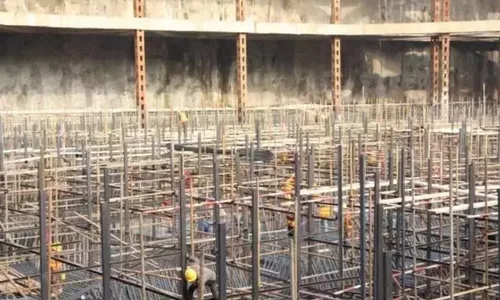
After thorough discussions, the team adopted a multi-layer support and waterproofing construction plan.
While excavation support is common, the triple-layer support system implemented here set a new benchmark for similar projects in western China. Each support layer stands nearly 10 meters tall, built tightly around the foundation pit using advanced steel reinforcement binding techniques combined with high-strength concrete. This design delivers exceptional resistance to deformation, effectively rendering the support system nearly indestructible. The triple-layer support consumed 1,200 tons of steel reinforcement and 8,000 cubic meters of concrete, representing the largest internal support investment in western China.
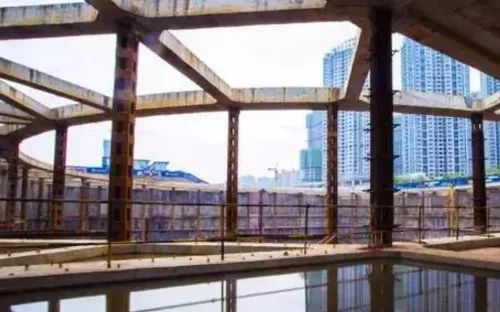
Zhang Zhenxing, a key participant in the foundation pit construction, explained, “The expansive soil behaves like foam, so our foundation approach must treat it accordingly.” When wet, this soil expands with immense force, posing a risk of breaking internal supports and causing foundation collapse, which would jeopardize subway safety. Waterproofing is critical. The project uses 31 pumping wells, each 30 meters deep, to dewater and maintain groundwater at safe levels, preventing soil infiltration beneath the pit. Surface measures include concrete barriers and sloped drainage to channel rainwater away from the foundation pit, creating a protective watershed and ensuring construction stability.
Record-Breaking Bottom Plate Concrete Pouring
At 5:00 a.m. on January 29th, after nearly 110 continuous hours, the last concrete mixer truck departed, marking the completion of pouring nearly 30,000 cubic meters of concrete for the Greenland Center’s bottom slab. This set a new record for the largest single concrete pour in western China.
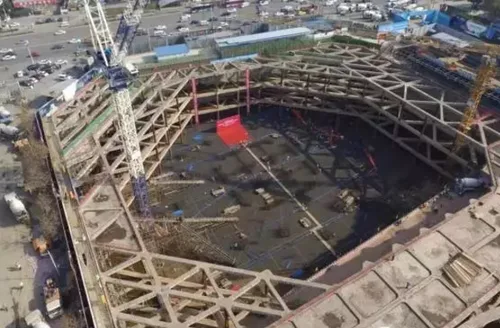
This achievement came with challenges: the pouring took place in the cold of the twelfth lunar month with an impending severe cold wave. Low temperatures slow concrete curing, risking poor formation, cracks, and leaks. To counter this, the construction team implemented a strategy combining shortened waiting times and continuous mixing to maintain concrete quality. They minimized the time between pump truck arrivals and pouring, ensuring continuous flow. A method of “inclined layering, thin layer pouring, sequential retreat, and one-time completion” was innovatively used, ensuring each layer was covered before initial setting to prevent uneven quality. After pouring, the concrete surface was insulated with a special “cotton quilt” covering.
On pouring day, temperatures in Chengdu dropped below freezing. Project secretary Zhou Weibo noted, “We provided cotton coats, warm boots, and other protective gear for all night-shift workers, with drinking water stations near the pouring area.” Hot water and ginger tea were supplied throughout the night, and the project canteen ensured workers had access to warm meals after their shifts, supporting their well-being during this demanding period.
The First Blasting Demolition of Internal Concrete Supports in Southwest China
As construction progressed, the internal “iron cloth shirt” supports became an obstacle. To expand the project’s space, the team decided on explosive demolition of the third internal support—a first for foundation pit support systems in Southwest China—presenting a highly complex challenge.
Preparation began six months in advance. Experts coordinated with the subway authority and public security departments to develop a “cut first, then blast” approach. This involved severing connections between internal supports and retaining piles to block vibration transmission before controlled blasting, minimizing impact on nearby subway stations.
Extensive safety measures were implemented to protect nearby residents. Steel plates were installed on the second internal support for horizontal protection, complemented by high-strength safety nets for vertical containment to prevent debris and reduce noise and dust pollution. The team coordinated closely with public security, traffic management, and subway operators, scheduling blasts during low-traffic periods, setting up warning zones, temporarily closing roads and subway entrances, and ensuring comprehensive area safety.
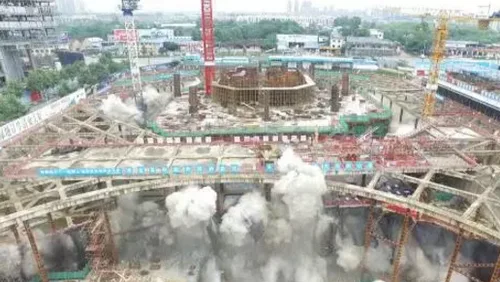
Blasting demolition site
The demolition used 2.4 tons of explosives, classified as Class A demolition blasting. Millisecond delay detonation technology allowed sequential charge explosions, optimizing the detonation network to reduce vibration and impact.
The blast produced a muffled sound lasting nearly 10 seconds. Many Chengdu residents initially mistook it for thunder, only learning of the demolition after news reports. This demonstrated that the blasting had minimal impact on daily life and city transportation.
Currently, the Greenland Center 468 basement structure has risen above ground level, breaking through zero elevation, and will continue to reshape the Chengdu skyline with a construction pace of 5-7 floors every week.












Must log in before commenting!
Sign Up