
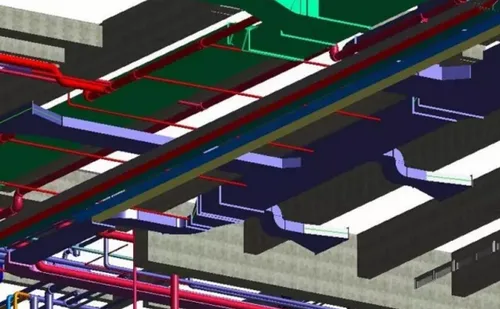
Building Information Modeling (BIM) technology has been hailed as the “second revolution” in the evolution of the construction industry. By leveraging computer technology, BIM enables the creation and utilization of three-dimensional building information models that support planning, design, construction, and operational management of engineering projects. This approach significantly reduces issues such as errors, omissions, clashes, and deficiencies during construction.
BIM plays a critical role in guiding the rational layout and installation of comprehensive electromechanical pipelines. To advance the application and promotion of BIM, the mechanical and electrical installation department of Liyuan Hotel has proactively implemented BIM technology throughout its construction process, achieving promising initial results.
The Liyuan Hotel project covers a total construction area of 65,000 square meters. It comprises three guest room buildings, with three underground floors and 5 to 7 floors above ground. Serving as a support facility for the Liyuan Mountain Villa International Conference Center, the hotel is designed as a high-end multifunctional venue, scheduled to open for the China ASEAN Expo on September 23 this year.
Recognizing its importance, the Water and Electricity Branch designated the project as a key initiative, providing substantial support in manpower, materials, and finances. Meanwhile, the project team promptly formed a BIM technology group to guide the mechanical and electrical installation work. This strategic use of BIM has accelerated construction progress without compromising quality.
The mechanical and electrical installation scope includes fire protection, HVAC, intelligent systems, hot water, and water supply, among others. The project features complex technical requirements, strict quality standards, a tight schedule, and heavy workloads. To ensure effective BIM implementation, the project department established a dedicated BIM team led by the branch company’s deputy manager and project manager, with Fan Quanquan serving as the technical supervisor. This team coordinates branch resources and oversees BIM promotion and application within the project. It comprises eight specialists in electrical, plumbing, and ventilation disciplines, with an average age below 28.
Once the BIM team was established, their first task was to collaborate closely with the project design party. After multiple rounds of design refinement, traditional 2D drawings were converted into detailed 3D models using BIM software. This transformation effectively addressed challenges posed by complex underground and public corridor pipelines.
On-site installation technicians rely on three-dimensional technical disclosures. Key construction node drawings are printed and displayed near installation sites to offer clear, visual guidance during construction. For particularly complicated installation nodes, the BIM team organizes sessions where construction personnel review BIM model demonstrations at the project office, ensuring precise execution.
Currently, the mechanical and electrical installation phase is in full swing to meet the project timeline. Practical use of BIM has enabled detailed design of comprehensive mechanical and electrical pipelines, resulting in a neat and well-organized layout. This not only complies with specification requirements for reasonable spacing and space efficiency but also facilitates on-site construction.
Moreover, the approach has significantly reduced rework rates, thereby cutting costs and enhancing overall project efficiency.













Must log in before commenting!
Sign Up