
1. Project Overview
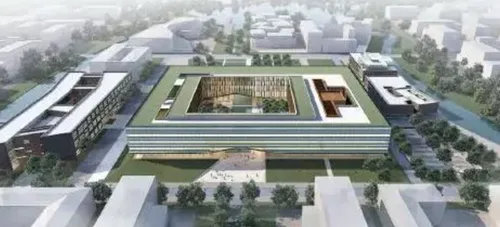
The new campus library at Tianjin University covers a total building area of 49,803.51 square meters, which includes 41,413.7 square meters above ground and 8,351.4 square meters underground. The basement primarily houses parking facilities and various equipment rooms. The ground floor features a public service hall, exhibition spaces, an electronic reading room, lecture halls, and multifunctional rooms. Floors above the ground level 2 and 14 accommodate conference rooms, administrative offices, self-study classrooms, and multiple reading rooms.
2. BIM Application
As a BIM pilot project, the Tianjin University New Campus Library effectively integrates BIM principles and advanced technologies, establishing itself as a flagship construction within the institution.
Given the project’s complexity, improving efficiency and saving time were critical challenges. A major highlight was the establishment of a BIM information platform, enabling real-time remote collaboration across multiple disciplines. This platform facilitated seamless data exchange among engineers and design teams, significantly enhancing productivity and allowing issues to be promptly addressed, ensuring smooth project progress.
Building such a platform was no simple task. After thorough site inspections and detailed research, the team gradually realized the goal of remote multi-disciplinary collaborative design.
First, a workstation equipped with high-performance graphics hardware was deployed as a server to support collaborative design, providing 3D computing, file sharing, and design collaboration services, thereby establishing a robust hardware foundation for the BIM platform.
Second, software tools like AutoCAD, Autodesk Revit, Autodesk Navisworks, and other office applications created an optimal software environment for BIM operations.
The deepening design team utilized this BIM platform to collaboratively complete the crucial modeling phase of the project. Engineers specialized in structural, architectural, and electrical design worked simultaneously at the same level, constantly updating data, which greatly boosted drawing and modeling efficiency.
Additionally, the project achieved real-time transmission of construction site progress, safety, and quality data through image and model synchronization. On-site monitoring images could be compared directly with BIM models for quality management and safety control in key areas, as summarized by Zhang Wenxiong.
Overcoming Two Major Project Bottlenecks with BIM Technology
The Tianjin University library project involves numerous disciplines and a complex workflow, greatly increasing the workload and challenges for engineers. Both construction and operation phases posed significant difficulties, with BIM technology playing a vital role in addressing them.
During construction, engineers struggled with insufficient and unclear basic data in the construction drawings.
To tackle this, the project team utilized BIM technology to supplement critical construction details. For example, during the detailed design of electromechanical pipelines, Autodesk Revit and Navisworks were employed along with clash detection to optimize pipeline layouts.
Furthermore, Autodesk Revit was used to calculate air conditioning loads and generate reports guiding equipment selection. After multiple client and supervisor reviews, detailed designs for each floor were completed, successfully resolving these issues.
The biggest challenge during the operation and maintenance phase was the difficulty for property management to centrally access and manage numerous construction documents and equipment data after project completion.
In response, the team leveraged BIM’s information features to create comprehensive data “articles.” Since critical construction information is stored within the BIM information model, this data became invaluable for property management. The BIM model was handed over to the facility management team, enabling them to continue adding maintenance records and efficiently manage assets with high accuracy, effectively addressing challenges during operation and maintenance.
The Tian Da Library project leader stated, “BIM concepts have been fully integrated into our team. Since engaging with BIM in 2009, we have contributed to national BIM standards and research, which allows us to adapt BIM technology effectively to local conditions and better support the construction of Tianjin University’s new library.”
BIM Software: Perfecting Details
BIM technology has become an industry standard in construction engineering, with modeling software providing a comprehensive information framework. However, the real value lies in BIM’s powerful detailed processing capabilities.
Details can make or break a project and also help reduce costs. For instance, the static material list exported from Autodesk Revit was transformed into a dynamic, operable material table via the OA platform. This table integrates subcontracting prices, comprehensive unit prices, and material prices linked with Excel spreadsheets, enabling interactive cost management. Permission controls allow different managers to access and modify data accordingly.
This approach allows BIM management personnel to perform material statistics, extract Excel sheets, and publish them on the platform. Managers can input pricing during bidding, linking material statistics with commercial pricing, ultimately saving material costs.
Additionally, remote desktop modeling saves costs by enabling server resource sharing and reducing hardware requirements and expenses, offering multiple benefits simultaneously.
Due to the large scale of the project, modeling was segmented by specialties, systems, and file types. An OA management system platform and a Server-U FTP platform were established to support the project: one platform serves as the design department’s proposal discussion tool for BIM 3D collaboration; the other acts as a project management platform. Files and data from project management link to the 3D design proposals as needed, with technical resolution files guiding BIM model corrections. These platforms work in tandem, resolving issues with rendering operations caused by excessive model data in later stages.














Must log in before commenting!
Sign Up