
The Shanghai Center Building is situated at the heart of the Lujiazui Finance and Trade Zone in Pudong, Shanghai. Rising to 632 meters, it boasts 127 floors above ground and 5 underground levels, with a total floor area of 576,000 square meters. This vertical city seamlessly integrates offices, hotels, exhibition spaces, retail, sightseeing, and other functions.

Project Overview
The Shanghai Center Building stretches upward in a vertical, spiral form. It is divided into nine adjacent functional zones from bottom to top, each containing multiple combined functional spaces that offer diverse living environments. The building adheres strictly to the standards of three-star green building certification and LEED Gold design criteria. Advanced green technologies are implemented, including triple water supply systems, ice storage, wind power generation, and rainwater harvesting.
Currently, the project has earned the national three-star green building design evaluation and the LEED-CS Platinum certification in the United States. It was also selected as a finalist in the 2016 MIPIM Awards.
Top-Level Design and Planning
As a landmark supertall skyscraper, the Shanghai Center Building incorporates numerous electromechanical systems and equipment distributed across multiple levels. Managing these systems poses challenges due to their vertical integration, overlapping spaces, and the need for multidisciplinary coordination.
To address these challenges, the project implemented full lifecycle Building Information Modeling (BIM). BIM technology is extensively applied in project management during design and construction phases. Additionally, during operation and maintenance, the BIM model integrates with the Integrated Building Management System (IBMS), facility and equipment management system, and property management system. This integration creates a green, intelligent operations platform that combines structure, systems, services, and management, enabling 4D real-time monitoring and improving operational efficiency.
By merging BIM models with static attribute data, equipment management information, real-time operational status, and property workflow data, the system supports decision-making through information analysis, statistics, and data mining. The BIM model for maintenance defines logical relationships between elements based on operational needs, delivering adaptive solutions via big data analysis. This approach enhances management efficiency and establishes an effective, energy-saving, intelligent, and human-centered model for supertall building operations.
Green and Intelligent Operation Applications
From the project’s top-level design, five operational management categories were established: space management, asset management, maintenance management, public safety management, and energy consumption management. After processes like model validation, lightweighting, attribute classification, and logical sorting, facility styles and equipment installations can be intuitively displayed across regions, floors, systems, and specialties on the platform. A unified coding system covers the full lifecycle of all managed equipment, including profession, system, spatial location, type, and serial number.
The facility equipment management system, IBMS, and property management system exchange data through unified coding and interface integration. This enables real-time display of operating parameters, alarms, and inspection events based on actual equipment status on the operations platform. Logical relationships and key performance indicators (KPIs) are organized within the BIM system and combined with real-time IBMS data and mobile inspection reports. This comprehensive data supports performance analysis, providing decision-making tools and technical backing for green, energy-efficient, and intelligent operations.
Application Scenarios
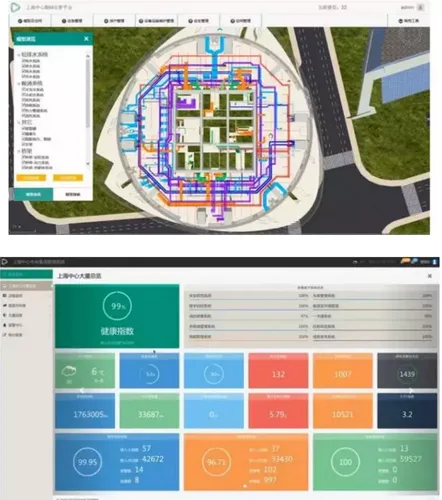
Multi-Screen Linked Display
The system’s integrated large screen offers a comprehensive and intuitive overview of the Shanghai Center Building’s overall operations. Driven by event triggers and organized by conditions and screen size, it displays key information such as building status summaries, centralized alarms, equipment location visualizations, emergency plans, and real-time security monitoring. This setup provides an efficient, accurate, and orderly management interface.
Facility Inspection and Fault Reporting Process
Facility management (FM) personnel use handheld devices to access IBMS real-time data during on-site inspections, comparing actual readings with real-time operational data. If anomalies are detected, they report device alarms via handheld terminals, generating work orders. The IBMS system receives detailed alarm event and work order information, locates alarmed devices, and links their positions and related scenarios within the BIM system. Management then dispatches tasks accordingly. IBMS tracks work order progress in real time until completion.
IBMS Automated Alarm Process
The IBMS monitors real-time data from access subsystems and triggers alerts when equipment alarms occur. Current alarms are displayed in the real-time alarm module, and notifications are pushed through the alarm publishing platform. Upon receiving these alerts, the BIM system locates the equipment and displays related scenarios. The FM system generates pending work orders as needed, while management dispatches tasks based on the situation. IBMS tracks work order status in real time until resolution. Depending on the alarm’s classification, severity, and impact, different emergency plans activate, displaying responsible personnel, on-duty staff, and simulating evacuation routes and rescue operations within the BIM system.
IBMS Intelligent Warning Process
IBMS synchronizes facility equipment data from the FM system, analyzes real-time operational data, and reports warning results to the platform, pushing relevant alerts. Upon receiving warnings, the BIM system locates equipment and shows corresponding scenarios. The FM system generates pending work orders as needed. Based on these warnings, the BIM system performs equipment positioning, status simulations, and scene displays. Management evaluates the situation and assigns tasks accordingly. IBMS continuously monitors work order progress through interfaces until tasks are completed.












Must log in before commenting!
Sign Up