
In recent years, driven by national policies and industry trends, Building Information Modeling (BIM) technology has rapidly established itself in China’s construction sector, igniting an information revolution. Chengdu Nengxin Engineering Management Co., Ltd. (hereafter referred to as Chengdu Nengxin) supported the 12th branch of Sichuan Huaxi Construction Group in implementing BIM technology for the challenging and complex aspects of the Chengdu Global Financial Center project. This ensured standardized, refined project management that effectively controlled cost, schedule, and quality throughout construction. The BIM application’s value was fully realized and earned unanimous praise from all project stakeholders.

Night view of the Global Financial Center
The Chengdu Global Financial Center is situated at the intersection of Desai 1st Street and adjacent planned roads, west of Tianfu Avenue in Gaoxin South District, Chengdu, next to the International Convention and Exhibition Center. The project comprises two 47-story super high-rise office towers, a five-story commercial podium, and a four-story underground garage, forming a mixed-use office and commercial complex. It includes four underground levels, totaling approximately 284,000 square meters of construction area—218,959.23 square meters above ground and 63,736 square meters underground. The building reaches a total height of 198.3 meters.
Due to its large scale and high quality requirements, the project presents significant construction challenges. Coordination and unity among all parties are difficult, making overall process control a major challenge. To address this, BIM technology’s features—digitization, parameterization, and visualization—were applied for virtual construction management. This approach allowed early detection and resolution of construction issues, ensuring smooth progress while saving time and cost.
Chengdu Nengxin provided comprehensive BIM consulting services throughout the construction, assisting the construction team in applying BIM technology. Key BIM applications included creating three-dimensional models for civil engineering, modeling corridor steel structures, detailed design of complex steel connection nodes, simulating corridor hoisting plans, optimizing pipeline clash detection, and refining tower crane dismantling plans. BIM helped identify errors early, guide construction progress, and reduce costs caused by rework. The main BIM application areas are outlined below:
1. Creation of 3D Information Models
Using design institute construction drawings as the basis, BIM software was used to build three-dimensional models of building structures, mechanical, electrical, and plumbing (MEP) systems, steel structures, curtain walls, and more. Detailed component information from the drawings was accurately incorporated into these 3D models.
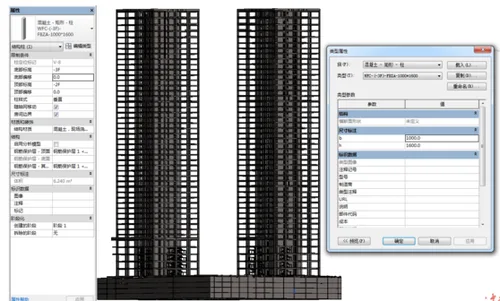
Revit model of Chengdu Global Financial Center civil engineering
2. Detailed Design of Complex Steel Structure Nodes
The corridor’s steel structure consists of lattice trusses with large spans and complex node connections. Plan drawings could not fully convey the relative positions and connection methods of each member. Using BIM 3D models, the construction processes for complex nodes were optimized and visually presented. This clearer representation ensured orderly, reasonable node connections, facilitated technical clarifications by the construction team, and enhanced connection quality assurance.
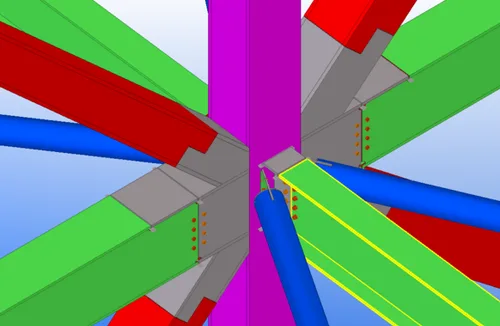
Detailed design of steel structure nodes
3. Simulation of Corridor Hoisting Construction Plan
The corridor assembly involved prefabrication of parts in the factory, followed by on-site assembly on a platform set up on the basement roof, and lifting after completion. The challenge lay in the heavy weight, high lifting height, and complex steel structure assembly and connections, posing significant safety and stability challenges. Leveraging BIM’s visualization and parameterization capabilities, 3D models simulated the lifting process, providing an intuitive display of the dynamic construction sequence to guide progress.
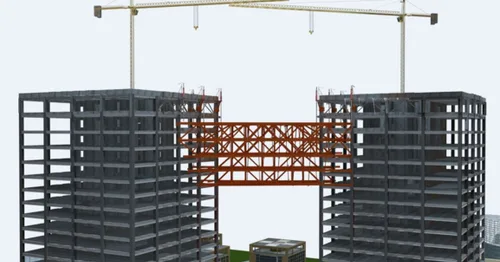
Simulation of corridor hoisting process
4. Comprehensive Pipeline Clash Detection and Optimization
Collision detection was performed on the existing model to identify design conflicts. Collaboration among all parties resolved these issues, aiming for a practical and construction-friendly design. The project focused on optimizing four disciplines: structure, HVAC, electrical, and plumbing. Key measures included:
- Increasing floor net height to maximize usable space;
- Rationalizing the routing of various systems to promote standardization and reduce non-standard components;
- Pre-drilling structural holes for three sets of pipelines passing through structural elements.
These measures improved pipeline installation efficiency and reduced costs.
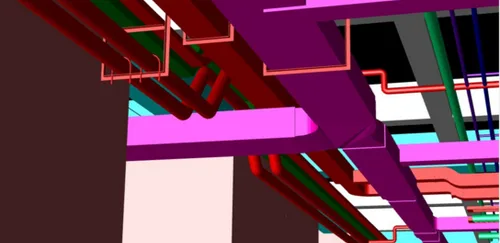
Pipeline comprehensive optimization diagram
5. Optimization and Simulation of Tower Crane Dismantling Plan
After main construction completion, two QTZ7050 tower cranes on the roof—one on Building 2 with a 60m arm and another on Building 1 with a 50m arm—needed dismantling. Due to the high floors and long arms, direct dismantling required careful planning considering multiple factors. Traditional two-dimensional plans lacked clarity and made cost analysis and plan comparison difficult. BIM technology enabled simulation and comparison of multiple dismantling strategies, allowing selection of the optimal approach.
Chengdu Nengxin’s BIM support helped the 12th branch of Sichuan Huaxi Construction Group achieve outstanding results in this project through close collaboration. Beyond the applications mentioned, BIM was also used for construction site layout simulation and optimization, BIM-based data management, on-site quality and safety monitoring, and dynamic progress management. These comprehensive BIM applications facilitated smoother construction and better control over project duration, quality, and cost.














Must log in before commenting!
Sign Up