
Designing waste incineration plants often presents challenges such as managing large pipelines and meeting the concentrated demands of complex equipment layouts. Relying on traditional design methods can lead to repeated engineering revisions and wasted resources, which contradicts the goals of green emission reduction. The construction industry has made significant strides in reducing smog emissions. A standout example is the Shanghai Laogang Renewable Energy Utilization Center, which has garnered widespread attention for its innovative use of BIM technology in construction design, promoting green construction, energy conservation, and emission reduction.
Let’s explore how this project leverages BIM technology to achieve energy efficiency and emission reductions.
Project Overview: The Laogang Renewable Energy Utilization Center is located in the southeast corner of the Laogang Solid Waste Comprehensive Utilization Base, west of Embankment 0 in Pudong New Area, Shanghai, and north of Xuanhuang Highway. The construction site covers 159,898 square meters, with a total building area of 49,805 square meters. The facility has a waste processing capacity of approximately one million tons per year and an annual power generation design point of 3.252 × 10⁸ kWh. With a total investment of 1.47878 billion yuan, this project is among the largest domestic waste-to-energy plants in Asia in terms of investment, construction area, and power generation capacity.
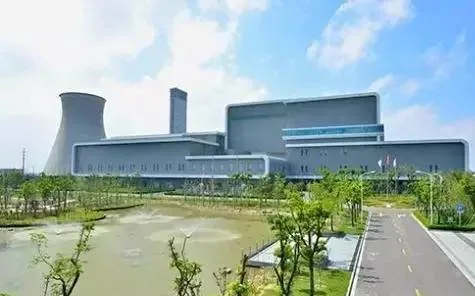
The domestic waste power plant project must comply with industry standards for power generation and faces several challenges:
1. Equipment layout within the plant requires a centralized and logical distribution, characterized by complex spatial arrangements, high design standards, and construction difficulties. Key requirements for the factory building layout include:
(1) Maximizing compliance with process production and equipment maintenance needs;
(2) Efficiently utilizing the workshop’s building area and volume;
(3) Allowing room for future development and expansion;
(4) Ensuring labor safety and industrial hygiene designs meet relevant regulations.
2. The project involves numerous systems with large-diameter pipelines, various pipe types, complex routing, and dense equipment layouts. The site is notable for its density and height, with the tallest points exceeding 20 meters. The air duct system covers 180,000 square meters, with the largest ducts measuring 1200mm × 800mm. Installation is challenging due to the extensive and voluminous pipeline network.
3. As a key project in Shanghai, it aims to be the largest domestic waste-to-energy plant in Asia, setting a benchmark for similar future projects. This raises the bar for quality and performance requirements.
BIM Application Process
Software Selection
For the mechanical and electrical design of the factory, the BIM team evaluated several leading MEP BIM software options. After comparing features against project needs, they narrowed the choice to Autodesk Revit and Guanglianda Software Co., Ltd.’s MagiCAD for AutoCAD, as summarized in the table below.
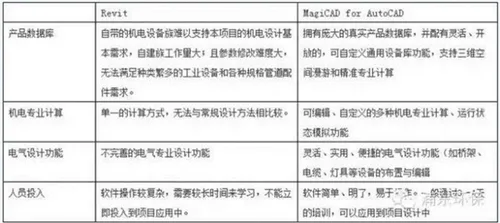
Following this comparison, Guanglianda MagiCAD for AutoCAD was selected for mechanical and electrical engineering BIM work. A dedicated BIM team was formed to focus on BIM design. The software trainer from Guanglianda conducted a three-day specialized training on MagiCAD operations for the team. Given the high demands for MEP installation, process equipment design, and related tasks, the team needed to go beyond typical BIM challenges like pipeline clash detection and comprehensive routing.
They also required advanced hydraulic calculations, system operation simulation, and the ability to generate construction drawings directly from BIM models. The training covered basic modeling, MEP design applications, and, importantly, the rich library of mechanical and electrical equipment components in MagiCAD. This enabled deep functionalities such as equipment selection and system verification, significantly improving efficiency in future BIM design projects.
Project Implementation
1) 3D Modeling
During the early stages, the BIM team used MagiCAD for intuitive and efficient 3D BIM design, as illustrated below. The modeling process began with specialized teams for HVAC, electrical, plumbing, thermal engineering, and other disciplines. They first performed a preliminary coordination to determine elevation ranges for each specialty, then modeled separately using MagiCAD, followed by collaborative integration and model inspection.
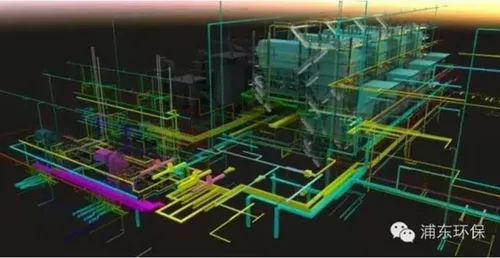
Because equipment in different industries often has unique characteristics and large sizes, standard 3D product libraries lack suitable components. MagiCAD’s extensive product library includes millions of components, allowing the team to accurately insert required products into the 3D model. This ensured precise reflection of actual equipment and pipeline layouts, accommodating dense arrangements while meeting spatial and design requirements.
2) Collision Detection
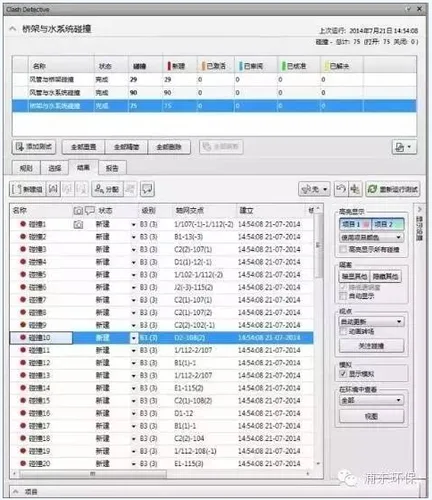
Collision detection followed a systematic approach: first within each discipline to resolve internal clashes; then on the integrated MEP model to address inter-disciplinary conflicts; and finally between the MEP systems and building structures. MagiCAD software provides one-click detection reports, covering internal collisions, external references, and AutoCAD entities within the drawing, as shown below. Using these reports, the team comprehensively adjusted and manually reviewed the design, greatly improving BIM model quality.
3) Issue Resolution
Following collision detection, the BIM team held group discussions and manual reviews to summarize findings. Due to many intersecting large and small pipelines—especially water-related ones—standard collision detection often flagged numerous minor issues, making it difficult to prioritize. MagiCAD’s capability to filter water pipe diameters helped classify collisions by importance, enabling the team to focus on critical clashes and resolve them efficiently.
4) System Debugging
After adjusting pipelines, the team used the BIM model to simulate system operations and verify equipment functionality according to design plans. MagiCAD’s calculation features allowed simulation of real product components to obtain precise operating parameters, such as valve positions. This facilitated further system optimization, enhancing energy savings and environmental benefits beyond traditional design deepening.
The Laogang Renewable Energy Utilization Center project demanded significant effort from the BIM team, but the results were remarkable. Leveraging Guanglianda MagiCAD software, they saved nine months in the design process and millions in costs through model-driven design deepening. The project achieved energy efficiency, emission reductions, and green environmental protection, aligning with national priorities and fully realizing the center’s value.













Must log in before commenting!
Sign Up