
Abstract: This project design actively incorporates the “Five New” technologies and promotes the concepts of “Smart Factory Design” and “Green Factory.” BIM technology is applied across industrial design, architecture, structural design, and comprehensive pipeline design to create a leading scientific and technological base for manufacturing oil drilling and production equipment.
1. Project Background
Project Name: Application in the Relocation and Renovation Project of Petroleum Machinery Factory
Design Unit: Sixth Design and Research Institute of Machinery Industry Co., Ltd.
Founded in 1951, China Machinery Industry Sixth Design and Research Institute Co., Ltd. (hereafter “Sixth Institute”) is one of China’s earliest and most influential design units. It ranks among the top 100 comprehensive strength units in the national survey and design industry and is affiliated with China Machinery Industry Group Co., Ltd., a major central enterprise group. In 2007, the institute earned the “three standard integration” certification, covering ISO9001 quality management, ISO14001 environmental management, and GB/T28001 occupational health and safety management systems.
The Sixth Institute is the only professional design institute in China specializing in both machine tools and inorganic non-metallic materials industries. It is a leading design institute in five major industries: tobacco, casting, heavy mining, engineering machinery, and civil construction. The institute holds first-class engineering capabilities in large-scale factory and park planning, enterprise production process reengineering, complex structural design, HVAC, industrial dust removal, information intelligence, green building, municipal and environmental engineering. It also serves as the chief editor of national green industrial building standards.
Related Software Applications:
- Autodesk Revit
- Autodesk Navisworks
- Autodesk Ecotect Analysis
- Autodesk Showcase
- Autodesk Project Vasari
- Autodesk SimulationCFD
- AutoCAD
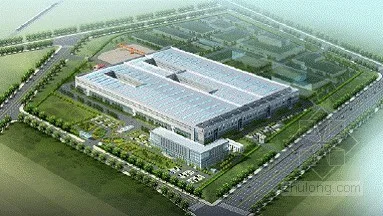
Aerial view of the relocation and renovation project of Beijing Petroleum Machinery Factory
2. Main Text
Project Overview:
Beijing Petroleum Machinery Factory, established in 1955, operates under the Drilling Engineering Technology Research Institute of China National Petroleum Corporation. It is a professional manufacturing enterprise integrating development, design, manufacturing, sales, and service of modern petroleum drilling and production equipment.
The new factory is located in the northeast area of the National Engineering Technology Innovation Base in Changping District, Beijing. Covering approximately 117,700 square meters with a total construction area of 73,500 square meters, the facility combines scientific innovation, research, experimentation, and achievement transformation. It serves domestic and international petroleum exploration and development markets, guided by cutting-edge drilling technology, aiming to build a scientific research achievement transformation base characterized by fully shared resources, reasonable production capacity, comprehensive support facilities, and a beautiful factory environment.
Once operational, the new factory will achieve annual outputs such as:
- 80 top drive devices
- 60 drilling-while-drilling instrument series
- 2,500 screw drilling tools series
- 500 ground blowout preventer control devices
- 1,000 shock absorbers
- 300 single screw oil pumps
- 300 screw pump ground drive devices
- 10 top drive lower casing devices
- 2 downhole generators for drilling instruments
- 4,472 sets of various products in total
At full production capacity, annual sales revenue is projected to reach 1.94 billion yuan.
The project design embraces “Five New” technologies, promoting “Smart Factory” and “Green Factory” concepts. Through construction, it supports rapid transformation and specialized production of new products, improves production efficiency and quality, and establishes a first-class petroleum drilling and production equipment manufacturing base with high scientific and technological content.
Project Challenges:
1. Production Environment
Scientific and rational production logistics planning within the factory area is critical for the overall layout of the industrial park. Factors such as wind and noise impact, workshop noise control, and treatment of smoke and dust are key to ensuring harmony between the buildings and their natural surroundings, as well as promoting healthy, practical, and efficient use of building spaces. Optimization of these environmental solutions is achieved through BIM technology.
2. Process Flow
The project aims to build a new digital factory characterized by “multi-variety, small batch” production. Limited production space and complex processes require a highly flexible, progressive, and efficient production system. To reduce construction risks and optimize workshop design and foundry production organization, BIM and simulation technologies are used to virtually simulate production processes, identify weak points, and propose optimized solutions.
3. Project Implementation Organization
The Sixth Institute and Ningxia Shared Equipment Co., Ltd. jointly developed a digital casting workshop system to promote intelligent and green development of “multi-variety, small batch” casting production. This system advances measurement and control technologies for key components, fosters intelligent manufacturing innovation, and serves as a model for upgrading China’s casting industry.
To achieve these goals, BIM technology was adopted with a detailed implementation plan. The Sixth Institute deployed Autodesk RevitServer using a central server and multiple local servers, enhancing data synchronization, backup, and management through a server-based workflow. The Autodesk Simulation platform, based on BIM, enables seamless integration between modeling and simulation, improving engineering design tools and promoting refined construction.
Project BIM Design and Application
1. Process Design
The digital casting workshop comprises pattern making, modeling, melting, finishing departments, ventilation and dust removal systems, and auxiliary systems, with an annual capacity of 20,000 tons of high-end castings. During the schematic design phase, Autodesk Revit is used to create the BIM model, which is then imported into a proprietary simulation platform. Four process design schemes are simulated and analyzed regarding workshop logistics, production balance, and capacity to validate process planning, visualize design, quantify evaluation metrics, optimize design, and reduce construction risks.
During construction, commissioning, and operation, simulation and virtual trial productions are performed on key workstations and production lines (melting stations, molding lines, annealing furnaces, white mold molding lines, etc.) to optimize processes, production schedules, product quality, and efficiency. The simulation platform embeds specific tools for production and logistics system modeling, enabling performance evaluation and visualization of results. Graphical analysis tools facilitate rapid visualization and comparison of simulation data, supporting deeper optimization of process and logistics design.
2. Architectural and Structural Design
The digital casting factory project of Ningxia Shared Equipment Co., Ltd. is a large-scale industrial building consisting of two zones: the white area and the black area. The building footprint covers 8,975.32 square meters, with a total construction area of 11,918.17 square meters, including an underground station of 127.99 square meters. The first-floor white area covers 2,814.86 square meters, the first-floor black area 6,160.46 square meters, and the two-story white area 2,814 square meters.
The factory is a steel structure building, while the public station building uses a frame structure. Factory building spans are 24m and 30m, with main column spacing of 9m for the factory and 6m for the station. Crane rail elevation is 9.6m, and crane capacity is 10 tons. The structure is designed for a 50-year service life with seismic resistance of 8 degrees. Structural elements include welded solid belly steel columns and beams, and the roof uses double-layer color steel panels with rock wool insulation.
Ventilation and dust removal systems are designed by analyzing pollutant dispersion patterns, verifying ventilation reliability, and optimizing HVAC and dust removal schemes to ensure employee health and comfort.
3. Comprehensive Pipeline Design
A secondary-developed comprehensive pipeline design program supports pipeline routing adjustments, support and hanger design, quick annotation, and drawing layout. The 3D support and hanger design tool developed on Autodesk Revit performs routine analyses, finite element calculations, and assists in selecting various support and hanger types, significantly improving design efficiency and quality.
The comprehensive pipeline design presents installations from multiple 3D perspectives—axonometric, sectional, and plan views—overcoming limitations of traditional 2D space representation. Detailed design of supports, hangers, and prefabricated components ensures compliance with maintenance and construction space requirements, enhancing product quality and providing valuable construction guidance.
Material statistics and real-time updates powered by Autodesk Revit dramatically boost design efficiency. Leveraging Revit’s API, the team developed a flexible material statistics feature that saves templates for reuse and integrates data with the comprehensive delivery system database, enabling rapid material tracking and data sharing.
Innovative Applications in the Project
1. Comprehensive Finished Product Delivery System
This system enables all project participants to collaborate online using a unified building information model, integrating the 3D model as the project’s information carrier. Construction data from design to completion is delivered to the owner, supporting integration with 3D operation and maintenance systems and the digital factory system to develop information-rich building information models.
2. Secondary Development Component Library
The Autodesk Revit software suite supports secondary development and auxiliary tool creation. The Sixth Institute developed a series of design plugins, including an enterprise 3D component library and comprehensive pipeline supports and hangers, enhancing design capabilities.
3. Design Specification Inspection and Collision Detection Cloud Service
This cloud service automatically saves and uploads Autodesk Revit files based on schedules or work orders. Using enterprise design specifications and preset collision detection rules, it calls Autodesk Revit and Navisworks plugins to perform specification checks and collision detection, providing designers with detailed feedback reports.
4. Auxiliary Project Management
BIM-based project management offers a new approach to managing projects. By combining construction schedule simulation and process simulation, it enables 4D visualization of construction plans, facilitating decision-making, improving communication and work efficiency, reducing rework due to schedule conflicts, and lowering labor and material costs.
The independently developed visual project management system unifies management of basic information, manpower allocation, and time costs for subcontracted projects, strengthens internal accounting, and reduces expenses.
5. Application of Virtual Reality Technology
To meet the requirements of digital factory construction and operation, the building information model undergoes lightweight processing, integrating production process control and management information. This achieves seamless connection between spatial data and factory facility data across the building information model and virtual reality environments, supporting the development of a visual factory management system and future technological upgrades during the digital factory’s operation phase.
Summary of BIM Technology Application
The Sixth Design and Research Institute of Machinery Industry Co., Ltd. continuously expands BIM technology applications across projects, improving proficiency and building a robust BIM platform to maintain core competitiveness. BIM solutions are applied throughout the entire project lifecycle—design, construction, operation, and maintenance—supporting bidding, schematic design, basic design, detailed design, on-site construction guidance, and operational maintenance for project development.












Must log in before commenting!
Sign Up