
Abstract: By leveraging BIM technology to manage materials in construction projects, and by efficiently and scientifically coordinating personnel, materials, and machinery throughout the construction process, construction companies can significantly enhance their profitability.
Building Information Modeling (BIM) serves as an information processing system for engineering projects, providing a comprehensive data foundation for collaborative workflows. During the construction phase, the construction company takes the leading role in project execution, and its management quality directly influences the final project outcome. Efficient material system management plays a crucial role in determining the construction company’s profits. The integration of BIM technology in material management, combined with effective utilization and scientific allocation of personnel, materials, and machinery, enables companies to maximize returns. The development of material management software tools aligned with BIM frameworks is becoming an industry trend.
Introduction
BIM integrates all project information throughout the entire lifecycle into a single model, digitally simulating the real-world details of a building. As a direct application of digital technology in construction engineering, BIM offers a digital approach to design, construction, and management processes. The scope of BIM covers the entire building lifecycle, from planning and design to construction, operation, and maintenance, supported by specialized BIM software tools.
Key features of BIM technology include visualization, coordination, simulation, optimization, and graphical representation. Implementing a BIM-based project information management system can improve production efficiency, enhance quality, shorten construction timelines, and reduce costs. However, most construction firms remain in the early stages of adopting BIM technology and still rely heavily on traditional management techniques. This paper explores a BIM-based material management system tailored for large-scale construction enterprises, demonstrating how such applications can deliver measurable economic benefits, promote BIM adoption, and support efficient management and global integration of Chinese construction firms.
By employing database technology to store and manage building and material information, alongside CAD display technology for visualizing construction processes, 3D visualization of contracted projects is achieved. Incorporating a time parameter adds a temporal dimension to CAD visualizations, enabling 4D technology application. This integration allows comprehensive management of component information and interactive control of engineering drawings.
Throughout construction, design modifications that require only adjustments are automatically synchronized and updated across all relevant information. Material statistics and project progress can be monitored in real-time, facilitating construction teams in managing schedules and controlling costs. By comparing planned versus actual material consumption, current progress can be assessed and schedules scientifically adjusted. The PDCA (Plan-Do-Check-Act) cycle is employed to manage construction effectively, conserve materials, enhance efficiency, and maximize enterprise profits.
1. Material Management in Construction Enterprises
Building materials account for the largest portion of construction costs, typically 60% to 70% of the total project expense. Material management is therefore a vital component of construction project management. By continuously enhancing material management practices, construction companies can prevent waste, reduce expenses, and ultimately increase profits.
1.1 Current State of Building Material Management
As a key production factor, material management significantly impacts the overall economic performance of construction enterprises. For construction firms, the quality of material management reflects primarily in two areas: minimizing material loss and optimizing procurement and inventory control.
Effectively managing enterprise resources, aligning supply and demand, and improving resource allocation efficiency have become essential management goals. However, a universal management system suitable for all construction enterprises is lacking. Traditional methods demand considerable manpower and resources to manage inventory, resulting in inefficiencies and suboptimal outcomes. Although computer technology has enabled the development of various construction management software, many are overly complex, hindering widespread adoption.
1.2 Integration of BIM Technology and Material Management
BIM delivers value throughout a building’s lifecycle, addressing the diverse concerns of all project stakeholders. Each stakeholder focuses on different aspects at various stages, and the industry seeks a virtual reality reference to anticipate issues. BIM provides such a solution by digitizing building information into a parameterized model that serves as a collaborative platform for designers, engineers, constructors, and maintenance teams.
The core strengths of BIM include 3D visualization and the tight integration of the building’s physical structure with embedded information. Construction teams prioritize schedule and material management, and by using BIM to create 3D models that incorporate material and time data, they can efficiently manage materials throughout the construction process.
1) Building Model Creation
Databases store information about building components — walls, beams, slabs, columns, etc. — including material types, elevations, and dimensions. Project progress is tracked by setting construction milestones based on schedules (such as completed floors or building heights). CAD software tools enable interactive 3D visualization and modification of building components.
2) Material Information Management
An interactive interface manages the material library, classifying materials and tracking details such as names, quantities, and purchase dates. Outputs include material consumption reports, data requirement tables, and purchase lists for each construction phase.
2. Material Management BIM Model Creation
Using database management and 3D CAD software, a 3D building model is established to facilitate material management aligned with construction progress. Integrating BIM with time data enables 4D applications for construction material management.
2.1 Software Model
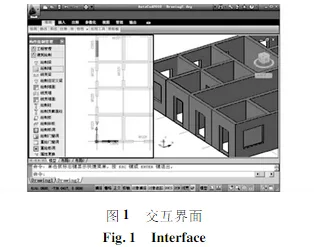
The system employs an SQLite database to manage all data and handle input/output operations. Autodesk AutoCAD serves as the graphical platform. Using ObjectARX and Visual C++, a BIM material database and 3D component display model are developed within AutoCAD. Functional modules and user interfaces interact with database data to display components on the CAD platform. Tools support human-computer interaction for managing the material library and drawing building components with attribute settings such as size and material category. The user interface is illustrated in Figure 1.
1) Material Database
The material management library interface tracks all materials for the project, including material codes, classifications, names, quantities, entry and exit dates, and demand forecasts for upcoming construction stages. This enables ongoing monitoring of material consumption and procurement funding requirements.
2) Floor Information
Information such as floor elevations, standard floor counts, and floor names is set to facilitate drawing components like walls, beams, slabs, and columns. Construction schedules based on floor numbers guide material supply planning.
3) Component Information
Building components including foundations, walls, beams, slabs, columns, doors, windows, and roofs are detailed with dimensions, elevations, and material attributes. These components are drawn and their data saved to the database. CAD functions as both the display tool and user interface.
4) Schedule
Construction progress is set according to the timeline, with planned completion milestones defined by building elevation or floor count. This facilitates stage-wise monitoring and control of material consumption.
5) Report Output
Material statistics are generated based on project progress, including summaries of completed materials, materials required for unfinished stages, next-stage material needs, and comparisons of planned versus actual consumption. This allows construction companies to monitor project status, adjust schedules, and manage capital investment to avoid losses.
2.2 Operation Process
The developed software supports material management across engineering construction, material control, and engineering changes. The process, depicted in Figure 2, focuses on scientific material management through the following steps:
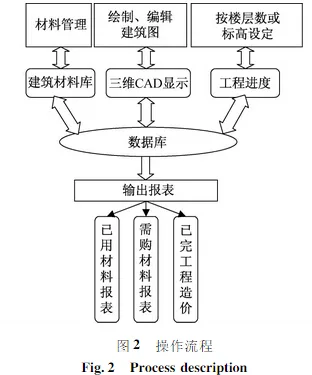
1) Material Warehouse Management
Enter material data including codes, categories, quantities, and retrieval dates.
2) Building Model Creation
Set floor details; draw components such as walls, beams, slabs, and columns; assign material categories, dimensions, and other attributes to each component.
3) Project Schedule Setup
Define construction timelines and specify completion milestones by floor or elevation.
4) Change Coordination
Input change orders including design modifications and schedule adjustments.
5) Material Requirement Output
Generate reports listing materials consumed in completed phases and materials required for upcoming construction stages.
6) Actual vs. Planned Comparison
Identify and address discrepancies in schedule and inventory management to prevent significant losses.
3. Application Outcomes
Leveraging BIM technology combined with specialized software enables intelligent material management in construction enterprises, reducing labor demands and controlling costs. Key benefits include:
1) Real-time monitoring of material consumption, allowing for timely assessment of project costs and capital expenditure.
2) Accurate forecasting of material demand for upcoming construction phases ensures timely funding and supplies, preventing overstocking and freeing working capital by optimizing inventory levels.
3) Continuous updating of material requirements in response to engineering and design changes minimizes losses caused by outdated or incomplete information.
4. Conclusion
A thorough understanding and application of BIM technology in construction enables integration of database and CAD 3D visualization with construction progress and quantity information. Representing material demand over time and simulating material usage throughout the construction process allows enterprises to monitor consumption and forecast future needs. This facilitates reasonable scheduling and cost savings, elevating construction management to a new level through the application of advanced information technologies.
References:
Sang Peidong, Xiao Lizhou. Application of BIM in the Integration of Design and Construction. Construction Technology, 2012, 41(17): 25-26
Li Xiao. Analysis of the Application Prospects of Green BIM in the Whole Life Cycle of Buildings in China. Civil and Architectural Engineering Information Technology, 2012, 4(2): 52-57
Zhang Jianping, Li Ding. The Application of BIM in Engineering Construction. Construction Technology, 2012, 41(17): 10-17
Zhang Jianping, Fan Zhe. Dynamic Management of Construction Resources and Real-Time Monitoring of Costs Based on 4D-BIM. Construction Technology, 2011, 40(4): 37-40
Wang Xueqing, Zhang Kangzhao, Xie Yin. 4D Simulation Based on BIM Real-Time Construction Model. Journal of Guangxi University: Natural Science Edition, 2012, 37(4): 814-819
Wang Hao, Tao Lu. Exploration of Material Management in Construction Enterprises. Building Technology Development, 2006, 33(8): 132-133
(Author: Pu Hongke, Beijing Jinrun Ark Software Co., Ltd.)














Must log in before commenting!
Sign Up