

1. Project Overview
The China Zun Project, also known as the Z15 plot project, is situated in the core area of Beijing’s Chaoyang District CBD. Located along the central axis of the CBD and facing the new CCTV site directly across the street, this development covers approximately 1.15 hectares. The total construction area spans 437,000 square meters, including 350,000 square meters above ground and 87,000 square meters underground. The building features 108 floors above ground and 7 underground levels, reaching a height of 528 meters. Upon completion, it will become the tallest building in Beijing and serve as a new landmark, integrating finance, office, commercial, and sightseeing functions.
Currently, foundation engineering work has progressed with the construction of two underground diaphragm walls beyond the foundation pit’s red line, as well as peripheral piles between these walls. Excavation within the foundation pit has reached a relative elevation of -27.000m (where ±0.000m corresponds to an absolute elevation of 38.350m). Key activities for this foundation project include removing 896 engineering piles and pile heads, installing horizontal supports at -27.000m within the pit, excavating and transporting soil from -27.000m up to 30cm above the bottom plate’s lower surface, setting up dewatering wells, and constructing the wharf.
The geological conditions are summarized in Table 1. The direct bearing layer beneath the foundation bottom plate is the ⑦ soil layer, composed mainly of clay and heavy silty clay. The pile end bearing layer is the fourth soil layer, with an estimated compression modulus of 150–160 MPa and a pile end resistance limit of 3000 kPa.
2. Analysis of Key Challenges in the Project
1) The construction schedule is tight, with a total period of only 218 days as specified in the bidding documents.
2) The project involves a large and complex scope, including approximately 60,000 m³ of pile foundation drilling and about 170,000 m³ of earthwork excavation. During earthwork operations, coordination is required with other contractors conducting prestressed anchor rod installation across the site.
3) Limited space in the core CBD area results in a foundation pit area of just 11,478 m². During peak periods, the site must accommodate rotary drilling rigs, forklifts, cranes, concrete mixers, as well as material storage and processing yards.
4) The pile foundations have large diameters and long piles and steel cages, with the drill holes extending over 10 meters in some cases. The geological layers mainly consist of dense sand and gravel, with the Cong layer containing gravel grains up to 12 cm in size. Additionally, pressurized water heads in layers ⑥, ⑧, and ⑩ are located near the surface, increasing difficulty. Drilling and steel cage installation require advanced machinery capabilities and skilled personnel.
5) A wharf must be constructed to facilitate the movement of machinery and personnel, acting as the vertical transportation lifeline within the pit. The design and construction of the wharf are critical for project logistics. The positioning of wharf columns often conflicts with foundation pit horizontal supports or engineering pile locations.
To address these challenges, the project integrates BIM technology to develop a 3D model of the China Zun foundation. A time dimension is added to simulate construction sequences, enabling comprehensive BIM-based construction management.
3. Implementation of BIM Technology
3.1 Creating the BIM Construction Model
The BIM construction model differs from the design-phase BIM model. While the design model focuses on architectural and structural design, the construction model guides actual construction activities and must accurately reflect on-site conditions. For instance, the construction model includes structural elements such as ring beams and columns, as well as construction phase divisions, which are absent in the design model. Furthermore, the construction BIM model encompasses not only the building components but also construction equipment and temporary facilities.
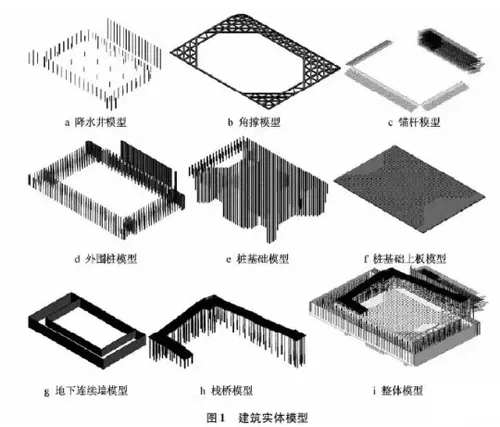
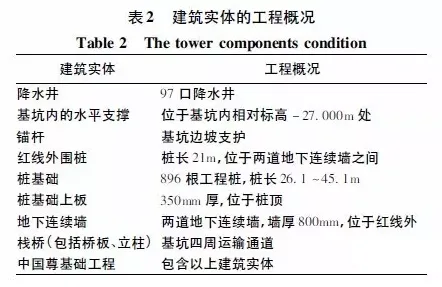
In the China Zun Foundation Project, the created building entity model is shown in Figure 1, and an overview of the building entity is provided in Table 2.
3.2 Collision Detection
Collision detection helps identify and report conflicts between building components early in the process. There are two types of collisions:
- Hard Collision: Physical overlap of entities.
- Soft Collision: Entities do not physically collide but lack adequate spacing to meet construction requirements (e.g., pipelines needing minimum clearance for installation or insulation).
BIM collision detection tools can selectively check for conflicts between specific systems, such as electromechanical and structural components, and allow classification-based checking.
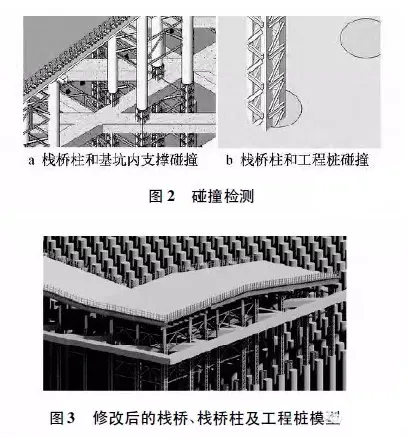
Using the BIM construction model of China Zun Foundation, Navisworks software was employed to detect collisions within the foundation pit model. Several design issues were identified and addressed, including collisions between pier columns and foundation pit supports (Figure 2a), and between pier columns and engineering piles (Figure 2b). The design was revised to eliminate these conflicts by replacing wharf columns with steel lattice columns positioned atop engineering piles. The updated BIM model is shown in Figure 3.
3.3 Quantity and Cost Calculation
There are three common approaches to calculating quantities and costs using BIM models:
- Using the BIM software’s built-in automatic quantity extraction feature to generate quantity data, which is then exported to Excel for cost calculation.
- Integrating BIM software with specialized cost estimation software via plugins or third-party tools that transfer quantity data, allowing cost engineers to perform detailed calculations using additional project information.
- Employing dedicated quantity takeoff software that connects directly to BIM databases. This method enables cost engineers to create visual quantity diagrams without needing BIM operation knowledge, although it requires understanding of the BIM database structure.
The first method is the most practical and user-friendly, provided the BIM model’s accuracy and material classifications align closely with the bill of quantities standards. For the China Zun Foundation Project, this approach is adopted. Materials are defined through BIM technology, enabling automatic calculation of core component quantities such as volume, count, material type, and length. This facilitates accurate and efficient quantity estimation.
The resulting data can be output as detailed tables, workload statistics, and cost reports within Revit, or exported to Microsoft Excel for traditional data analysis and cost calculation methods.















Must log in before commenting!
Sign Up