
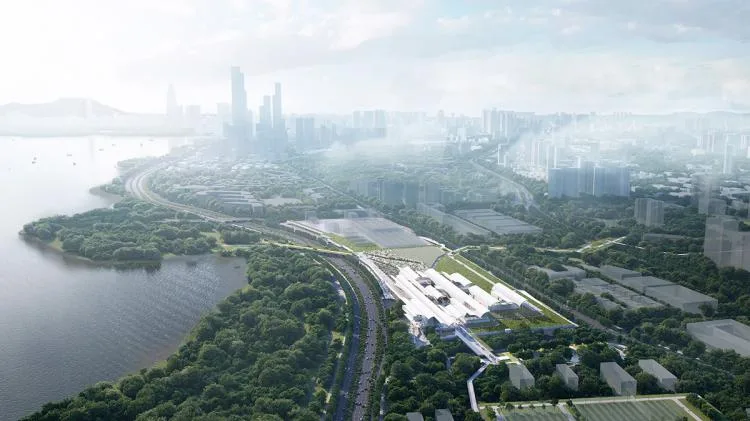
Overall bird’s-eye view rendering © Architectural Firm (TAO)
Recently, TAO Architectural Firm collaborated with AECOM Environmental Planning and Design (Shanghai) Co., Ltd. to participate in the international competition for the Shenzhen Mangrove Wetland Museum project. Among numerous domestic and international design teams, they stood out and won the competition, securing the bid.
△ Project video © TAO Architectural Firm + AECOM
Location
The Shenzhen Mangrove Wetland Museum site is situated atop the Qiaocheng East Depot of Metro Line 9, above closed urban infrastructure. It borders the Futian Water Purification Plant to the east and faces Shenzhen Bay and the Mangrove Wetland Protection Zone to the south. This unique geographical setting, combined with the single urban function of the surrounding area, creates an isolated island.
Its relatively negative urban attributes demand a museum with striking architectural forms and diverse multifunctional spaces to reconnect the fragmented surroundings, invigorate urban life, and serve as a vital node in creating a cohesive green ecosystem and cultural public space within the area.
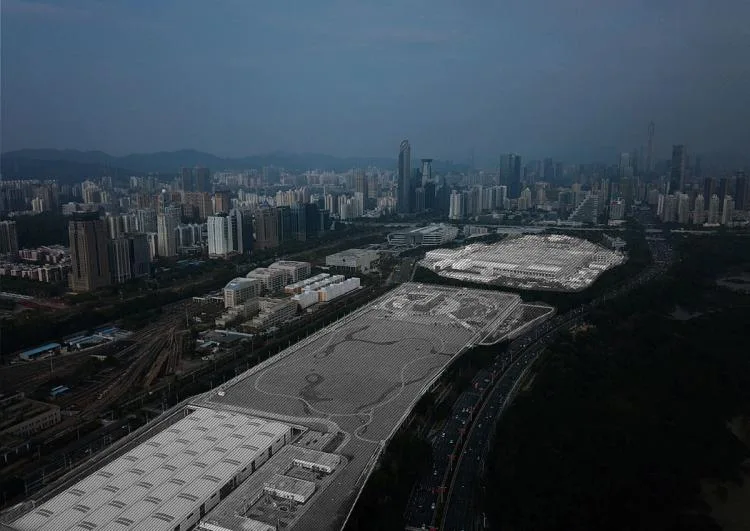
△ Aerial view of the venue © Shenzhen Urban Planning and Design Institute Co., Ltd
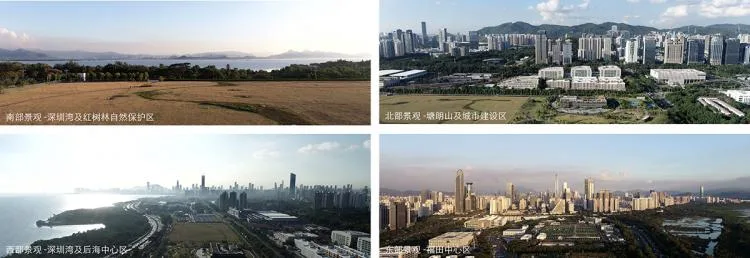
△ Landscape of the venue © Zhang Xuetao
From a broader perspective, the Mangrove Museum sits at the intersection of Futian and Nanshan’s central districts, where the planned east-west Shenzhen Bay Coastal Leisure Belt meets the north-south Shanhai Corridor. This urban center is surrounded by high-rise buildings, offering views of the precious mangrove wetlands and the vast Shenzhen Bay.
The site’s unique position between city and nature provokes reflection on how to balance the coexistence of pristine ecological landscapes with futuristic urban development.
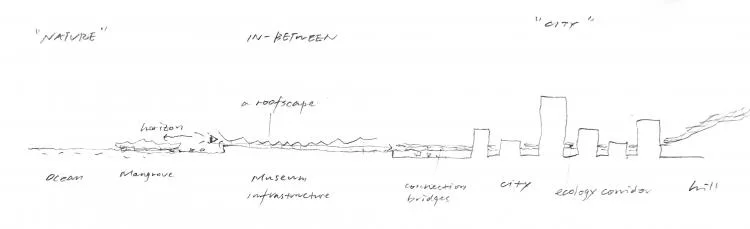
Concept sketch © Huali
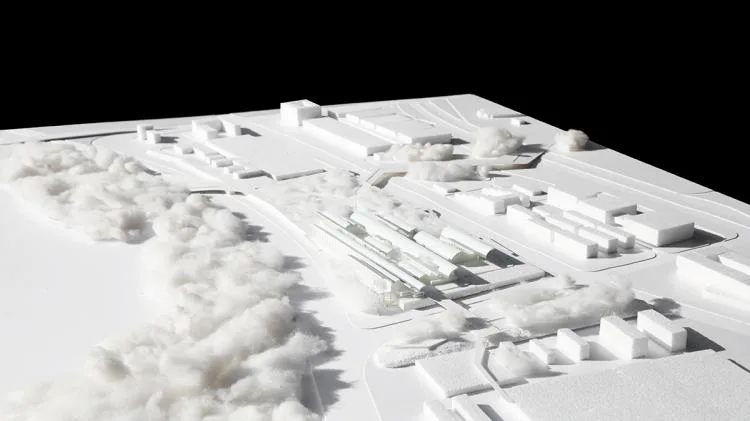
△ 1:1000 handmade model © Architectural Firm (TAO)
Design Concept
Inspired by the natural surroundings, the architectural form draws from the imagery of “flying birds” and “mangroves.” The lightweight structural system and extended roof gracefully rest atop a solid platform, minimizing the building’s impact on the site.
Viewed from afar, the building appears nestled among tall green trees, with only the soaring white roof visible above the treetops, resembling a flock of birds in flight.
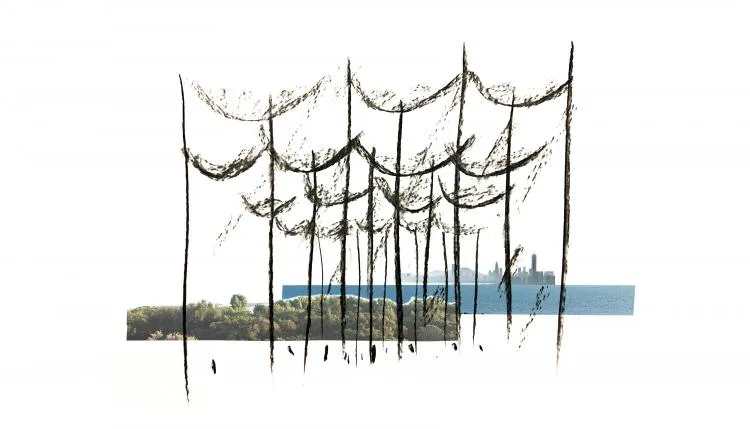
△ Concept collage © Architectural Firm (TAO)
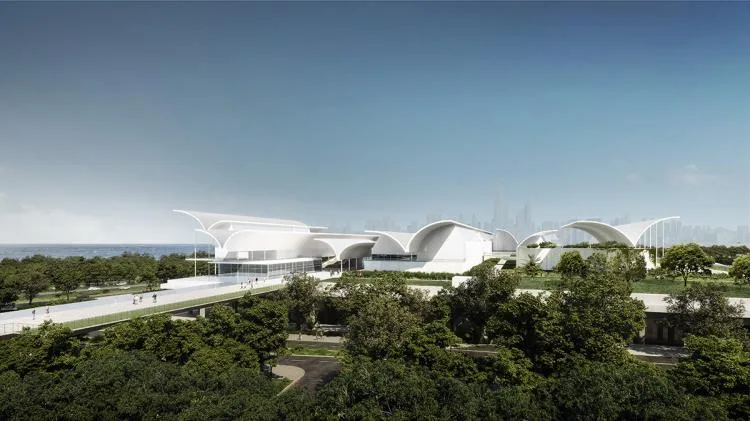
View towards the main building © Architectural Firm (TAO)
The dynamic architectural form transforms the originally rigid subway depot into a fluid, natural structure that stands out along Binhai Avenue, creating a distinctive urban silhouette visible from Nanshan and Futian.
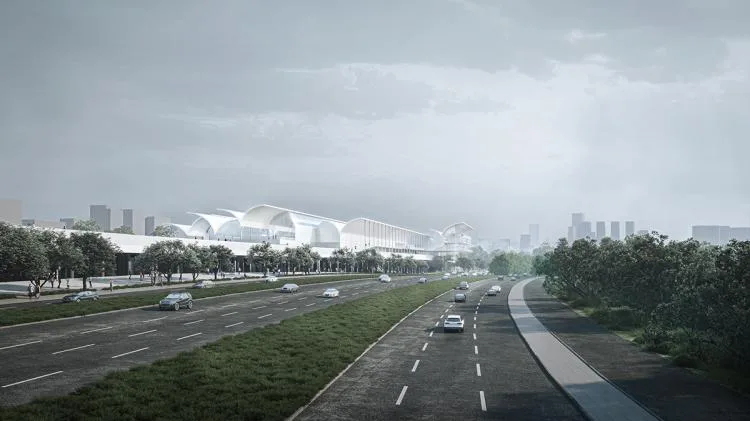
△ Bird’s-eye view rendering © Architectural Firm (TAO)
Spatial Design
The extended semi-arched roof creates shaded, weather-protected outdoor spaces beneath, responding to the local climate and offering comfortable public areas.
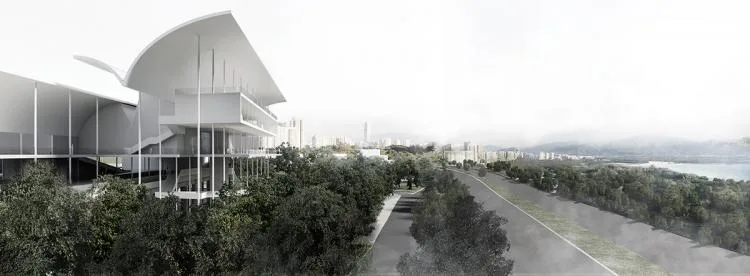
Partial protruding volume of buildings on the southeast side © Architectural Firm (TAO)
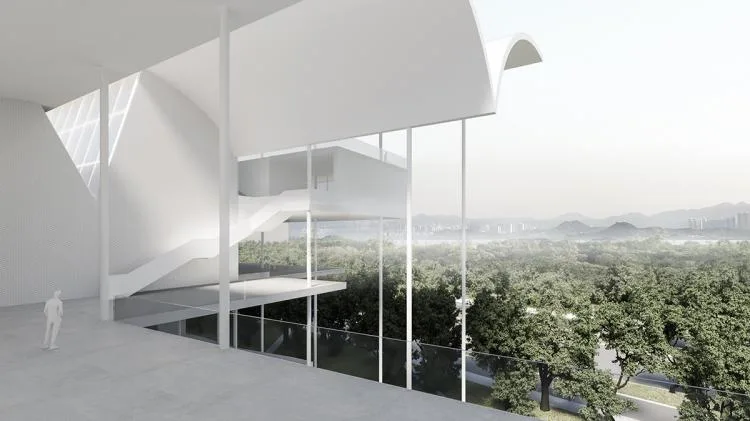
Half outdoor corridor overlooking mangrove nature reserve © Architectural Firm (TAO)
The continuous curved roof varies with different column spans, creating diverse spatial scales and natural lighting effects. Visitors experience a smooth and engaging journey through the space, where curved surfaces soften light and establish a calm, gentle interior atmosphere.
Intelligent, controllable shading systems indoors allow a blend of natural and artificial lighting, accommodating various exhibition needs.
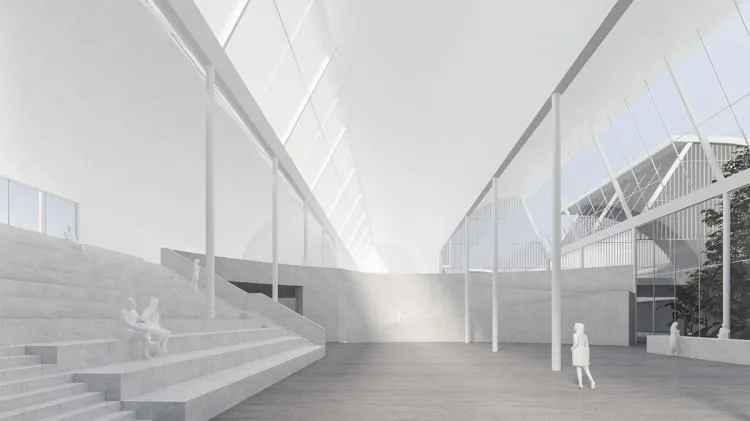
△ Entrance Hall © Architectural Firm (TAO)
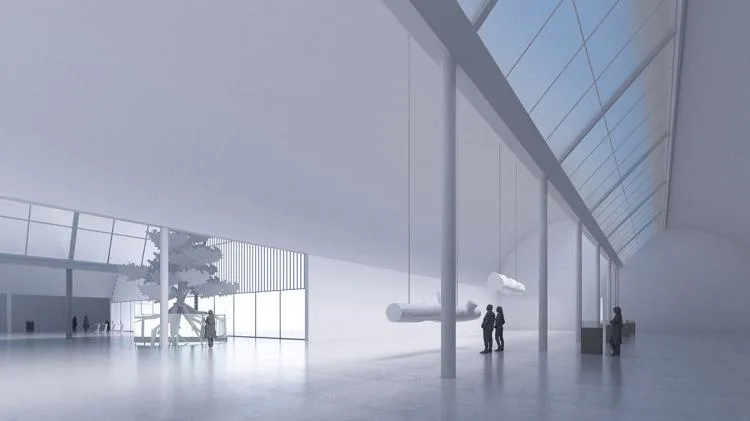
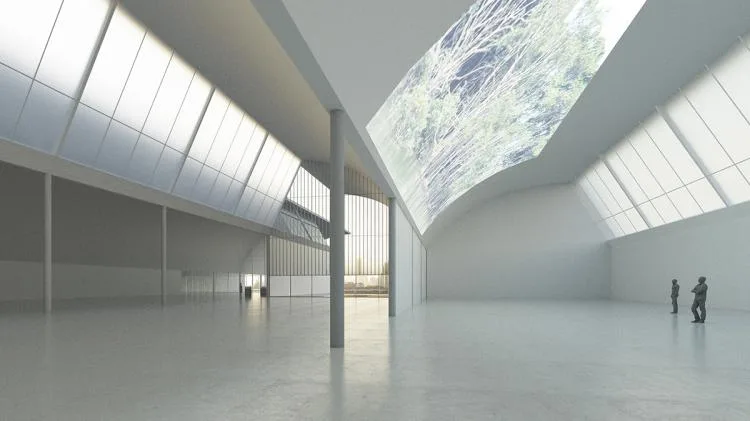
Exhibition Space © Architectural Firm (TAO)
The undulating eaves frame views of nature and the city, integrating the exterior landscapes into the building interior. Walking along this rhythmic “frame,” visitors can enjoy panoramic views of the vibrant city skyline on both sides.
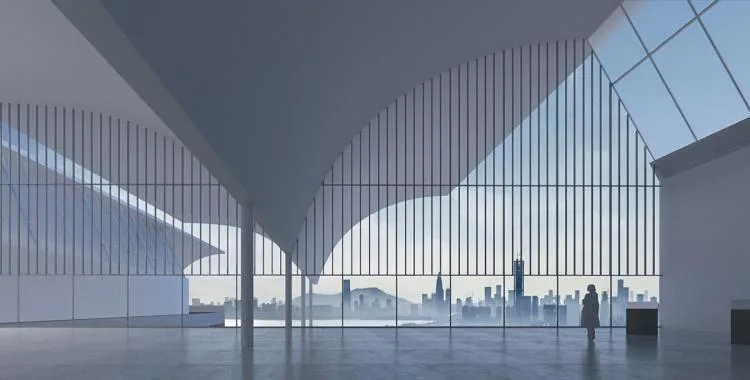
Unique frame scenery of exhibition space © Architectural Firm (TAO)
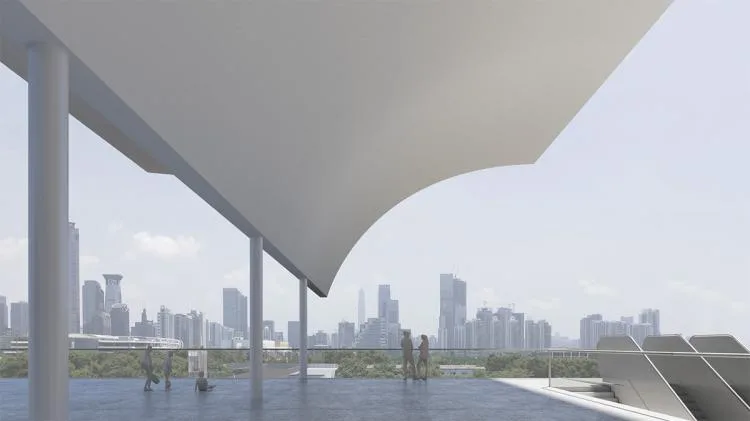
Half outdoor space overlooking the city skyline © Architectural Firm (TAO)
On the seawards side, the building extends to form a semi-outdoor space that broadens horizontally, providing an excellent platform to observe the mangrove wetland park and fostering a harmonious dialogue with nature.
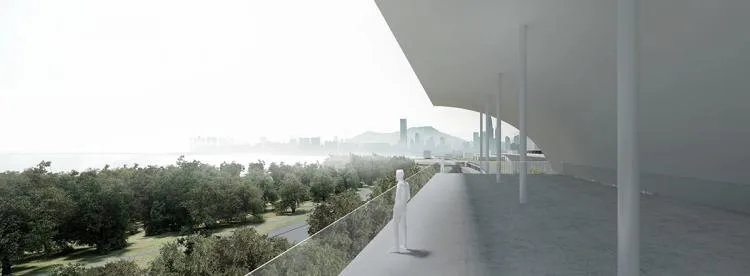
△ Observatory © Architectural Firm (TAO)
Construction
Drawing from traditional Chinese architecture, the design features a solid base rooted into the ground with a roof elevated above, creating a dynamic interplay between mass and lightness.
The first floor houses service areas such as storage and equipment rooms, while exhibition and office spaces occupy the second floor, located between the suspended roof and the solid base, allowing for flexible spatial arrangements.
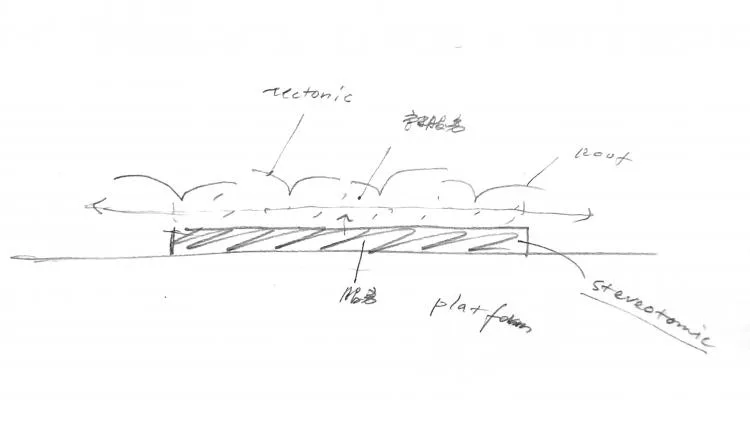
Concept sketch © Huali
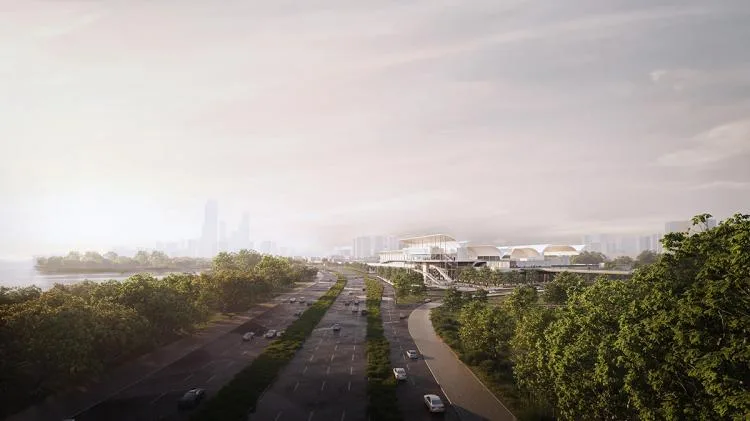
△ Bird’s-eye view rendering © Architectural Firm (TAO)
The building’s facade on the first floor uses prefabricated GRC curtain walls, giving a sense of solidity and a layered stacking effect. The roof is a steel, arc-shaped shell structure, elevated high and finished with light-colored matte ceramic tiles, emphasizing lightness and tectonic clarity.
The steel structural system integrates with the existing urban infrastructure below. The column grid aligns one-to-one with the underlying structure, creating a cohesive and expandable spatial framework.
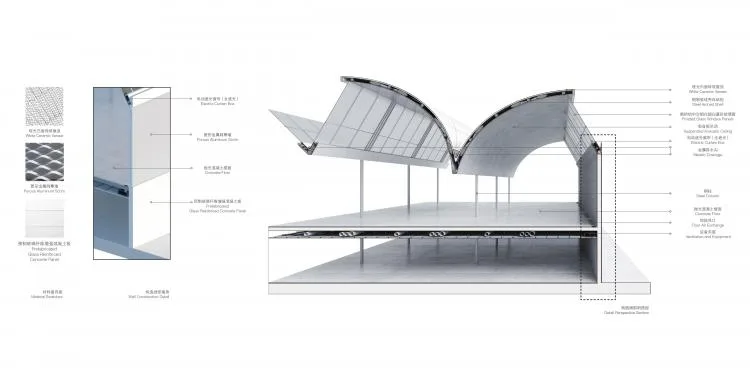
△ Structural analysis diagram © Architectural Firm (TAO)
Within this structure, the floor plan expands modularly, allowing high flexibility and scalability to accommodate future changes in exhibition styles and phased construction or expansions.
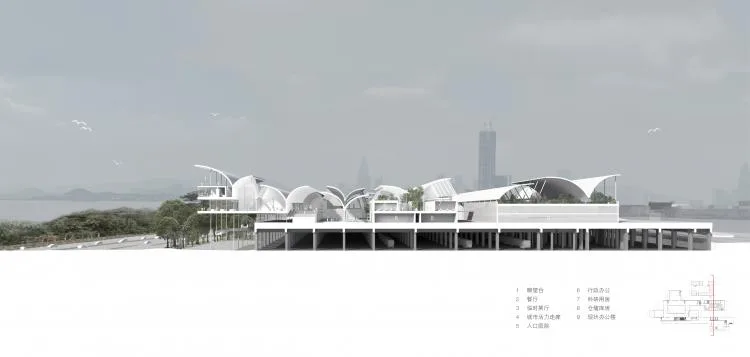
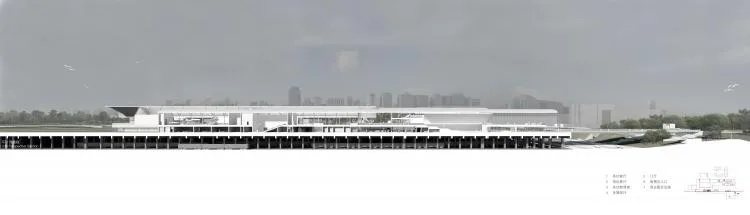
△ Sectional perspective © Architectural Firm (TAO)
Urban Integration
Today’s museums transcend their traditional exhibition roles, serving as multifaceted venues for display, education, leisure, and entertainment. Their urban presence is as important as their commemorative function.
The Mangrove Museum is conceived as a complex micro-city, embodying accessibility, openness, diversity, and integration.
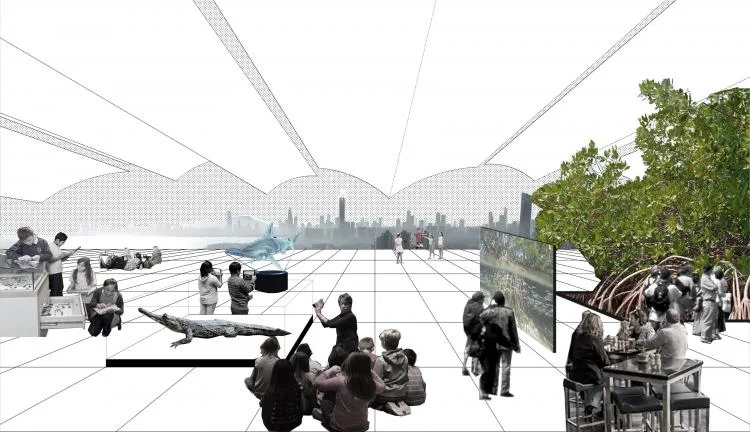
△ Concept collage © Architectural Firm (TAO)
Since the base is elevated on a second-level platform, site redesigns introduce bridges, ramps, and escalators to connect with surrounding plots at varying heights and directions, creating continuous urban nodes.
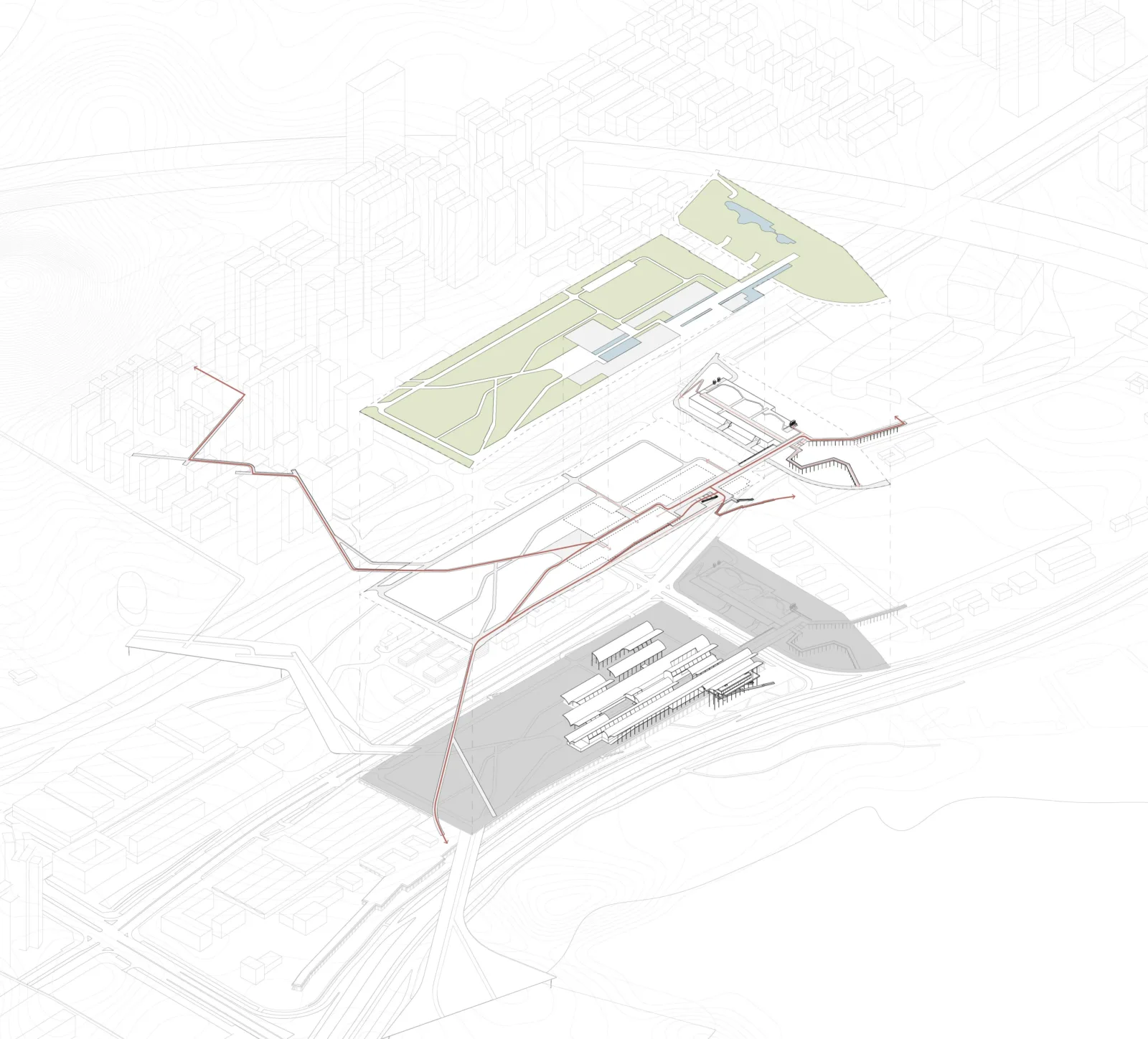
△ Site explosion axonometric diagram © Architectural Firm (TAO)
The design breaks traditional museum boundaries, creating a permeable spatial relationship with the city. Multiple public pathways weave through the building, offering a street-like experience.
Cultural, creative spaces, temporary exhibitions, multimedia areas, and restaurants are decentralized and operate independently, ensuring the museum remains active even when permanent exhibits are closed. This approach transforms a passive urban fringe into a vibrant, sustainable destination.
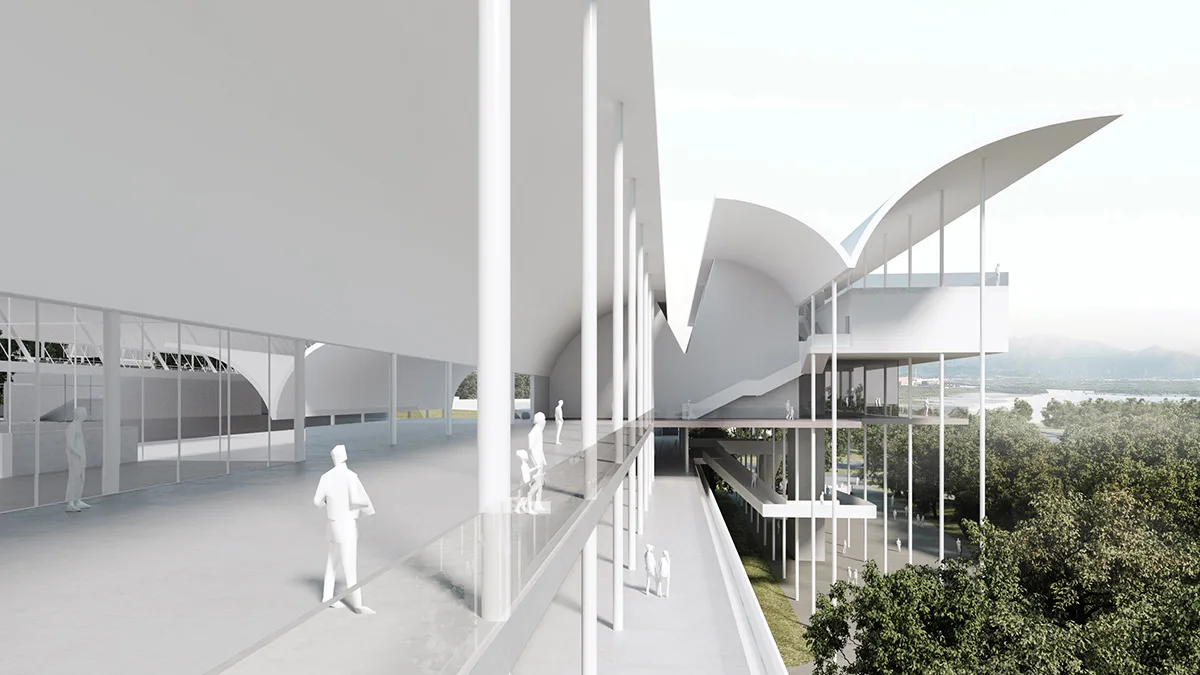
△ Semi outdoor corridor © Architectural Firm (TAO)
Ecology and Landscape
The base lies at the intersection of the urban mountain-sea corridor and Shenzhen Bay. Landscape design respects the platform’s structural conditions while creating diverse ecological patches and habitats.
Serving as a “relay station” for migratory birds, the site facilitates passage, breeding, and shelter of species along the ecological corridor. The design emphasizes biodiversity and incorporates innovative sustainable solutions.
Following the natural transition between land and sea, the base is divided into three zones: the Western Ecological Corridor, Central Urban Ecological Zone, and Eastern Ecological Transition Zone. Each zone undergoes ecological restoration to enhance the site’s ecological value.
This restoration includes infrastructure improvements and leverages migratory bird stations as stepping stones, connecting Zhuzilin mountain corridor with the coastal park belt running north-south.
By merging the “elastic growth” landscape with the “growth style” architectural community, an organic, diverse ecological environment is created, evolving across time.
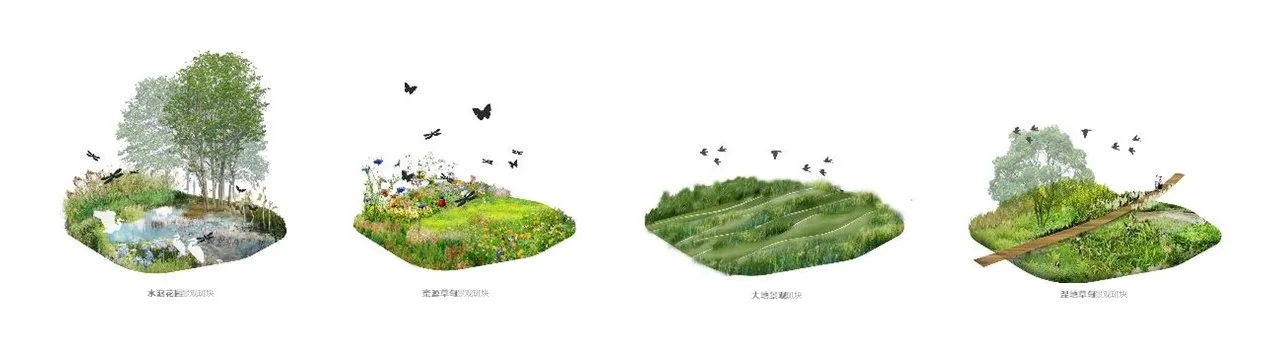
△ Ecological patches © AECOM
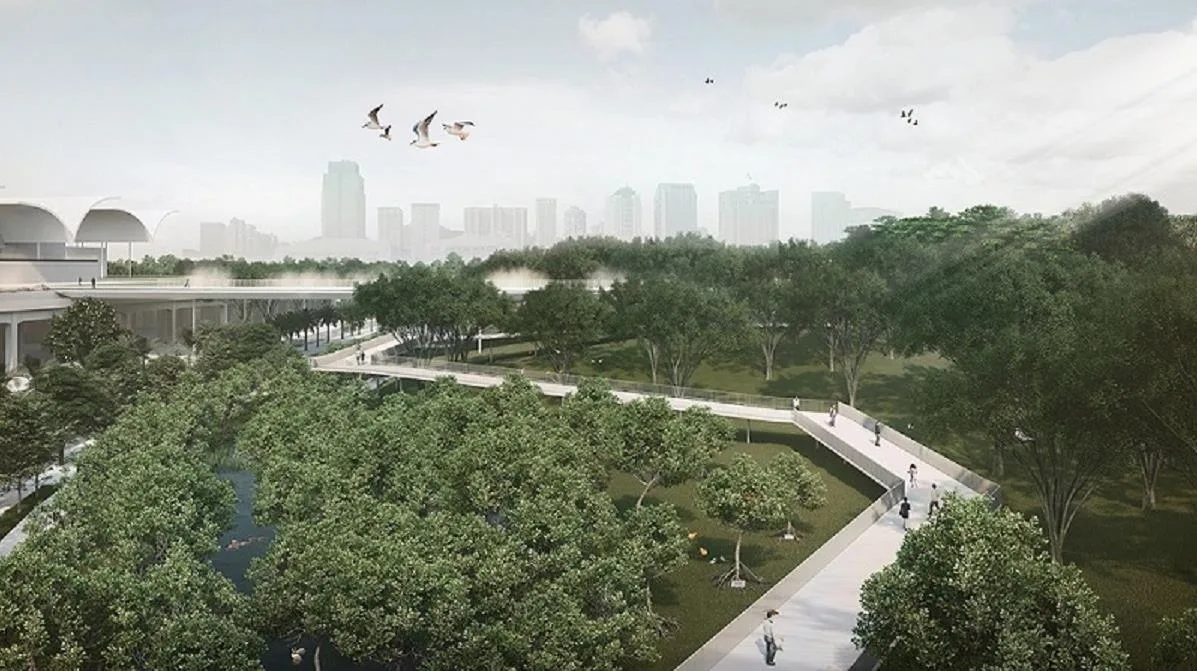
△ Mangrove Display Area © AECOM
The green space west of the Futian Water Purification Plant, adjacent to Futian Mangrove Ecological Park, forms the land-sea junction and serves as the prime outdoor display area for mangrove specimens.
A two-level underground parking garage is planned north of the eastern green space, freeing valuable nearshore green areas. This Eastern Ecological Transition Zone simulates natural mangrove succession—nearshore mangroves, associated species, and secondary mangroves—allowing visitors to learn about Shenzhen’s coastal ecology.

△ Eastern Ecological Transition Green Space Profile © AECOM
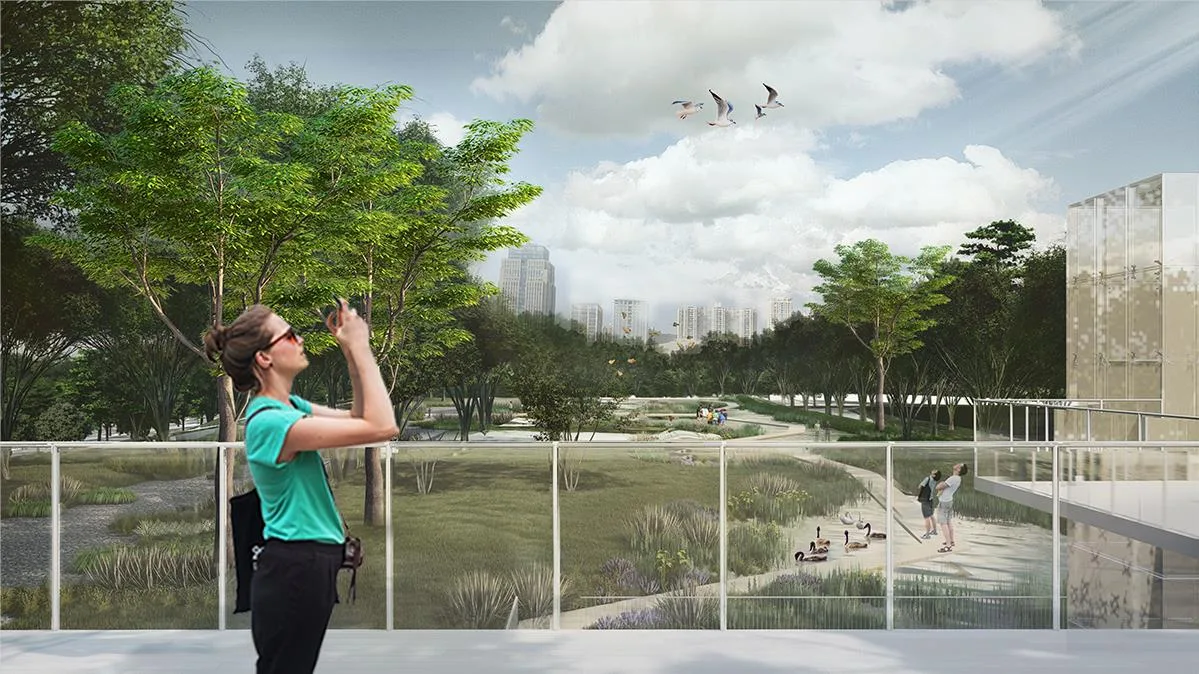
△ Wetland Botanical Garden © AECOM
At the main entrance’s east-west ecological corridor bridge, the design mimics natural waves to symbolize the transition between land and sea, evoking visitors’ connection to the ocean and mangrove habitats.
A dialogue unfolds between coastal reefs and mangrove exhibits within the museum’s exhibition hall.
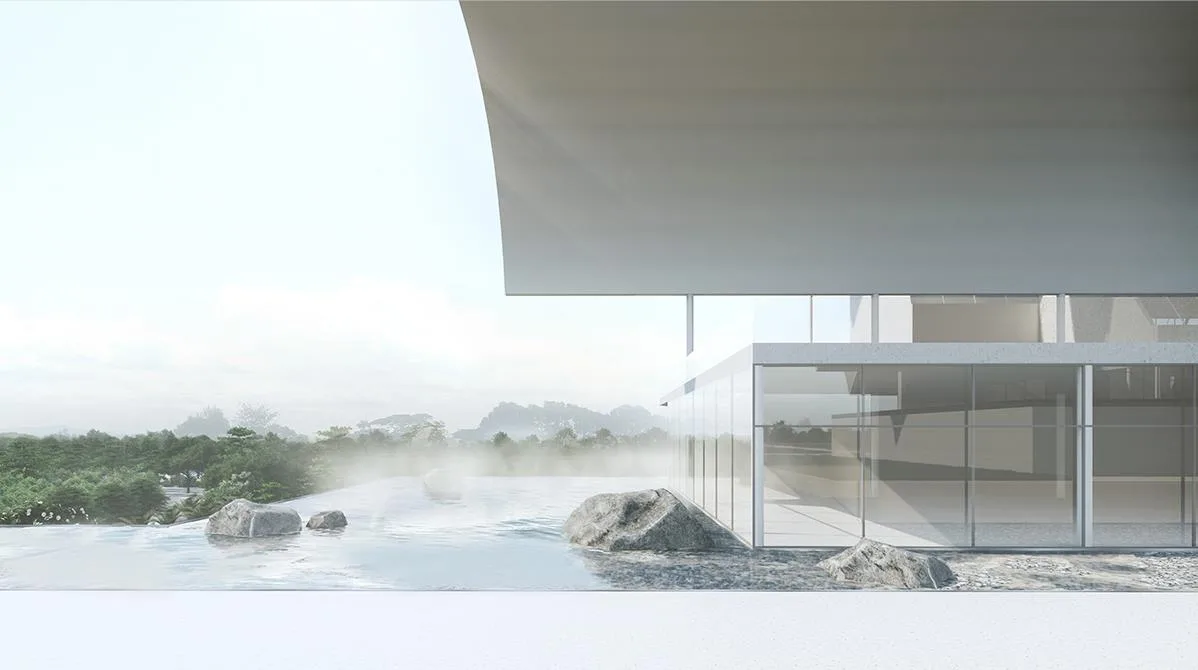
△ East entrance © AECOM
Huahai Park extends the museum outdoors and serves as a vital urban ecological zone. The design reserves lawn areas for outdoor exhibitions and includes features such as water troughs, shelters, and pollination walls to support local wildlife, creating an ecologically rich and diverse landscape evolving over time.
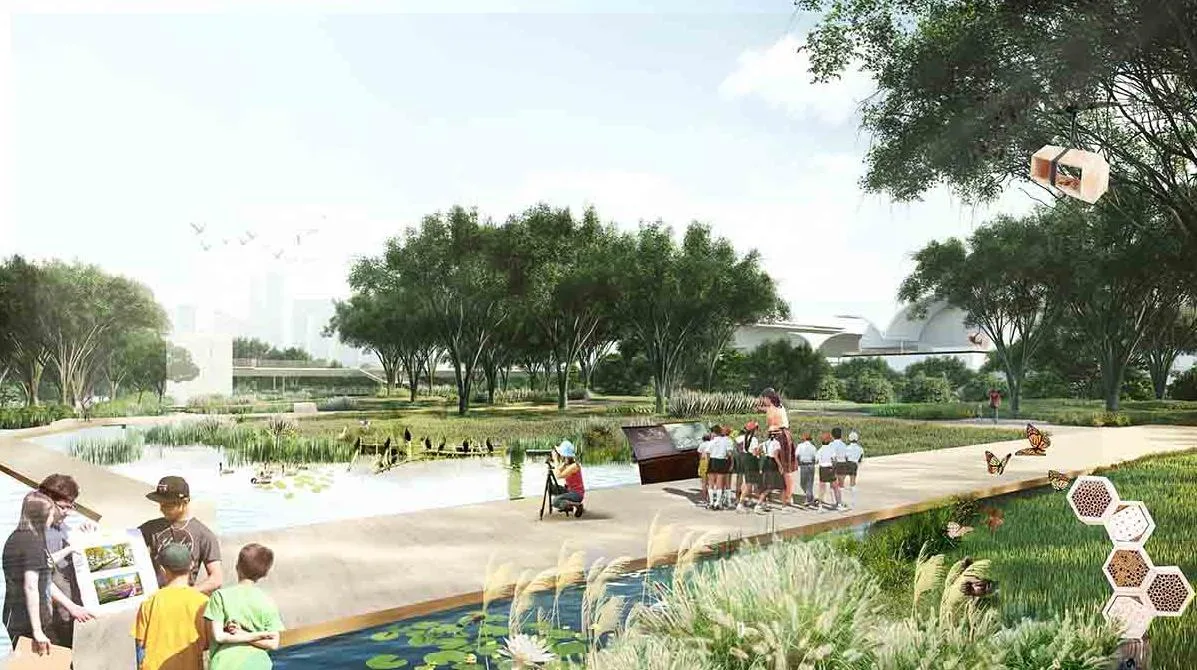
△ Wetland Botanical Garden © AECOM
Returning to the site’s contrast between the bustling Binhai Avenue and the tidal mangrove wetlands, it reflects Shenzhen’s 40 years of rapid growth and its impact on nature. This location embodies both Shenzhen’s past and future and raises important questions about coexistence with nature amid urban development.
In an era of fragmented information consumption, what kind of mangrove museum do we need? We believe that architecture can move beyond reason to inspire, and we look forward to a future where Shenzhen is remembered not only for its towering skylines and vibrant complexes but also for a flock of “flying birds” spreading their wings and a thriving “mangrove forest.”
In this rapidly advancing city, there remains a poetic space for reflection and pause.
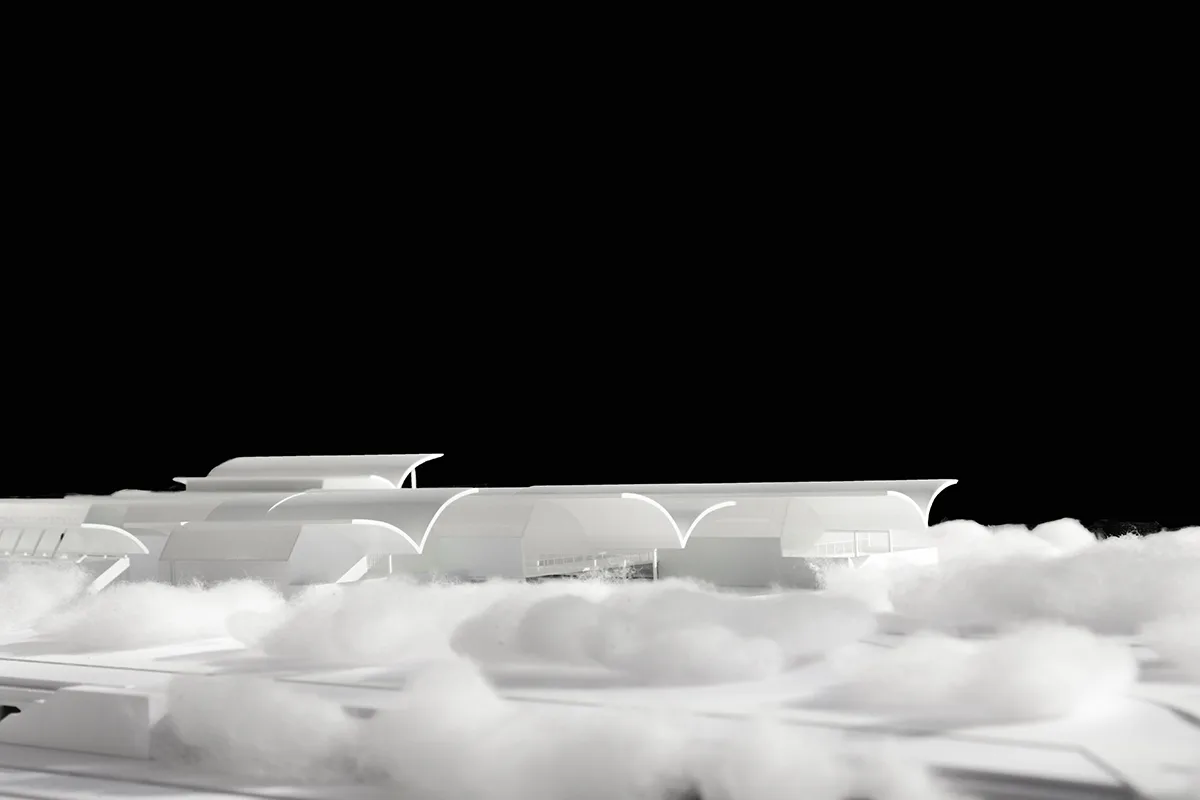
△ 1:1000 handmade model © Architectural Firm (TAO)
Project Information
Project Name: International Competition for Shenzhen Mangrove Wetland Museum Project
Client: Guangdong Neilingding Futian National Nature Reserve Management Bureau
Location: Shenzhen, Guangdong
Function: Museum, educational and public service facilities
Design Team:
Architecture: Architectural Firm (TAO)
Landscape: AECOM Environmental Planning and Design (Shanghai) Co., Ltd.
Lead Architect: Huali
Landscape Architect: Shen Tongsheng
Architectural Firm (TAO) Team: Huali, Xie Yicheng, Liu Yu, Sun Haonan, Wu Jiahui, Li Wenjie, Xu Ting, Leng Xueshuang, Wang Langhuan, Du Jingyi, Xiao Wei, Zhong Sheng, Wei Nan, Gu Yue
Project Coordination: Lv Jianjun, Fan Aifang
Structural Engineer: Ma Zhigang
Structural Consultant: Zhang Zhun
Mechanical and Electrical Consultant: Lv Jianjun and kcain Carlin Electromechanical Team: Sun Jing, Li Xin, Zhao Zirui, Liu Mingwang
AECOM Team Leader: Zhong Bing
Landscape Team: Shen Tongsheng, Yu Shaona, Hu Ruijue, Liang Li, Huang Jiaheng, Hu Mengyu, Ye Qian’an, Fan Fei, Shao Mingzhe, Zhu Qianqian, Liang Jinxia
Strategic Planning: Chen Lifeng
Planning and Transportation Team: Wei Ran, Yue Peng
Ecological Team: Dr. David Gallacher, Cesar Rocha, Tang Xiongfei, Li Luxi, Huang Jingjie
Construction Team: Peng Xiaoming, You Yanxiang, Xiang Ye, Lin Luqian, Gui Bin
Structural Team: Tan Nongchao, Ren Kai
Total Construction Area: 39,500 square meters
Design Period: August 2020 – November 2020
Note: Daoji Architectural Design Firm (Beijing) Co., Ltd., abbreviated as TAO Architectural Firm












Must log in before commenting!
Sign Up