

The Yanchang Petroleum Research Center project is situated at the northeast corner of the Tangyan Road and Keji Eighth Road intersection within Xi’an High-tech Zone. It spans approximately 37 acres, with a total construction area of 217,600 square meters and an investment of 2.239 billion yuan. The tower rises 46 floors above ground, reaching a building height of 195.45 meters and a peak height of 217.3 meters. The podium consists of 5 floors above ground, standing 23.25 meters tall. The basement includes three levels: the first basement (-1F) is 6 meters high, the second (-2F) is 3.7 meters, and the third basement floor reaches 3.9 meters in height.
This project serves as an extension of the petroleum office and research building, incorporating numerous mechanical and electrical installation systems alongside complex pipelines. Electrical engineering comprises power and lighting systems, automatic fire alarm systems, and more. Ventilation and air conditioning works include air conditioning systems, air supply and exhaust systems, as well as smoke control and exhaust systems. Pipeline engineering covers multiple subsystems such as water supply, drainage, wastewater, rainwater, reclaimed water, direct drinking water, sanitary hot water, sprinkler systems, fire hydrants, gas fire extinguishing, air conditioning cooling circulating water, and air conditioning water replenishment. All these systems are integrated into the BIM pipeline comprehensive layout for coordinated planning.
Project Challenges
Coordination Among Multiple Units
This project involves numerous units responsible for BIM implementation, making effective collaboration across multiple teams and disciplines a significant challenge. The engineering operations span various stages—including design, construction, and operation & maintenance—handled by different entities. Therefore, the chosen BIM software must support mature collaborative functions to facilitate seamless integration and manage the entire building lifecycle efficiently.
Complexity of Branch Systems
The project features an extensive range of electromechanical installation systems and intricate pipelines. Electrical engineering includes power, lighting, and automatic fire alarm systems. Ventilation and air conditioning encompass air conditioning, air supply, exhaust, and smoke control systems. Pipeline engineering covers subsystems such as water supply, drainage, wastewater, rainwater, reclaimed water, direct drinking water, sanitary hot water, sprinkler systems, fire hydrants, gas fire extinguishing, air conditioning cooling circulating water, and makeup water. Managing this complexity requires detailed coordination and precision.
Project Application
Applying BIM Technology in the Deepening Phase
Given the numerous subsystems and the complexity of the mechanical and electrical installations, combined with the project’s unique structural design, mechanical and electrical pipelines often need to penetrate the thickest parts of structural walls or beam columns—sometimes extending up to 1000mm. Additionally, the project team aims to meet the Luban Award quality standards, which demand higher precision in BIM deepening design. After thorough analysis, the key challenges in BIM deepening design for mechanical and electrical installations are as follows:
- Critical Areas: These include various air conditioning rooms, water pump rooms, pipeline shafts, electrical shafts, and core tube public corridors, as well as functional zones where mechanical and electrical pipelines are concentrated, such as equipment floors 3 to 1, 12, 27, and 42.
- Key Tasks: These involve the comprehensive layout of mechanical and electrical pipelines, detection of errors, omissions, collisions, and defects, preparation of reserved hole diagrams during pre-embedding, precise positioning of specialized equipment, and determining support structures.
- Construction Simulations: Simulation of critical processes including the hoisting of large-scale equipment, installation of large-diameter pipelines, and laying of ultra-long cables.
- Operational Condition Simulations: Verification of system functionalities such as hydraulic balance and the most unfavorable loop conditions at the ends of ventilation and air conditioning systems.
Preliminary Comprehensive Layout
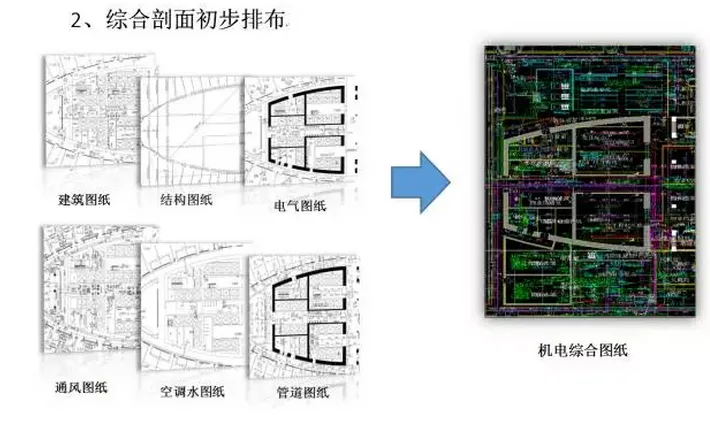
Collision Detection of Electromechanical Pipelines
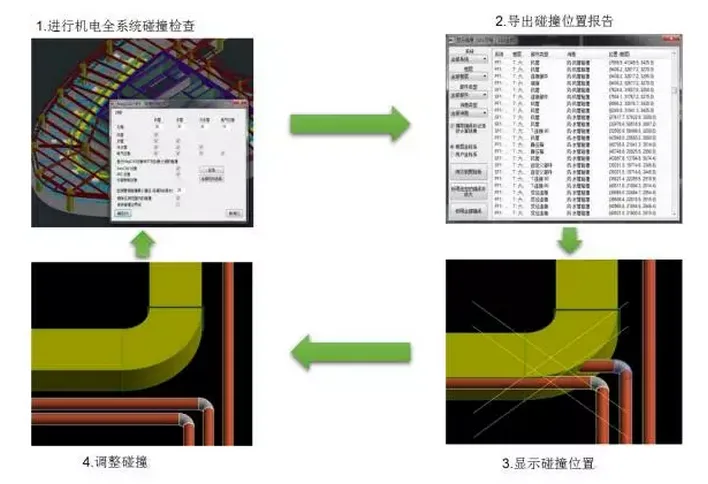
Using the design drawings as a base, three-dimensional models were developed with MagiCAD software for water supply and drainage, fire protection, electrical, and HVAC systems. Each specialty created their respective models using a shared grid coordinate system. Multi-disciplinary collision detection was performed to ensure accuracy and completeness in the construction deepening design.













Must log in before commenting!
Sign Up