
Project Overview
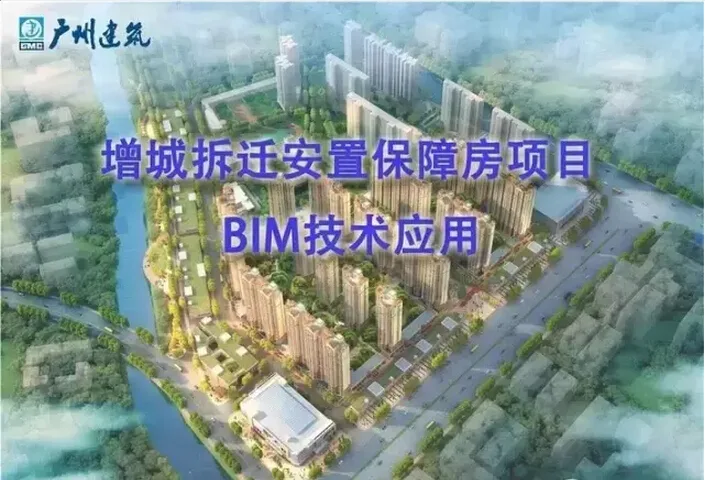
The total construction area covers 540,000 square meters, with a floor area of 160,000 square meters.
The development includes 29 high-rise residential buildings: 17 buildings with 28 floors, 8 buildings with 29 floors, and 4 buildings with 31 floors. Additionally, there are two 5-story centralized commercial buildings, 10 street shops (one 3-story and nine 2-story buildings), a 5-story elementary school, and a 3-story kindergarten.
The structures utilize a frame shear wall design.
Key Participants:
- Construction Unit: Zengcheng Xintang Industrial Processing Zone Development Corporation
- Design Unit: Guangzhou Construction Engineering Design Institute Co., Ltd
- Supervision Unit: Guangzhou Construction Engineering Supervision Co., Ltd
- General Contractor: Guangzhou Construction Co., Ltd
- BIM Team: Guangzhou First Construction Engineering Co., Ltd
The estimated total investment is 2.57 billion yuan, with a planned construction period from October 13, 2013, to July 6, 2016, spanning 997 calendar days.
Project Background
This EPC project required extensive preliminary design and product selection efforts due to its scale and complexity.
Key construction metrics include the excavation and transportation of 770,000 cubic meters of soil, approximately 32,500 tons of steel bars, and about 250,000 tons of concrete. The structural construction phase lasts roughly 230 days, averaging 141.3 tons of steel bar processing and 1,087 tons of concrete pouring daily.
Site layout and road coordination posed significant challenges due to compact process overlaps.
The large site accommodates numerous construction machines, including 13 tower cranes, 19 construction elevators, and 7 material hoists, making machinery management a demanding task.
Several high-rise buildings feature numerous external grills with both cantilever and floor-standing structures.
There are multiple zones with ultra-high formwork: five in the South Shopping Mall, four in the North Shopping Mall, one in the Ancestral Hall, six in the Primary School, and various pillars and caps in the basement civil air defense area. The tallest formwork reaches 21.6 meters.
The project adopts a BIM application model based on overall planning by the general contractor, with collaboration among various specialized construction units. The BIM team of the general contractor manages the entire platform from setup through application, with active cooperation from departments and subcontractors onsite.
Innovations and Highlights
1. Quality and Safety Management
This includes two main components: quality and safety inspection records and interfaces for quality and safety monitoring.
(1) Inspection records are created by establishing inspection points in the BIM model and completing daily inspection forms.
(2) The monitoring interface integrates third-party testing results directly into the platform.
Daily inspections include textual descriptions, inspected units, model-based markings (specific sections or floors), photo uploads, SMS notifications, and assignment of handlers and verifiers.
A closed-loop issue resolution process is implemented: the Quality and Safety Department inspects and reports issues, assigns responsible personnel with SMS alerts; the assigned party addresses the issue and uploads evidence; the verifier confirms resolution and approves closure.
The project dashboard automatically summarizes daily inspection records, categorized into pending submission, pending processing, and approved. Users can click each category to view detailed inspection information.
2. Material Testing Monitoring
The BIM collaboration platform automatically imports material testing results twice daily from the Suijian quality inspection system. Project managers can access detailed inspection reports anytime via the platform’s “View Report” feature.
3. Excavation Monitoring and Management
Based on the project’s foundation pit monitoring layout, each monitoring point’s type, alarm values, and absolute limits are set within the BIM model.
Third-party monitoring data is imported as Excel files, with the platform automatically analyzing and interpreting the results for each point.
Users can query data by monitoring type or date range, providing clear insight for relevant managers into foundation pit conditions.
4. 5D Simulation
5D simulation enables project managers to visualize site layout, heavy equipment, and key construction milestones in advance. It forecasts required funding, materials, and labor on a monthly and weekly basis, helping identify and address potential issues early for process optimization.
Social Benefits
Implementing BIM technology and the integrated platform delivers efficient and streamlined project management, standardizing construction workflows and boosting management efficiency.
This approach reduces management costs by 20% and elevates construction management through close integration with digital information systems.
It enables unified data management across all project stakeholders, real-time data transmission, automatic data summarization, and coordinated collaboration, fulfilling core project control and management goals.
The platform fosters accumulation of management experience and data, transforming traditional rough management into refined, benefit-driven practices.
Economic Benefits
By reducing communication and coordination time by over 20%, and minimizing errors, omissions, and clashes by more than 50%, the project realizes cost savings exceeding 5%.
Successful demonstration of BIM applications encourages adoption in other company projects, significantly cutting project and management expenses.
Moreover, the BIM platform facilitates seamless data transfer across project phases, supporting rapid decision-making and effective construction guidance. This shortens project timelines, lowers management costs, and enables owners to commence operations sooner, creating additional indirect economic value.












Must log in before commenting!
Sign Up