
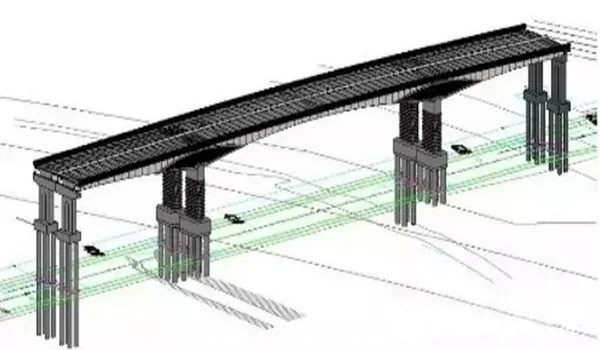
Recently, the BIM working group on the Daijiashan Bridge project has made significant progress by completing the preliminary modeling of the main bridge, the south approach bridge, and the steel wharf. They have also initiated construction simulation efforts for the project.
To further enhance cost control and scientific management in engineering construction, and to achieve new breakthroughs in 3D technology-driven building processes, the Sixth Branch of the Second Aviation Administration partnered with Wuhan Tianwei. Together, they formed a professional software development team and collaborated with the Technology Center to integrate BIM systems into the project’s information infrastructure. Currently, the Wuhan Daijiashan Bridge project leads the way in BIM modeling, showcasing the bridge’s construction process through detailed 3D models.
The system provides a clear and realistic depiction of key components such as the pile foundations, pier columns, and box girder construction of the main bridge. Additionally, the prefabricated beams of the south approach bridge are being simulated in sync with construction progress. The comprehensive model of the entire project will be completed in subsequent stages.
Technicians explain that the system converts traditional 2D drawings into multidimensional, fully simulated models based on design plans and construction schedules. This allows builders to optimize cost control, reduce construction time reasonably, and maintain high project quality through virtual construction simulations—resulting in a win-win scenario for safety, quality, and efficiency.
Given the broad range of BIM applications, fully implementing the system is both time-consuming and labor-intensive, with uncertain outcomes at various stages. Currently, the team is focusing on two main applications:
First, the BIM system is used to optimize construction plans through simulation. While traditional planning is often limited to “paper-based discussions,” BIM-driven simulated construction acts as a “practical rehearsal.” This approach verifies the reasonableness of temporary setups, process sequencing, and identifies potential conflicts in overlapping construction activities. By repeatedly refining the plan through simulation, a construction strategy that best fits real-world needs can be developed, saving costs and improving efficiency.
Second, the system supports effective cost control and management by modeling based on the bill of quantities. Initially, this involves verifying that the drawings align with the bill of quantities and checking for design errors. For example, a drilled pile with a 2-meter diameter and a design length of 20 meters should correspond to a concrete volume of 251.2 cubic meters. If the BIM model shows the pile is shorter than 20 meters, it provides an accurate assessment of the actual design quantity. This modeling also facilitates daily measurement tasks, helping reduce costs and enhance efficiency.














Must log in before commenting!
Sign Up