
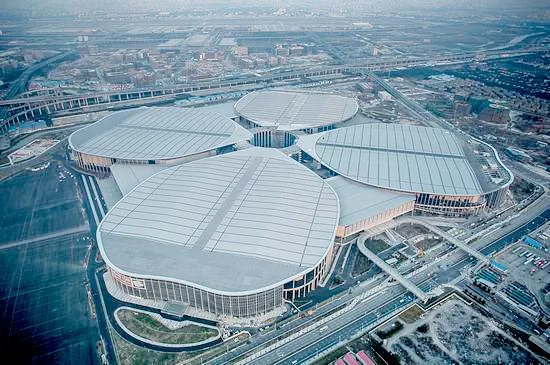
Project Overview:
The China Expo Convention and Exhibition Complex is strategically located in the western core area of the Hongqiao Business District, just 1.5 kilometers from the Hongqiao Transportation Hub. It is seamlessly connected to the Hongqiao High-Speed Railway Station and Hongqiao Airport via subway. The surrounding expressway network links this site to major cities in the Yangtze River Delta within two hours, ensuring excellent transportation accessibility.
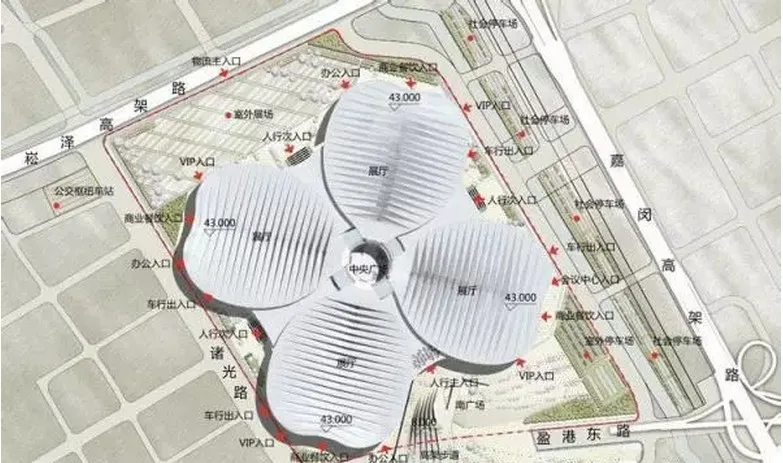
Location Map of the National Exhibition Center
The complex offers an indoor exhibition area of 400,000 square meters and an outdoor exhibition area of 100,000 square meters. With a total building area of 1.47 million square meters, it stands as the world’s largest exhibition complex and pioneers the “column-free” design for large-scale exhibition halls.
There are 13 large exhibition halls, each covering 28,800 square meters, and 3 smaller halls arranged across 4 exhibition areas. The smaller halls total nearly 10,000 square meters. Collectively, the 13 halls cover an area equivalent to 52 football fields.
Viewed from above, the Shanghai National Convention and Exhibition Center’s architecture resembles a four-leaf clover, an elegant and symbolic design. According to the installation lead from China Construction Engineering Corporation, the complex is divided into four main sections labeled A, B, C, and D, with each “leaf” representing an exhibition hall.
The general contracting is split into two parts. Shanghai Construction Engineering Group is responsible for the first part, covering approximately 870,000 square meters. This includes exhibition halls A, B, and D; AO and BO office buildings; E1 and E2 commercial centers; and small exhibition halls F1 and F3. Simply put, this company manages three leaves and the clover’s core, representing about 75% of the project. The general contracting scope consists of two areas: self-managed construction — including civil works, steel structure fabrication and installation, HVAC, electrical, plumbing, and natural gas systems — and subcontracted works such as curtain walls, roofing, elevators, fire protection, exterior landscaping, and interior finishes.
Construction Partners: The National Convention and Exhibition Center is a joint project between the Ministry of Commerce and the Shanghai Municipal Government, with China Construction Installation Engineering Co., Ltd. (“China Construction Installation”) and Shanghai Construction Engineering Group as the primary contractors.
Construction Timeline: Groundbreaking occurred on February 28, 2013, with drawings received by March 15, 2013. The entire construction was completed in just 15 months.
By December 2014, the main entrance was finished, featuring 24 large steel and glass-aluminum canopies that mimic the four-leaf clover shape, shining brightly as a landmark.
This “giant” exhibition center, located in the Hongqiao area, divides its indoor space among halls A, B, C, and D. It takes only about 10 minutes to walk from Hall C to the opposite Hall A via the central Exhibition Avenue. A dedicated truck route further facilitates efficient internal logistics.
The Symbolism Behind the Four-Leaf Clover Design
In Western culture, the four-leaf clover is an ancient symbol of luck, happiness, and magic. Legend has it that Eve brought the four-leaf clover from the Garden of Eden. Normally, clovers have three leaves, making the rare four-leaf variant a symbol of good fortune and divine blessing.
The four-leaf clover design is not only symbolic but also represents the project’s ambitious scale. Upon completion, the National Convention and Exhibition Center became the world’s largest exhibition hall and one of the most competitive complexes globally. Shanghai Construction Engineering Group’s thousands of workers overcame tight schedules, challenging weather, and complex surroundings, completing the project at “maximum speed” and leaving a remarkable legacy on the “four-leaf clover.”
Unveiling the Construction Challenges and Achievements
1. Massive Construction Scale: The project includes 13 exhibition halls, each roughly the size of four football fields. Structural steel roofing covers 260,000 square meters, curtain walls span 170,000 square meters, and the facility includes 47 substations (10,000 volts), 407 motor rooms, 295 air conditioning rooms, and 268 elevators. Excavation involved approximately 930,000 cubic meters of earthwork, 500,000 cubic meters of concrete, 140,000 tons of steel reinforcement, and nearly 90,000 tons of steel components. The curtain wall covers 327,000 square meters, and the metal roof spans 340,000 square meters—an immense construction effort.
2. Extremely Tight Schedule: Though the planned construction period was 655 calendar days, buildings A and B were operational by June 30, 2014. From site entry on February 28, 2013, to drawing receipt on March 15, 2013, the actual building period was only 15 months—about 40% of a typical schedule. As Mei Xinwen, Executive Vice General Manager, described, it was the “maximum” construction speed.
3. Complex Construction Coordination: Situated in Xujing, Qingpu District, west of Hongqiao Transportation Hub, the site features Metro Line 2 running east-west beneath it. The small exhibition hall F3 and commercial centers E1 and E2 are built above the subway, requiring uninterrupted metro operation and smooth traffic during construction. The complex interfaces between steel structures, curtain walls, roofing, MEP installations, and interior finishes required intricate, multi-disciplinary coordination.
4. High Quality Standards: The project aimed to win prestigious awards such as the Shanghai “Magnolia Award,” the “Luban Award,” and the “China Three Star Green Building Design and Evaluation Labels.” At the same time, the team prioritized zero major equipment failures or injuries, targeting a city-level safety demonstration and civilized construction site.
Construction Milestones: The project completed 930,000 cubic meters of excavation, over 500,000 cubic meters of concrete pouring and compaction, 90,000 tons of steel structure fabrication and installation, 60,000 tons of steel pipe formwork installation, fully completed civil and steel structure works, and 80% of mechanical and electrical installations.
Innovative Solutions Under Extreme Conditions
During an unprecedented heat wave starting August 11, 2013, with temperatures exceeding 39°C and site temperatures soaring above 60°C under direct sunlight, the project team adopted a “reverse schedule” to maintain productivity. Instead of traditional sunrise-to-sunset shifts, workers began at 4:00 a.m., paused during the hottest hours from 8:00 a.m. to 4:00 p.m., and resumed work until 7:00 p.m. This approach enabled completion of 16-meter-high scaffolding around the nearly one million square meter building within two months.
BIM Technology Enhances Project Precision
The complex’s diverse structural and engineering elements required detailed coordination. To manage this, the general contracting team implemented Building Information Modeling (BIM) technology. A dedicated BIM studio created detailed models of the main structure and integrated models from various specialties. This process identified hard clashes (blocking conflicts) and soft clashes (close proximities restricting operations), allowing the team to resolve conflicts early, avoid rework, and improve construction efficiency.
Building Above the Subway: Precision and Care
The “flower core” of the four-leaf clover is the circular E1 commercial center, covering 110,000 square meters. It features an underground concrete frame and seven above-ground steel structures, primarily built by the Second Construction Group.
The foundation pit spans approximately 20,000 square meters, with excavation depths reaching up to 11 meters near the metro station. The pit encircles the Xujingdong Station of Metro Line 2 and is divided into two independent sections by the subway. To ensure uninterrupted metro operation and scheduled progress, the project adopted “small steps and fast progress” excavation tactics, controlling excavation volumes and promptly completing concrete pours. The strategy prioritized phases: south before north, large before small, and inside before outside.
Before excavation, the project held comprehensive technical briefings covering construction technology, coordination, safety, and site management, clearly defining responsibilities. Excavation units adhered to strict requirements on slope gradients, depths, excavation methods, and coordinated closely with support and reinforcement installation to maintain workflow and safety.
The two foundation pits required a combined 50,000 cubic meters of earthwork, 5,000 tons of steel reinforcement binding, and over 7,000 cubic meters of concrete pouring, all completed continuously within tight timelines (20 days for the large pit, 15 days for the small pit).
“Borrowing the Sky, Not the Earth”: The Aerial “Spaceship”
The mechanical and electrical installation, contracted to Shanghai Construction Engineering Installation Group, faced tight schedules, high standards, and complex functionalities. Using BIM-driven model construction, the team optimized the design and layout of MEP pipelines in trusses and main machine rooms. Factory prefabrication of components accelerated installation, commissioning, and acceptance processes.
One innovative technique, nicknamed the “spaceship,” is a 6-meter-wide, 108-meter-long steel truss platform suspended by cables. This platform moves horizontally and vertically, enabling efficient installation of air ducts and other systems. A single-track hand-operated crane, combined with an electric hoist and suspended basket, facilitates lifting and positioning. By utilizing H-shaped steel purlins as tracks, technicians enhanced maneuverability and installation precision.
Unique Features and Technologies of the Exhibition Center
The Exhibition Avenue, elevated at 8 meters, connects exhibition halls, commercial centers, offices, and hotels, allowing visitors to move easily throughout the complex. A trip from Hall C through the central commercial zone to Hall A takes about 10 minutes. The center also includes a dedicated truck route, allowing vehicles to access upper-level exhibition halls via a ramp.
Additionally, the center employs cutting-edge technologies such as high-rise air supply systems, elevated work platforms for MEP installation, and fire isolation zones, making it a state-of-the-art venue.












Must log in before commenting!
Sign Up