

With the rapid advancement of computer science and technology, the development and application of CAD have revolutionized traditional design and production methods. Architects and engineers have shifted from manual drafting to electronic drawing, significantly shortening design cycles and enhancing design quality. This transition marks the first major revolution in construction engineering. More recently, Building Information Modeling (BIM) technology has emerged as a new digital innovation, representing a second transformative shift by enabling the move from 2D drawings to 3D models.
As an emerging scientific technology, BIM is elevating information technology in the construction industry to new heights. Its broad and comprehensive application promises profound impacts, offering substantial benefits to construction development and greatly improving project quality and efficiency. Although BIM adoption in China is still in its early stages, it is steadily gaining traction across various construction sectors. Globally, BIM has become a mainstream concept and technology in the construction industry.
This article explores the use of BIM software to create structural and comprehensive mechanical and electrical pipeline models for the Yanxiang Hotel renovation and expansion project. Through simulation analysis, it performs clash detection for mechanical and electrical pipelines. By combining theory with practice, the article provides a comprehensive analysis of experimental results and lays the groundwork for BIM’s application in the project’s later stages.
1. Development and Application of Building Information Modeling
1.1 Concept of Building Information Modeling
Building Information Modeling (BIM) refers to the computable representation of the physical and functional characteristics of building facilities, along with project lifecycle information, based on open industry standards. It is an engineering data model integrating various construction-related information through a common standard, the Industry Foundation Classes (IFC). BIM provides a digital, parametric representation of engineering project attributes, delivering reliable, real-time data that supports designers and engineers in collaborative work.
1.2 Development Background of Building Information Modeling
Traditional computer-aided design primarily relies on 2D software like AutoCAD. However, this approach merely digitizes manual drawing processes to enhance efficiency and accuracy without fundamentally reducing designers’ workload. While 3D design software such as 3ds Max allows the creation of renderings, these models lack integration with material, texture, and construction data and serve only for visualization purposes.
Additionally, traditional design tools struggle to maintain consistency between plans, elevations, sections, and 3D models. Changes in one drawing do not automatically update others, often resulting in conflicting information.
These challenges highlight the limitations of current CAD methods and underscore the need for new technologies. BIM addresses these issues by representing the entire building within a 3D electronic environment enriched with detailed practical information, including materials, specifications, dimensions, and construction data, effectively digitizing the complete building.
1.3 Application of Building Information Modeling in Mechanical and Electrical Engineering
In mechanical and electrical engineering construction, BIM supports clash detection, construction simulation, and quantity estimation, guiding on-site work to save materials, control costs, accelerate progress, and ensure schedules.
A key feature of BIM is the creation of a 3D digital information model that enables comprehensive clash checks among building structures and mechanical and electrical pipelines during design refinement. Highlighting conflicts allows construction teams to detect issues early and optimize pipeline layouts, preventing costly rework and delays.
Moreover, BIM facilitates simulation of construction management, optimizing materials stacking, equipment placement, workflows, and resource allocation. For complex areas, precise simulations reduce waste and rework caused by inefficient sequences or plans.
Because BIM models embed detailed specifications and dimensions, they enable accurate measurement and budgeting of materials and prefabricated components, minimizing errors and improving efficiency.
Application of BIM Technology in Yanxiang Hotel Renovation and Expansion Project

To reduce rework and enhance labor productivity in mechanical and electrical installations, BIM technology was first applied in constructing the model room for this project. Leading BIM software includes Autodesk Revit, Bentley Revit, Progman’s MagiCAD, and Graphisoft’s ArchiCAD. We selected Autodesk Revit for modeling, creating the main structural model with Revit Architecture and designing the mechanical and electrical pipeline layout with Revit MEP. Simulation analysis was performed to conduct comprehensive clash detection, simple construction simulations, and material estimation based on actual engineering conditions. This approach verified the technology’s feasibility and effectiveness through practical application.
Project Overview
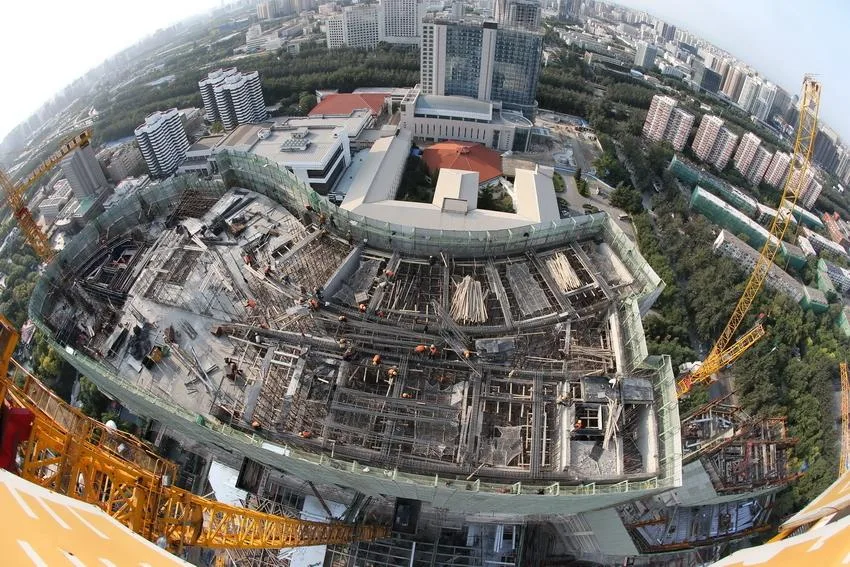
The Yanxiang Hotel renovation and expansion project, developed by the First Tourism Group, is a key construction initiative in Beijing. It integrates five-star and three-star hotels alongside Grade A commercial office buildings. The total construction area spans 166,293.20 m², including 108,766.00 m² above ground and 57,527.20 m² underground. The structure features cast-in-place reinforced concrete frame shear walls with a raft foundation. Exterior finishes primarily consist of glass, aluminum components, and glazed tile panels.
The project aims to earn top industry accolades, including the Great Wall Cup Gold Medal for structure and architecture and the prestigious Luban Award. Due to its high-quality standards and lengthy construction period, a model room was established to guide the fine decoration of main guest rooms. This model room helps finalize materials, minimize changes, shorten schedules, and reduce costs.
Comprehensive Mechanical and Electrical Pipeline Design Using BIM
During the detailed design phase, a thorough analysis of mechanical and electrical pipelines was necessary to identify and resolve clashes among air ducts, conduits, pipes, and support frames, thereby guiding subsequent construction.
BIM technology enables rapid, precise identification of conflicts within the model, providing a theoretical basis for addressing issues on-site. Users can click an element in the conflict report to highlight it visually in the current view, facilitating easy review.
For example, adjustments to the elevation of the air conditioning water supply pipe resolved clashes, as illustrated in Figure 8 showing the actual on-site pipeline layout. Compared to traditional 2D drawings, BIM’s 3D clash detection offers intuitive visualization, faster identification, and correction of conflicts, significantly enhancing design accuracy and efficiency.
Simulated Construction Using BIM
Autodesk Navisworks Simulate offers advanced tools for 4D simulation and animation, enabling users to visualize design intent, simulate construction processes, and deepen project understanding. This four-dimensional approach links model geometry with time, allowing for effective project activity analysis and minimizing delays.
The workflow involves associating model components with scheduling data imported from project management software, creating dynamic links between the timeline and building model. This allows visualization of estimated versus actual progress and highlights deviations.
To verify the software’s effectiveness, we built a simulation model reflecting the actual construction schedule of the model room. By adjusting task sequences and shortening durations in critical areas, we accelerated progress and ensured schedule adherence. This simulation capability helps reduce rework and waste caused by improper construction sequences or plans.
Material Quantity Estimation in Mechanical and Electrical Engineering
Beyond clash detection and construction simulation, BIM also supports detailed material quantity estimation. Autodesk Revit MEP generates comprehensive reports listing specifications, models, and quantities of materials used in structural, mechanical, electrical, and pipeline systems.
For instance, the software can list galvanized steel pipes by specification and length and calculate total quantities for cost control and material management. As a product of information technology evolution in construction, BIM enhances project speed, accuracy, and interdisciplinary coordination. Its benefits extend beyond design and construction into building operation, maintenance, and facility management.
In summary, this article demonstrates the application of BIM technology in mechanical and electrical construction using Autodesk Revit software. Collision detection addresses critical pipeline conflicts and guides on-site work, while simulation and material quantity estimation further support construction efficiency. As software and hardware continue to advance, BIM will drive significant transformations across traditional construction practices, boosting productivity and reshaping the industry.
(Author: Yang Haijun, China Railway 16th Bureau Group Urban Construction and Development Co., Ltd.)














Must log in before commenting!
Sign Up