
Hunan is home to half of the nation’s poets, and its rich cultural identity is vividly expressed in the poetic essence of BIM architecture. Shuangxi Academy captures this spirit through a harmonious lifestyle intertwined with the mountains and waters—leveraging the natural terrain, settling by the river, and thoughtfully arranging structures in a staggered yet orderly fashion. Here, architectural design transcends mere physical space, embodying a meaningful context: hiking, exploring history, seeking solitude, resting on high ground, leaning against bamboo, watching fish, washing feet, playing the qin, drinking tea, and burning incense. These poetic moments are organically revived and seamlessly integrated into modern humanistic values, presenting a fresh “poetic quality.” As Heidegger famously stated, “Poetry is what first brings man to the earth, makes him belong to the earth, and thus leads him into dwelling.” At Shuangxi Academy, poetry is both a way of life and a setting for Zen and transcendence.
This poetic inspiration shapes the architectural design from the outset. On one hand, the fundamental principle of early “planning” is to genuinely integrate the buildings into the natural environment, enhancing the overall scene without causing disruption. Although called planning, it resembles a natural “arrangement” that adapts to the terrain—valleys ranging 11 to 14 meters wide twist and turn in multiple directions, with buildings carved into these valleys, exposing only one facade at each valley entrance. The seven individual buildings of Shuangxi Academy, except for the reception hall (which also functions as a restaurant) and the tea room, are tucked away within four open valleys. They never face each other and each exists from its unique perspective, much like the scattered viewpoints in traditional Chinese landscape paintings, where each segment is autonomous yet collectively forms a complete picture.
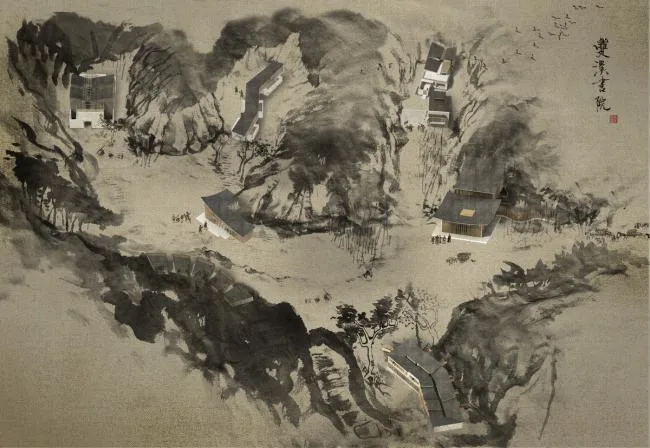
▲ Aerial View Overview of Shuangxi Academy
On the other hand, the architectural style of Shuangxi Academy represents an effort to express traditional regional architectural intentions using modern materials and structural technologies. From the structural layout of the inner courtyard to the wooden frames, towering white walls, and continuous gray tile roofs, to the textures of materials like stone, wood, and tiles, the design draws inspiration from local traditional residences and abstracts broader architectural symbols of southern Chinese homes. Construction combines conventional concrete frames with bamboo steel, aluminum sheet metal roofs, and GRC (glass fiber reinforced concrete) materials, introducing new construction challenges and techniques. While the seven buildings share similar stylistic elements, their appearances differ to respond uniquely to the mountainous terrain.
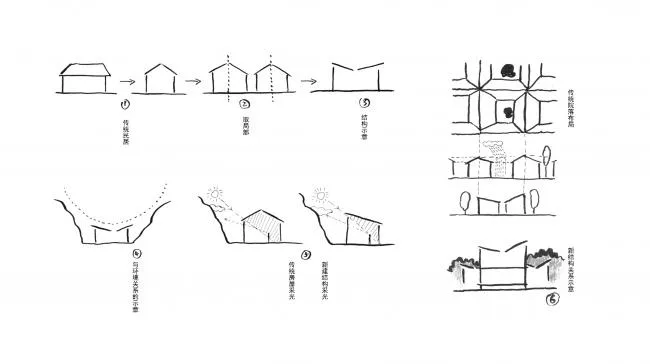
▲ Relationship Diagram
Reception Hall
The valley’s contours restrict sightlines, so visitors approach the buildings from specific vantage points. Within this carefully composed “picture,” close-up views feature trees or bamboo groves, while distant vistas reveal a mountain ridge that sweeps upward on both sides. This positioning places the building naturally at the midpoint of the scene, emphasizing the facade’s planar shape over the building’s volume itself.
The reception hall’s design highlights a downward curved eave line at the roof and a strong vertical emphasis on its facade. Although it omits the traditional sloping gray tile roof, the structural concept of transferring load from layered rafters to columns beneath the eaves maintains a connection to traditional architecture. The other facades mirror the main one, creating a square layout around a central courtyard. The “Hui” shaped structure draws inspiration from the classic courtyard layouts of Pingjiang residential buildings. The raised eaves harmonize with the surrounding skyline, enhancing interior lighting and offering a transparent, spacious feel.
The western wing, adjoining the reception hall, is nearly fully embedded into the mountain, accommodating auxiliary functions such as the kitchen, dining room, and a small exhibition hall. A large single-sloped roof cascades down the mountain, stacking visually with the reception hall’s roof. To achieve a lighter, slimmer look, bamboo and steel form the main structure, with each vertical column bearing load evenly. The “column” and “beam” connections use a simple overlapping stacking approach reminiscent of wooden architectural arches. The roof consists of GRC prefabricated panels laid flat on the bamboo steel frame, topped with metal tiles that replace traditional ones—significantly reducing weight, lightening the structure, and conveying the elegance of southern architecture with a modern flair.
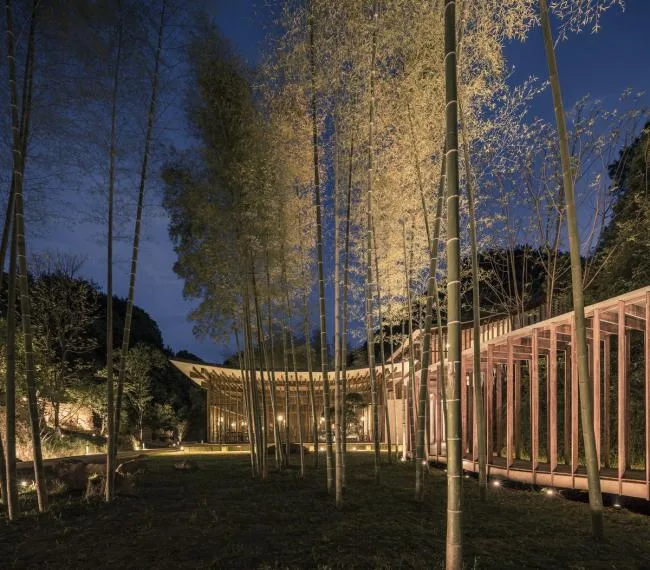
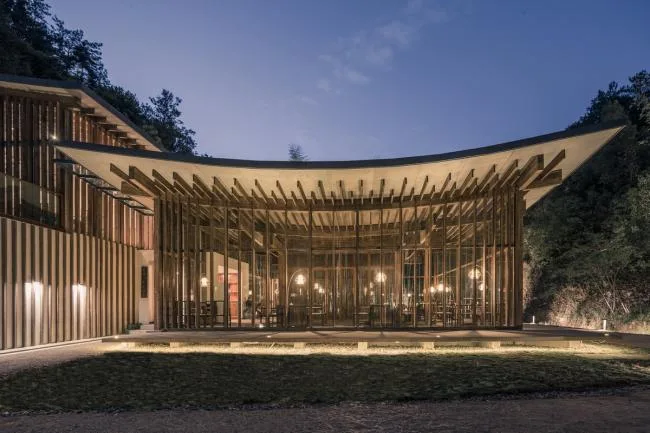
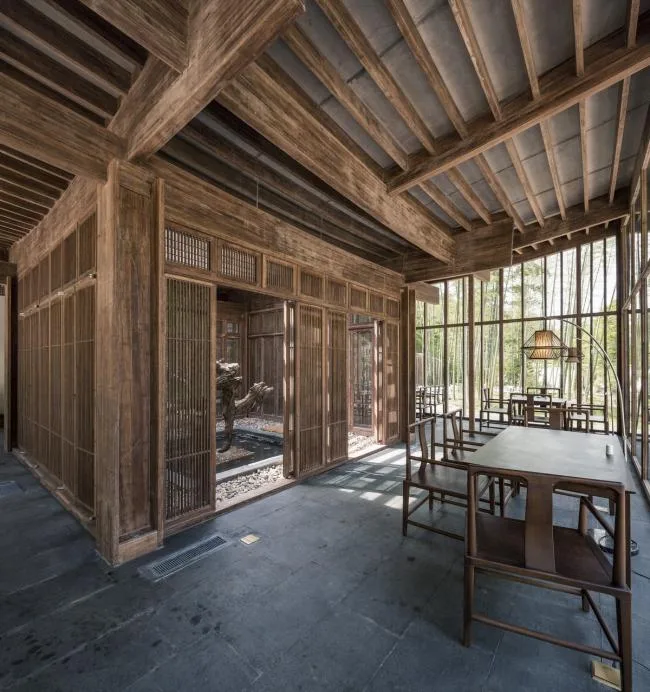
▲ Reception Hall
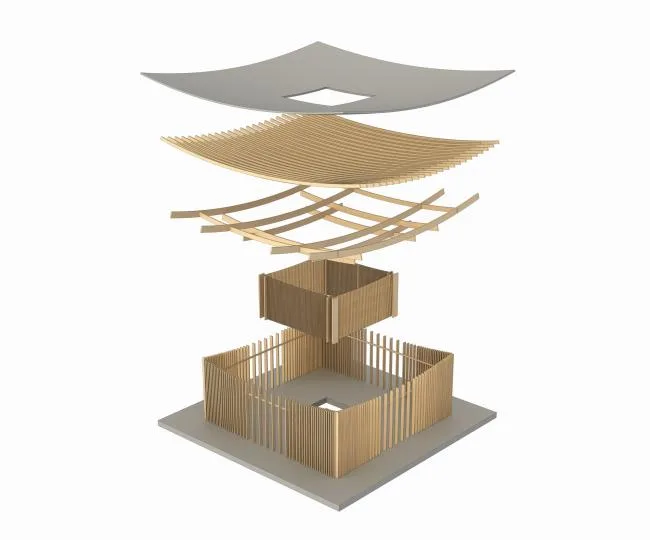
▲ Structural Analysis of Reception Hall
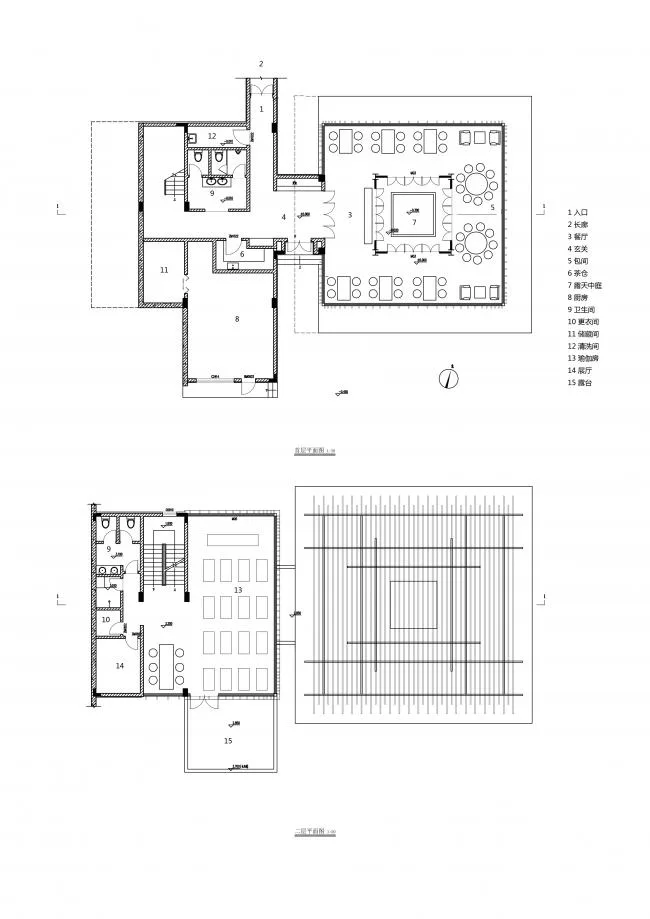
▲ Reception Hall – View 1
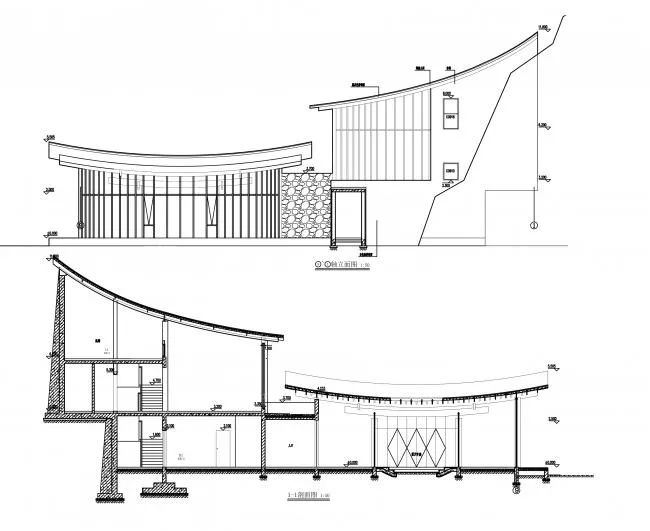
▲ Reception Hall – View 2
Tea House
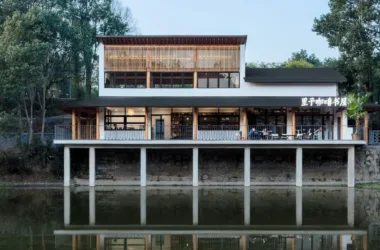
The tea house’s east facade aligns axially with the reception hall’s east facade, establishing visual coherence along the main perspective line. Covering 109 square meters, the tea house forms a semi-enclosed “L”-shaped courtyard. One end nests into the mountain, while the other extends over the pond. The corner where the two wings meet rises approximately 8 meters, pointing towards the southeast sky. This corner has become a landmark marking the confluence of three valleys, creating a high point along the axis in dialogue with the reception hall. The roof slopes sharply toward both ends, producing a narrow, inward-tilting inner roof. A tall glass curtain wall maximizes natural light and offers expansive views.
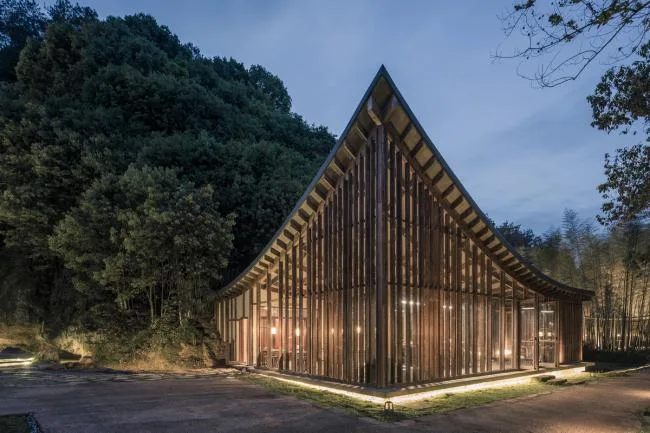
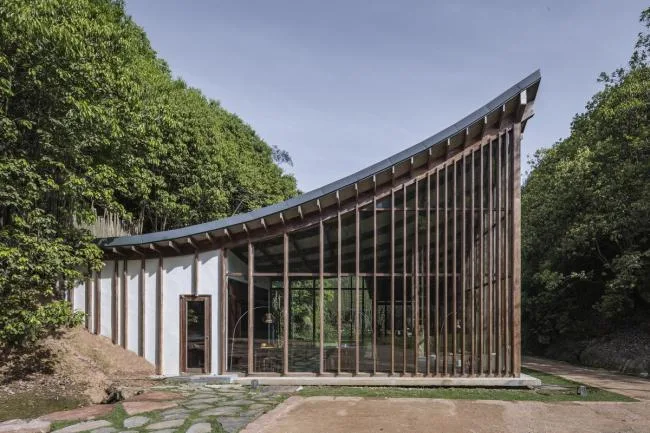
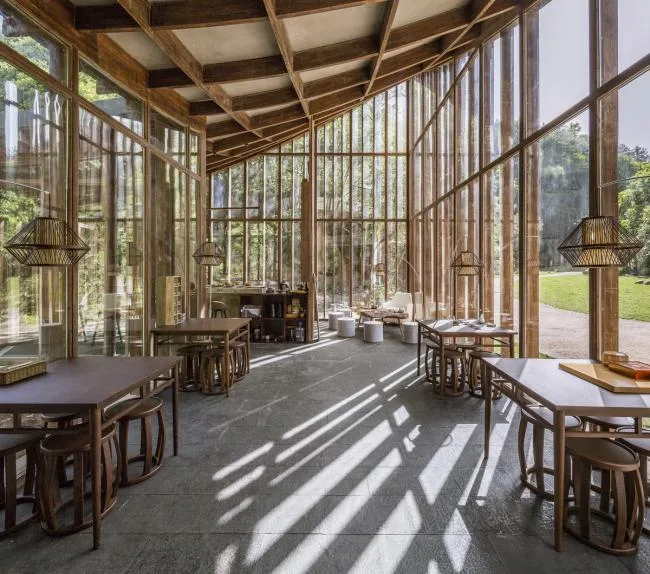
▲ Tea Room Interiors
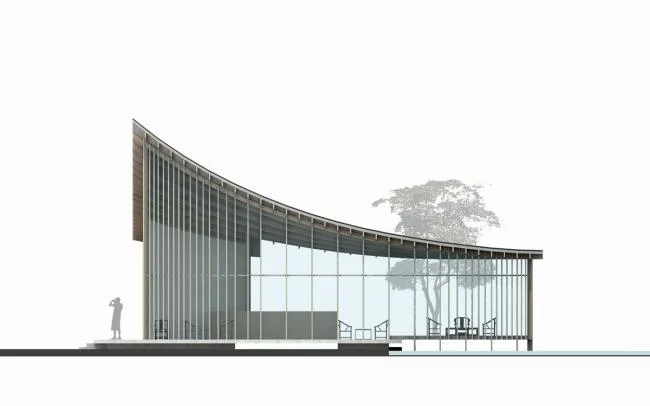
▲ Tea Room
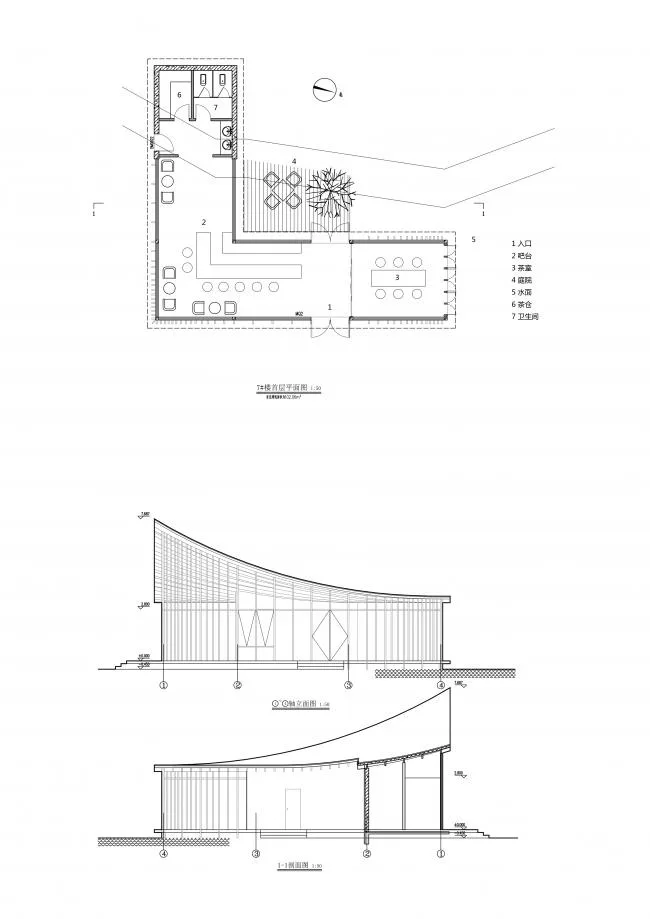
▲ Tea Room
Academy and Teacher’s Room
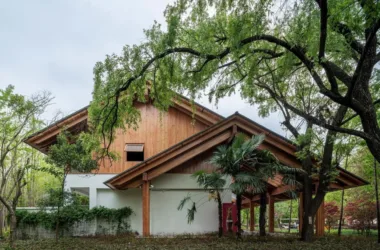
Located in a western valley, the academy and teacher’s room are nestled behind a thick bamboo forest. Flanked by a small stream on one side and dense bamboo on the other, the entrance gate sits at the end of the path on the left side of a white courtyard wall. This creates a balanced composition with the lounge that protrudes over the wall on the right. Inside, the U-shaped courtyard is clearly visible: a terrace divides it into two levels, linking two separate buildings and creating a dynamic spatial relationship that enriches the landscape experience. Although the academy appears as two distinct buildings, the consistent use of structure and materials unifies them. The roof slopes inward from both sides layer by layer, echoing the surrounding mountain contours and harmonizing with the landscape.
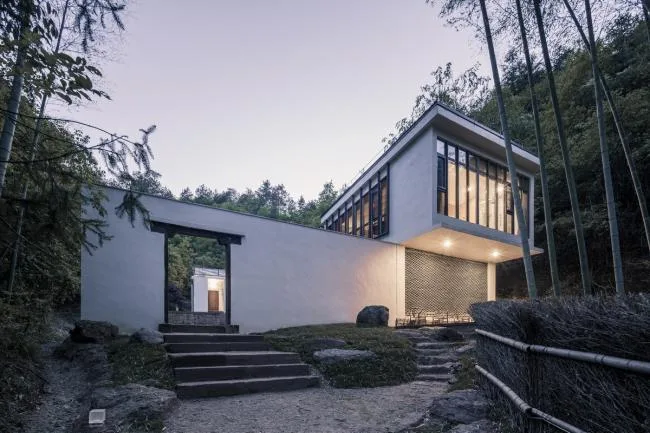
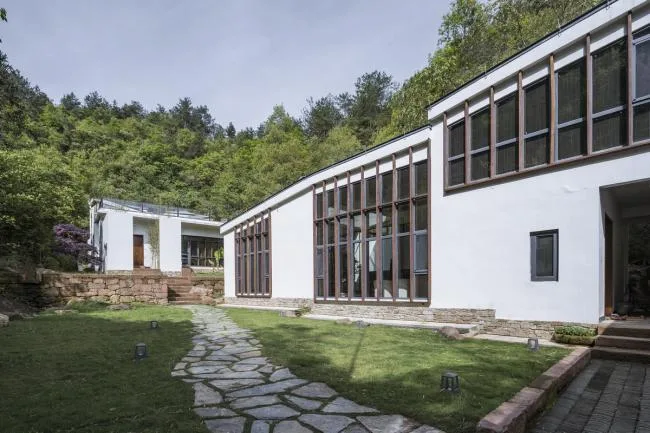
▲ Academy and Teacher’s Room
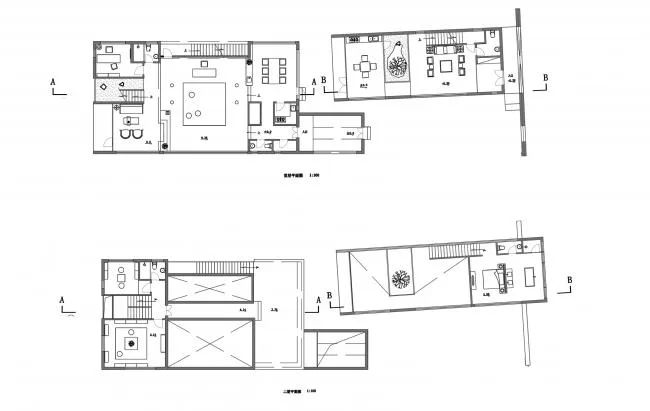
▲ Academy Floor Plan
Valley Room
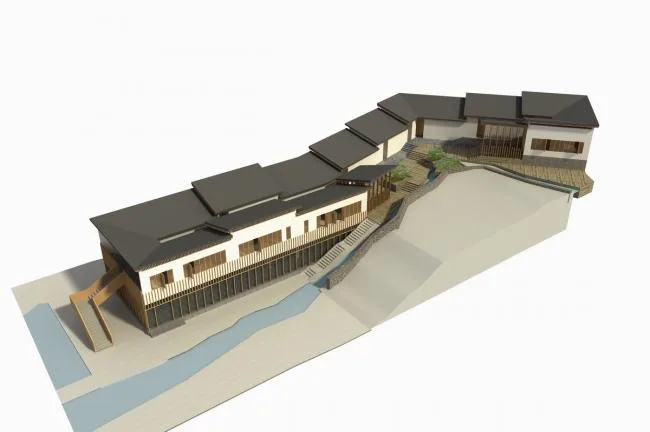
This building extends 86 meters in a narrow, elongated form that twists along the valley, maintaining a distinct facade at the valley entrance. A mountain stream flows around the structure, creating a reflective water surface that mirrors the entrance facade and evokes a serene, tranquil atmosphere.
Covering roughly 1100 square meters, the building’s form closely follows the valley’s natural contours. It ascends in a zigzag pattern, enclosed by a sloping roof of varying heights, creating a tunnel-like space reminiscent of southern rural architecture. The guest room roofs on either side form a V-shape, consistent with the overall design of the reception hall and academy buildings. Compared to the guest rooms’ pitched roofs, single-sloped roofs allow for better mountain views indoors.
The first floor, partially embedded into the mountain, serves as an elevated ancillary space housing a multifunctional leisure hall, café, water bar, and a small conference room. Traffic flow separates the first and second floors; guest rooms occupy the second floor and are accessed independently via a landscaped staircase at the main entrance, ensuring a quiet and private environment for guests. Eighteen guest rooms line the alley on both sides.
▲ Valley Room Exterior
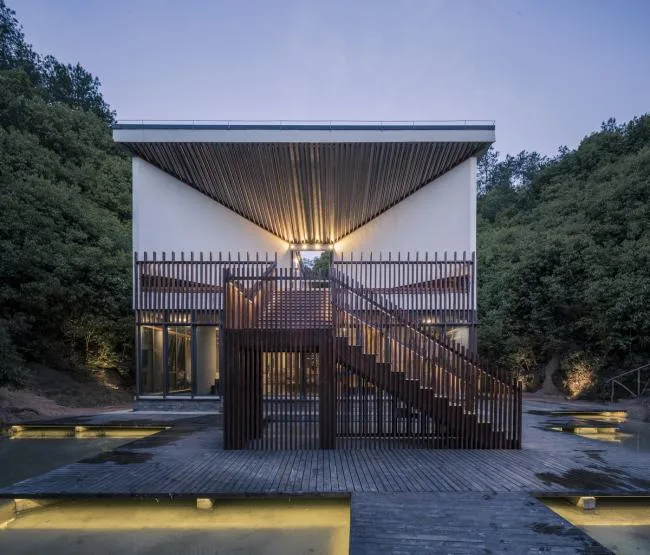
▲ Valley Room Detail
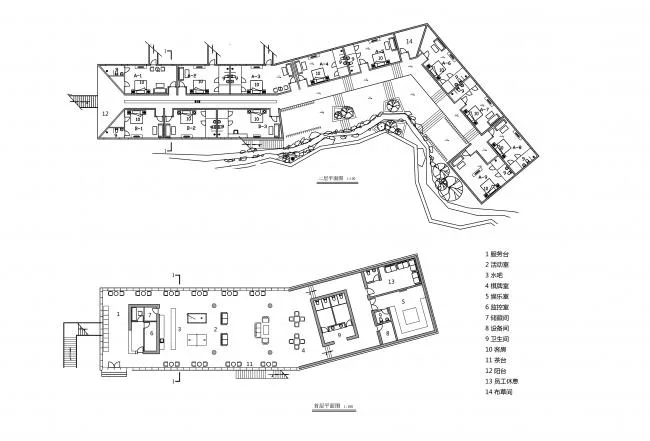
▲ Room Floor Plan
Three-Fold Villa
This building shares similarities with the valley guest rooms in that its end facades face the valley entrance, serving as the main facade, while the bulk of the structure remains concealed within the valley. The building follows a zigzag pattern along the valley terrain. On the first floor, there are three independent “boxes” primarily designated as public activity spaces, interspersed with semi-outdoor pavilion areas connected by a side corridor. The second floor is dedicated to private spaces such as bedrooms, arranged linearly as a continuous “corridor bridge.” The bamboo steel grating facade adds visual cohesion to the bridge-like structure. Functionally, bedrooms on the second floor are usually independent, connected by the walkway only when needed. The folding triangular roof shape echoes the traditional sloping roofs, enhancing the building’s overall traditional aesthetic.
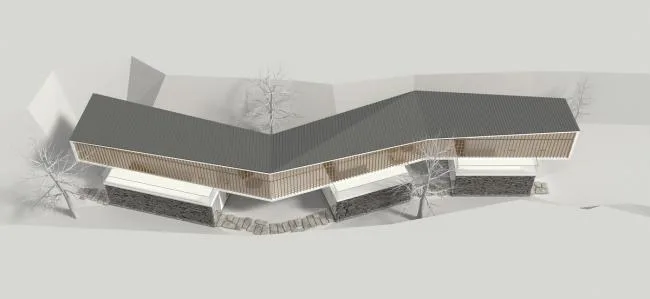
▲ Three-Fold Villa
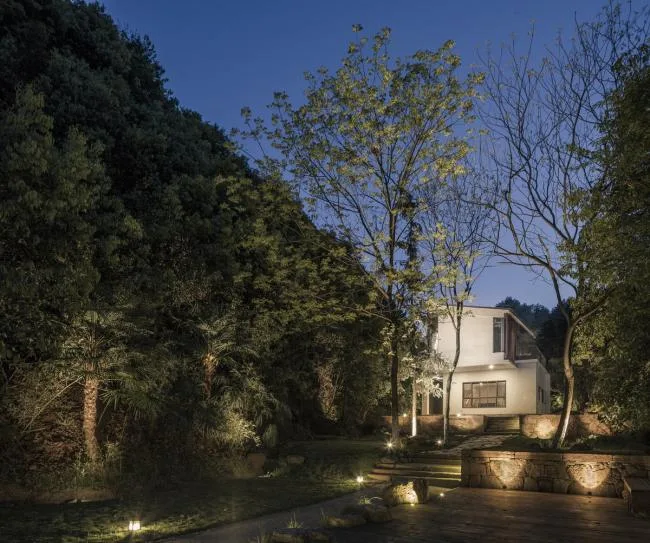
▲ Three-Fold Villa
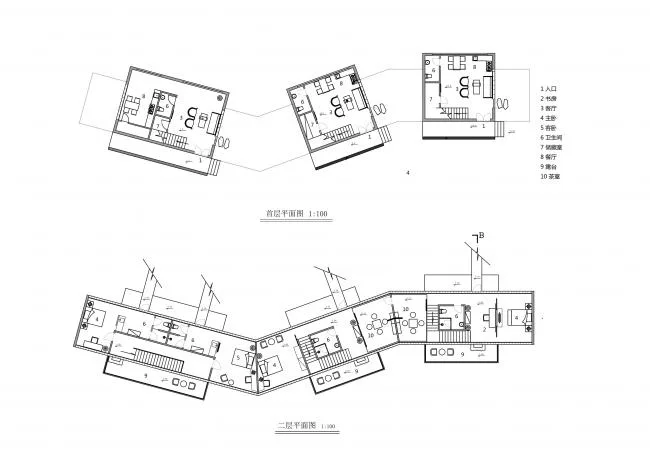
▲ Three-Fold Villa
Four-Quarter Villa
Nearly all of Shuangxi Academy’s individual buildings feature a V-shaped inward sloping roof, a form derived from the cross-sectional relationships of traditional Pingjiang residential courtyards. This connection is especially clear in the Four-Quarter Villa. The four inward-sloping roof blocks create independent rest areas, while the spaces defined by these blocks and outer walls form alleys and public areas. This layout allows the building to adapt gracefully to the site and avoids abrupt massing. Four separate functional blocks nest around a transparent glass box, fostering continuous interaction between indoor and outdoor spaces. Meanwhile, six small courtyards are formed by wall partitions. Inside, artificial landscaping in the courtyards blends with the natural outdoor scenery through carefully placed viewfinder windows.
The transparent glass box welcomes southern sunlight deep into the building, softening the overall architectural image. Viewed from a distance, the raised eaves and gradually ascending ridges on either side create a harmonious dialogue—although this approach diminishes the facade’s volumetric prominence from certain perspectives.
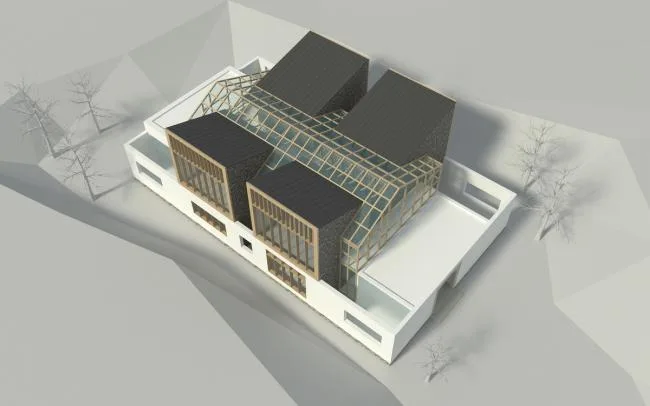
▲ Villa No. 9
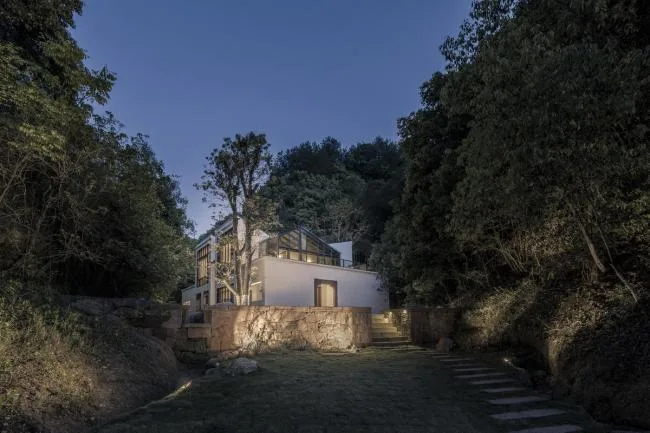
▲ Villa No. 9
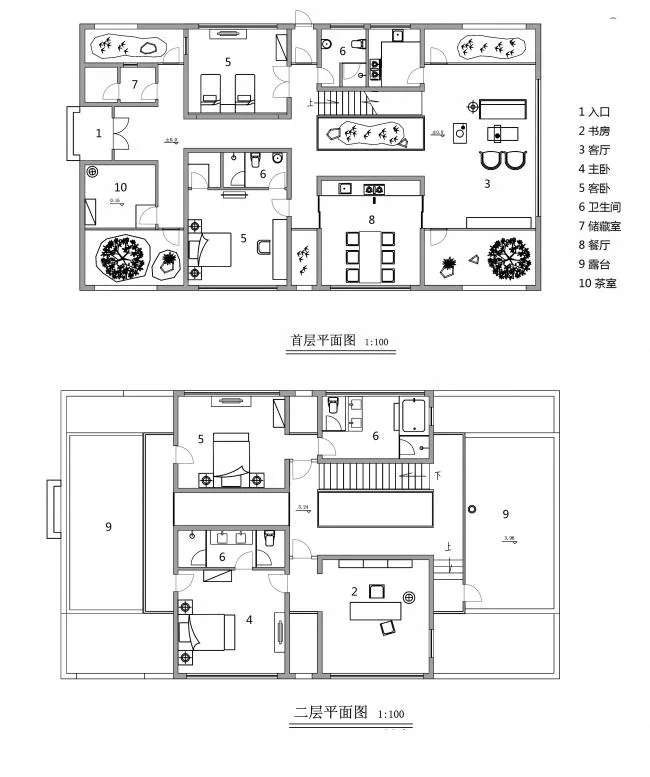
▲ Quarter Floor Plan
When architecture is harmoniously integrated with nature, all professional design or interpretation must align with the inherent “forces” or “momentum” of the natural environment. Nature’s embrace transforms architecture from opposition into submission, or more accurately, into integration and symbiosis. Just as in traditional Chinese landscape paintings, homes appear like shadows nestled between mountains and waters, evoking a poetic connection to the ancients. They explored the philosophy of natural landscapes through this spiritual experience. Today, we continue to create scenarios where architecture and nature engage in dialogue. Perhaps such a scene is quietly nestled within the environment of Shuangxi Academy. Walking through this secluded valley alongside the gentle stream, one might recall the poem by Southern Song Dynasty literati Zou Yu: “Flowers cast shadows, the moon approaches the west, I long lazily to move to the stream’s edge. Sitting silently before the mountain, this heart is only understood by the ancients.”
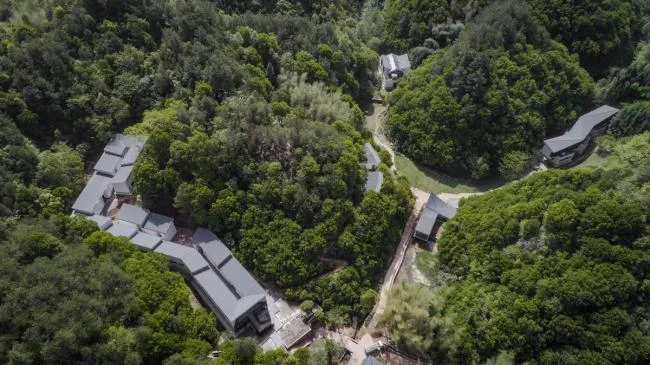
▲ Aerial View of Shuangxi Academy
Project Information
Location: Baimao Village, Pingjiang County, Hunan Province
Developer: Zizi Xiaoyin Hotel (Hunan) Co., Ltd
Chief Consultant: Wang Shouzhi
Project Planner: Cui Donghui
Architectural Design: Beijing Duoduojie Architectural Design
Lead Designer: Li Liang
Design Team: Zhang Bichang, Huang Chang, Xu Lin
Building Area: 3,800 square meters
Construction Period: June 2014 – March 2018
Architectural Photography: Jin Weiqi












Must log in before commenting!
Sign Up