
Lize SOHO is situated in Beijing’s Lize Financial and Business District. The architectural design is led by the renowned Zaha Hadid Architects from the UK. Jianyan Technology Engineering Consulting and Design Institute served as the structural consultant throughout the project, completing the preliminary structural design and successfully passing the over-limit review in September last year. Meanwhile, the Beijing Institute of Architectural Design and Research was responsible for the construction drawing design.
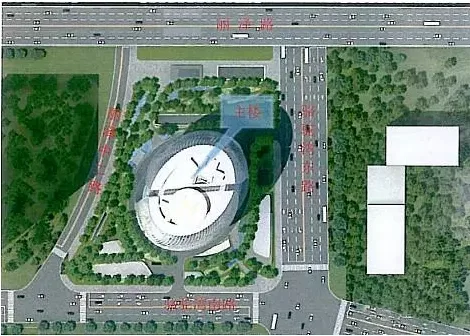
Vertical View
The commercial and financial land project on plot E-04 in the Lize Financial Business District, Fengtai District, known as Lize SOHO, is located east of Lize Bridge in Fengtai, Beijing. The E-04 plot is bordered by Lize Road to the north, Luotuowan West Road and Zhonghuan Road to the east, and municipal green space to the south. The project primarily consists of office buildings, complemented by commercial spaces at the lower levels and partial basements. The total land area covers 14,365.3 square meters, with a total construction area of approximately 172,800 square meters — 124,000 square meters above ground and 48,800 square meters underground.
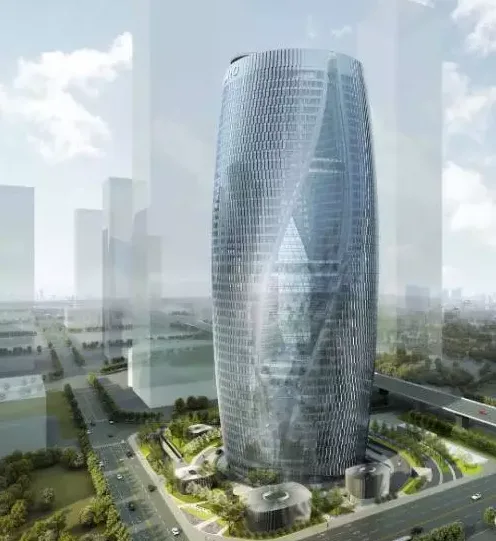
Rendering
Lize SOHO features a structural height of 191.5 meters and is composed of two anti-symmetric single towers. Each tower uses a cylindrical, single-sided curved frame structural system. The two towers are linked by four elliptical waist trusses, forming a unified structural system of anti-symmetric complex twin towers with a main structure height of 191.5 meters and a curved steel corridor spanning between 9 and 38 meters.
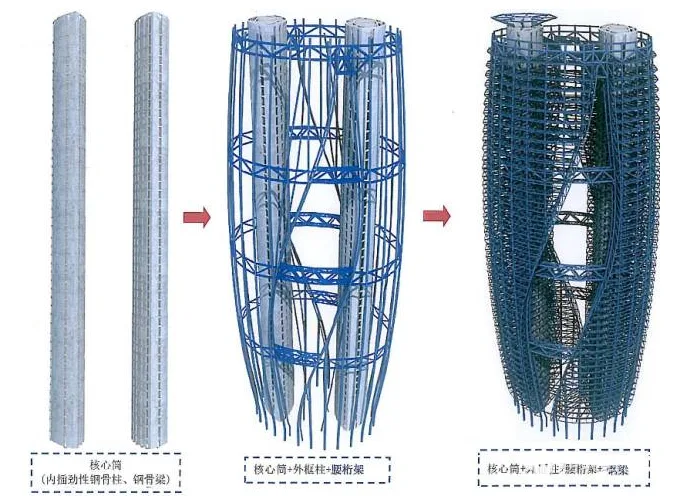
Schematic Diagram of Structural System
The building’s lateral force resistance system consists mainly of circular steel tube concrete inclined columns, reinforced concrete core tubes, waist trusses, and connecting bridges between the towers.
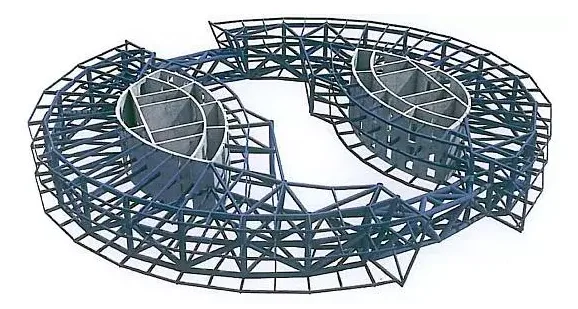
Floor Plan
This structure exceeds the maximum height limit of 150 meters for steel tube concrete frame reinforced concrete core tube structures, as specified in the Technical Specification for Concrete Structures of Tall Buildings (JGJ3-2010). Therefore, it is classified as an over-limit high-rise building.
The project includes 45 floors above ground and 4 underground levels. A subway connecting tunnel passes through the basement. The pure basement section uses a frame shear wall structure. Additionally, six-level civil air defense basements are located on the 3rd and 4th underground floors.
The foundation under the main structure employs a pile foundation raft system, while the pure basement section uses a natural raft foundation reinforced with anti-pull anchor rods.
Height and Number of Floors: The tower reaches approximately 191.5 meters in height, comprising 45 floors above ground and 4 underground floors.
Lize SOHO has a first-floor height of 4.1 meters, a second-floor height of 5.9 meters, and standard office floors at 4.1 meters each. The total building height is 199.99 meters. There are three refuge floors located on the 13th, 24th, and 35th levels, with heights of 5.1 meters, 5.7 meters, and 5.1 meters, respectively.
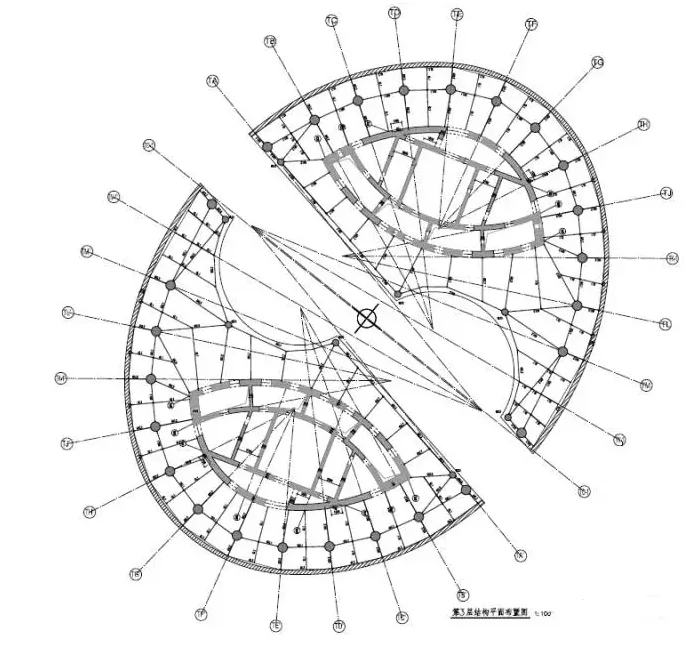
Third Floor Structural Layout Plan
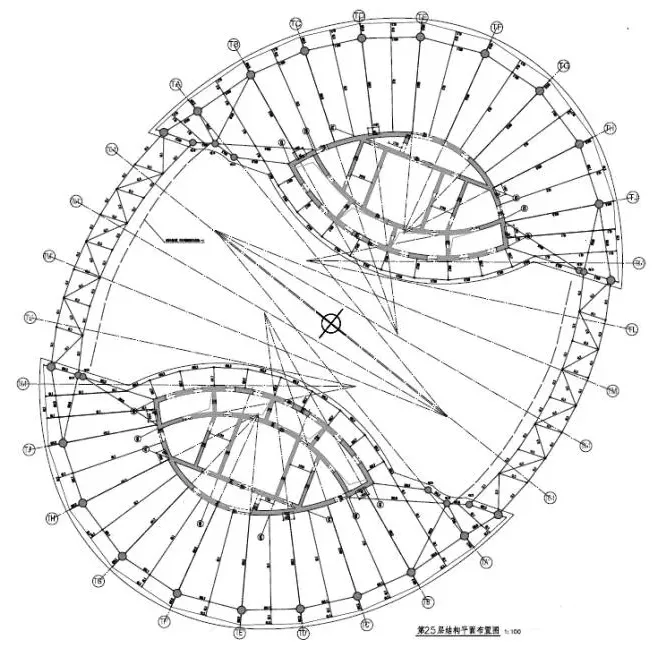
25th Floor Structural Layout Plan
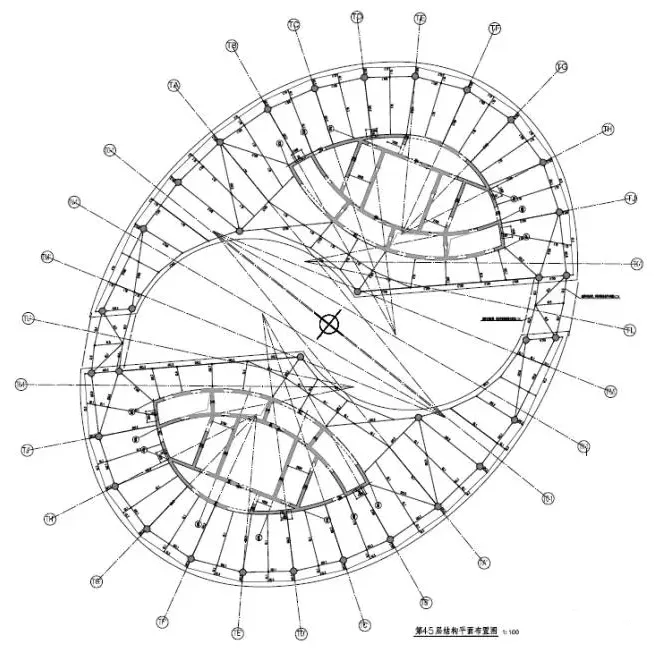
45th Floor Structural Layout Plan
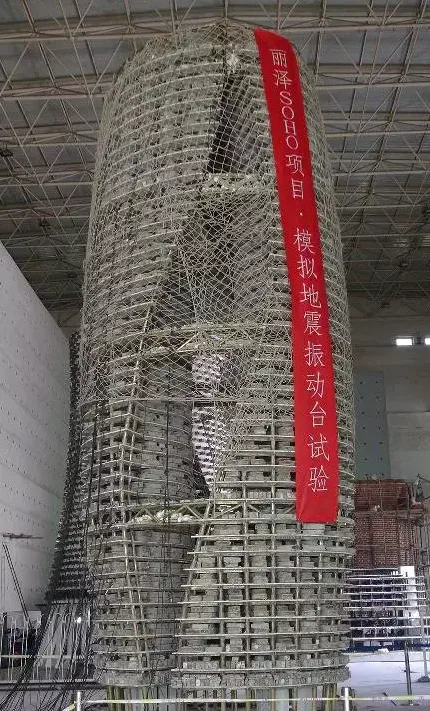
On August 12, the project underwent a shaking table test at the State Key Laboratory of Building Safety and Environment, China Academy of Building Sciences. The Lize SOHO vibration table model was created at a 1:25 scale, with a base plate size approximately 3.3 meters square. The model stands 8.04 meters tall and weighs 7.5 tons, supported by a 49.1-ton counterweight and a 5.4-ton model bottom plate, totaling 62 tons.
The test included 21 scenarios simulating minor earthquakes, 3 for moderate earthquakes, and 1 for a severe earthquake. After successfully completing all scheduled tests, experts confirmed Lize SOHO’s bearing capacity. Additional tests simulated an 8.5 magnitude earthquake with a peak acceleration of 510 gal, which is 27.5% higher than the design peak acceleration of 400 gal. The model sustained this super design intensity without collapsing, meeting the design goal of structural integrity during a major earthquake.
The results of the shaking table experiment confirmed the building’s structural design and safety margin, receiving recognition from on-site experts.















Must log in before commenting!
Sign Up