
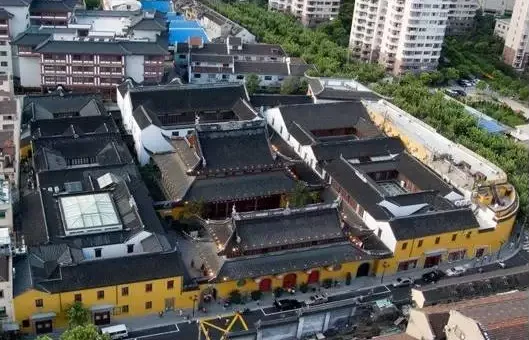
Project Overview
Jade Buddha Temple is Shanghai’s premier temple, located at 170 Anyuan Road in the Putuo District. It is one of the city’s most important historic buildings. The temple consists of two main sections: the front yard and the back yard. This project focuses on the front yard, which serves as the main open space for Buddha worship and visitor activities. Key structures in this area include the Temple of the Heavenly King, the Shakya Mani Hall (a distinguished historic building), and the Jade Buddha Tower, covering a total construction area of 31,566 ㎡. The introduction of BIM technology has significantly transformed the way designers approach and execute their work.
The renovation, reconstruction, and expansion of the Shanghai Jade Buddha Temple aim to rebuild and enlarge the temple while preserving and protecting the Heavenly King Hall and the Shakya Mani Hall through integrated translation and jacking techniques. The project addresses critical safety issues such as fire hazards, traffic congestion, structural integrity, and overcrowding. The elevated ground floor will serve as a safety reserve area to facilitate crowd evacuation and traffic management. The main Buddha worship hall will be raised, with the Heavenly King Hall and Shakya Mani Hall maintained along the central axis, and the Jade Buddha Tower reconstructed. Following the complete demolition of buildings on the east and west sides, new structures will be built in the classical Jiangnan palace architectural style, incorporating two basement levels to accommodate the increasing spiritual and functional needs of the temple’s modern development.
Preservation and Restoration Value
1. Religious and Cultural Significance
Jade Buddha Temple is a key religious site in China and the foremost temple in Shanghai. In 1942, its fifth abbot, Venerable Yuanchen, founded the Shanghai Buddhist Academy within the temple grounds. Recognized as a national cultural relic protection unit, the temple has received multiple rounds of state funding for maintenance. During the Cultural Revolution, thanks to protection efforts by the Municipal Party Committee, local governments, relevant units, cadres, the public, and the temple’s monks, the entire temple structure was preserved intact. Buddhist scriptures, statues, artifacts, and the two jade Buddha statues remained unharmed, even though religious activities were suspended. In 1979, Master Zhenchan became the abbot and formed a temple affairs committee to manage temple operations and gradually restore religious practices. In April 1983, the State Council designated Jade Buddha Temple as a key Buddhist temple in Han areas.
2. Historical Importance
Jade Buddha Temple is a nationally renowned site that has documented the development of Buddhism in Shanghai for over a century. Over the past 50 years, it has hosted more than 250 foreign heads of state and dignitaries, serving as a vital link for international Buddhist exchanges. It remains an important hub for Buddhist research and communication across East China and the entire country.
3. Architectural Value
The temple’s architectural layout is well preserved, representing a large-scale example of the modern Jiangnan traditional wooden temple complex. Its intricate construction, exquisite carvings, and well-maintained wooden, stone, and brick elements hold significant architectural and artistic value.
Project Challenges
1. Restoration of Historic Buildings
As a district-level cultural relic protection unit and an exemplary historic building, Shanghai Jade Buddha Temple faces unique restoration challenges. The project involves raising the mountain gate and main hall by 5 meters and shifting them 8 meters north from their original positions. Some structures will be demolished and rebuilt. The design and construction must emphasize structural reinforcement and renovation, while ensuring the restoration process preserves the buildings’ historical authenticity and allows for reversibility, maintaining visible traces of their original state.
2. BIM Technology Application in Ancient Architecture
Given the complexity of the ancient architectural complex, the project requires BIM engineers to possess specialized knowledge in the repair, design, construction, and management of historic buildings. Key challenges in applying BIM technology to this restoration include:
(1) Complexity — The intricate design and diversity of components in ancient architecture make BIM software implementation highly challenging, demanding advanced solutions from both BIM engineers and software platforms.
(2) Modeling — Traditional Chinese wooden architecture relies heavily on wooden frames as load-bearing structures. These consist of columns set on foundations, beams resting on columns, and multiple layers of melon columns and beams forming roof trusses topped with ridge melon columns. Rafters create the roof skeleton, and the unique dougong brackets, assembled in layered sets, support beams and extend eaves. This complexity necessitates advanced spatial modeling capabilities in BIM software, presenting significant challenges for engineers.
(3) Architectural Detailing — Decorative features, such as the roof’s swallowtail ridges and glazed beasts adorning the corners, add to the architectural complexity. Wooden support grids on ceilings, painted surfaces, and the coffered ceiling above the Buddhist altar—consisting of intricate layered wooden frames—require sophisticated software applications like Autodesk Revit. These details demand diverse and specialized BIM modeling approaches.
Use of BIM, 3D Laser Scanning, and 3D GIS in Renovation
Application of 3D Laser Scanning Technology
3D laser scanning has been widely applied in fields such as heritage building preservation, industrial pipeline installation, and ship machinery since its inception. This technology captures three-dimensional coordinate data of object surfaces through rapid laser scanning, enabling fast and comprehensive collection of spatial point information with high resolution. It offers a new technical approach for quickly creating detailed 3D models of objects. The scanning instruments used can collect up to one million points per second, with an overall accuracy of 1–2 mm.













Must log in before commenting!
Sign Up