
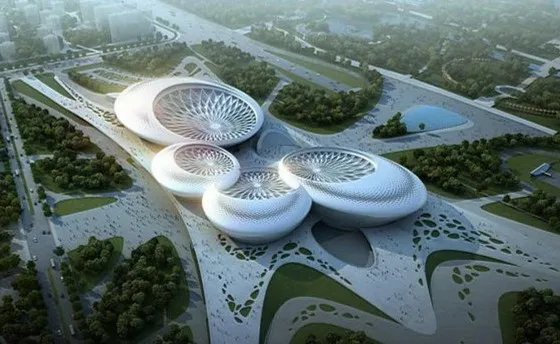
The Jiangsu Grand Theatre, situated west of the Olympic Stadium, ranks as one of China’s largest modern theaters, second only to the National Centre for the Performing Arts. Scheduled for completion by the end of 2016, the project is progressing steadily. A reporter from the Nanjing Morning Post recently visited the construction site and learned that all four main halls—the Opera Hall, Drama Hall, Music Hall, and Variety Hall—are set to be topped out by the end of this month. By the end of October, the distinctive “Water Drop” shapes of these halls will be fully formed, and by year-end, the entire complex will be clad with a metal curtain wall.
The concert hall has begun curtain wall installation, while the opera hall remains under main structural construction.
Arriving at the site at 10 a.m., the reporter observed the “Lotus Leaf Water Drop” design display near the entrance. Behind this display, two large spherical structures represent two of the four “Water Drop” halls: the Theater and Variety Halls. Around these spheres, three towering cranes are actively transporting materials. Moving along the site access road, the Music Hall came into view, showing the fastest progress. Its main structure was topped out some time ago, and the external spherical steel framework has been completed. Workers were seen on the curved roof installing long strip card slots as preparation for the upcoming metal curtain wall installation. A construction supervisor on the ground reminded the workers to stay safe amid strong winds.
Adjacent to the Music Hall is the Opera Hall, which is still under main construction. While the characteristic “Water Drop” shapes of the other three halls are already visible, the Opera Hall remains enclosed and is yet to be topped out. The most challenging aspect of this hall is the excavation of a more than ten-meter-deep underground adjustable stage. This stage can rise over ten meters, requiring ample underground space for installation.
The exterior metal curtain wall of the “Water Drop” halls is made of titanium panels.
In front of the Opera Hall, rows of silver roofing materials with small windows gleamed under the sunlight. Initially mistaken for solar panels, the staff clarified that these are titanium panels intended for the curved metal curtain walls that will cover all four halls. These titanium plates will reflect sunlight brilliantly.
“This is a prototype that was reviewed by the project command center before construction,” explained an on-site construction manager. “Any necessary adjustments are made on this template. Once finalized, it becomes the standard component for all metal curtain walls.” Approximately 85% of the exterior facades of the opera, theater, music, and variety halls will use this type of metal curtain wall, with the remaining portions featuring glass curtain walls. The metal curtain wall samples are about 60 centimeters thick and consist of multiple layers: an outer decorative titanium plate, an aluminum-magnesium-manganese waterproof layer, insulation cotton, soundproofing, and sound absorption layers. This design ensures warmth in winter, coolness in summer, and enhanced surround sound effects.
All four halls are expected to be topped out by the end of this month, with the “Water Drop” forms completed by the end of October.
Despite delays caused by the complexity of the Opera Hall’s construction, progress has accelerated following the completion of the underground stage. The site manager explained the construction sequence: first, the internal main structure is built—including the five-floor height internal stage and functional halls—followed by installation of the arched spherical steel framework around the main structure. Finally, metal and glass curtain walls are assembled on this steel framework.
Currently, the Music Hall is installing metal curtain walls, while the Variety and Theater Halls are undergoing steel structure exterior construction. The Opera Hall is expected to be topped out before the end of the month. By late October, all four halls will have taken shape, and by year-end, their exteriors will be completed with metal curtain walls installed. The construction phase will then transition to interior decoration. The entire project is slated for completion by the end of 2016, with the Jiangsu Grand Theatre opening to the public in 2017.
The complex concrete arc construction presents significant challenges, addressed through advanced BIM technology and simulation.
The Jiangsu Grand Theatre construction is managed by the China Construction Eighth Engineering Division. Deputy Chief Engineer Wang Guilin shared that the most difficult aspect of the project is the construction of the concrete arc-shaped walls. Unlike typical buildings with straightforward horizontal and vertical lines, all four halls feature curved “Water Drop” surfaces with large-span hyperbolic arc grandstands inside, making concrete pouring highly complex. To overcome this, advanced BIM technology has been employed to convert floor plans into 3D models, breaking curves into short straight segments and reassembling them into arcs. At key construction stages, animated models simulate the process, marking a first in national theater construction.
Wang also highlighted the extensive underground parking planned for the theater. Covering nearly 100,000 square meters, the underground area will primarily serve as parking, with only a few auxiliary facilities such as computer rooms. This will ensure ample parking space for visitors attending performances.
[News link]
Jiangsu Grand Theatre Overview
Located in the western section of Hexi New City’s cultural and sports axis in Nanjing, just west of the Nanjing Olympic Sports Center and near the Yangtze River, the Jiangsu Grand Theatre covers a total construction area of 271,386 square meters. The complex includes an Opera Hall with 2,280 seats, a Theater with 1,001 seats, a Music Hall with 1,500 seats, a large Variety Hall with 2,711 seats, a smaller Variety Hall with 780 seats, and various ancillary facilities. It caters to a wide range of performances, including opera, dance drama, traditional Chinese opera, symphony, folk art, and large-scale variety shows. The venue is designed to host world-class performance groups, serving as a cultural hub and an open space for public cultural activities.












Must log in before commenting!
Sign Up