
Some say that 2010 marked the beginning of BIM, as numerous BIM consulting firms suddenly appeared. Construction software companies proudly claimed to be key players in the BIM software ecosystem, and architectural designers and project budget teams frequently used the term. However, it must be acknowledged that in 2012, BIM was still relatively new, and many construction professionals were unfamiliar with it. So, what drove Wanda to adopt BIM technology for their Wanda Plaza project?
Let’s take a closer look at the Wuhan Hanjie Wanda Plaza project to understand the impact BIM technology had on its construction.
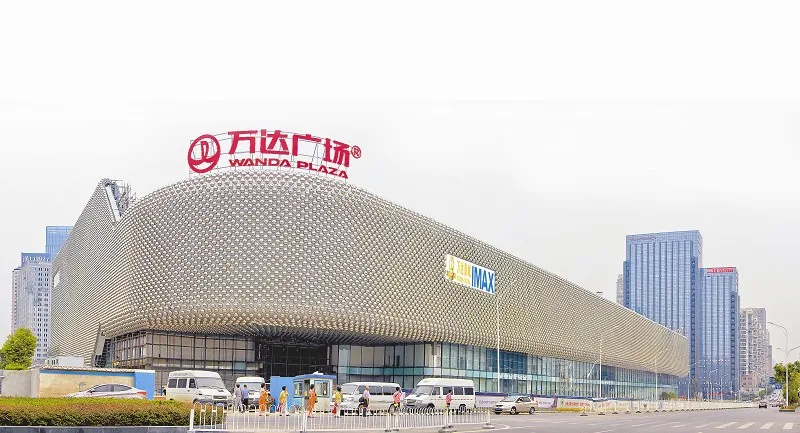
Indoor Clearance Optimization
The Hanjie Wanda Plaza project utilized BIM to integrate various professional models through pipeline coordination, enhancing interdisciplinary collaboration. Throughout both design and construction phases, BIM enabled project modeling, clash detection, 3D simulation analysis, and assisted design management. This approach went beyond expectations by resolving coordination challenges among different disciplines and pipeline integration issues.
Moreover, the 3D model allowed all design teams to intuitively review and optimize the design together, addressing problems that planning institutes and project companies could not detect with traditional 2D drawings. This collaborative process effectively reduced costs in a timely manner.
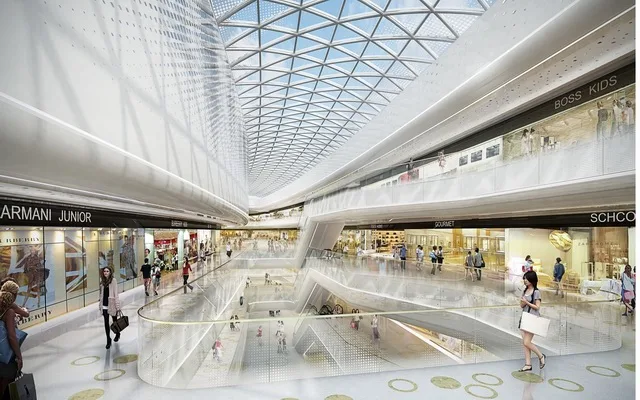
One longstanding issue—the floor height—was optimized by simulating the comprehensive pipeline layout virtually. This simulation accounted for reserved spaces for lamp troughs and decorations, saving space while maintaining the indoor spatial effect of Han Street Wanda Plaza. Originally, the net height of the electromechanical space at the intersection of the 5-B axis and 1-8~1-9 axis on the second floor above ground was 3500mm. After thorough pipeline optimization, the net height increased to 3600mm, providing improved design conditions for interior design and other aspects.
Landscape Scheme Optimization
The BIM model offered a comprehensive reflection of construction drawing information. Due to the limitations of two-dimensional drawings, elements like lamp post foundations and identification were presented separately across various specialized drawings, leading to occasional repeated positioning errors.
For example, sprinkler and landscape furniture placements were shown in different drawings, which sometimes resulted in sprinkler locations that were impractical—wetting furniture, obstructing landscape functionality, or even drenching pedestrians. These issues highlighted flaws in the landscape design.
Besides conflicts within the landscape discipline, BIM also revealed clashes involving municipal pipelines. Conflicts between landscape pipelines, road edges, municipal pipelines, and pipe wells became apparent, facilitating better cross-disciplinary coordination.
Roof Equipment Layout Optimization
Roof equipment layout posed significant challenges during construction because the roof hosts numerous large machines and rooms, including heating and ventilation fans, fire hydrants, elevator machine rooms, and cooling towers. This layout required foundation coordination with the structural team, space feasibility confirmation, and synchronization with drainage ditches, electrical lightning protection belts, and lightning protection nets.
Simulating the arrangement of roof equipment with BIM was critical, demanding close cooperation between mechanical, electrical, and structural teams. Additionally, an often-overlooked requirement was ensuring the roof equipment aligned visually with the building’s overall aesthetic.
Although the Wuhan Hanjie Building’s unique curtain wall design significantly enhances the facade, the size constraints of cooling towers and large air conditioning units required careful consideration. It was essential to verify whether the facade could conceal rooftop equipment; otherwise, the visual appeal—and thus the consumer experience—would suffer considerably. BIM simulation allowed these issues to be addressed proactively, preserving the intended visual effect.
In the past, China’s construction industry faced many errors and inefficiencies. What’s the solution? Establishing a collaborative BIM platform where all information is transparent. This is the direction China’s construction sector should embrace and an inevitable step toward social progress.
We firmly believe that by persistently fostering BIM collaboration platforms, China’s real estate and construction industries will experience a revolutionary transformation.














Must log in before commenting!
Sign Up