
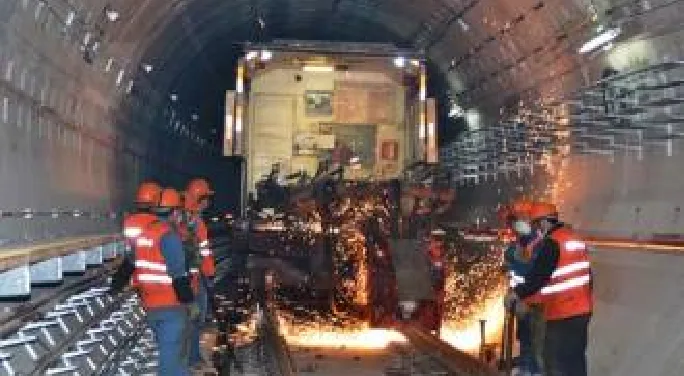
Shanghai Metro Line 12 has recently entered the delivery and debugging phase, drawing attention due to its innovative use of BIM technology in mechanical and electrical installation construction. “The construction space for the subway is already limited, and engineers each provide their own drawings. No one is satisfied with each other, and personnel from several units often argue over where a line should be installed. After adopting BIM technology, with just one click, the 3D model of the project can be visualized, clearly showing where collisions occur,” explained Cao Ruqing, Project Manager for Shanghai Metro Line 12 at China Railway 14th Bureau Group Electrification Engineering Co., Ltd.
Shanghai Metro Line 12 is a circular route within Shanghai’s urban rail transit network, connecting the city’s western and northeastern areas. It will serve as a major north-south line through the central urban area, underscoring its strategic importance. The mechanical and electrical installation work covers ventilation and air conditioning, water supply and fire protection systems, and power and lighting installations for Gudai Road Station and adjacent sections, as well as Donglan Road Station and its surroundings.
Cao Ruqing outlined that the BIM technology implementation in this project involved three key phases: modeling, on-site guidance, and summary.
Modeling Phase
The project team leveraged design phase results to quickly and efficiently build BIM models. These models were maintained ahead of the actual construction schedule to maximize BIM’s warning capabilities. They conducted collision checks across multiple disciplines—including mechanical and electrical, civil engineering structures, and decoration—using structural elevations and detailed mechanical and electrical layouts. Any clashes affecting construction were promptly identified and communicated to the design team, enabling timely adjustments to pipelines and equipment placements. This process resulted in a preliminary comprehensive pipeline diagram.
On-Site Guidance Phase
Using BIM’s multidimensional visualization, the team simulated critical construction plans and provided visual presentations of construction processes and key components—especially the management of reserved openings. This improved the quality and schedule control of secondary structure walls and facilitated the input of equipment and pipeline information.
Additionally, the BIM model was used to export engineering quantities for each specialty, which were then compared against manual calculations to refine material procurement plans. Dynamic monitoring of overall construction progress allowed the team to optimize work assignments for enhanced safety, conduct real-time quality and safety inspections, and track weekly progress through BIM-based quantity calculations.
3D rendered animations provided a realistic visual impact, aiding communication and negotiation among stakeholders, and simplifying consensus-building.
Summary Phase
In the final phase, BIM was used to improve the efficiency of information transmission and distribution, streamlining data collection for economic and risk management. Centralized information processing helped standardize analyses and supported computerized management, ultimately enhancing decision-making efficiency.
Cao Ruqing further explained that BIM software enabled 3D collision detection simulations for wind, water, electrical, and other pipeline routes within the station. It also allowed for 3D modeling of reserved openings in the station structure and the installation positions of mechanical and electrical equipment. This process helped identify mismatches between reserved openings and pipeline locations, enabling timely feedback and adjustments from the design team.
The application of BIM technology significantly reduced common issues faced in previous subway mechanical and electrical projects, such as pipeline clashes, misplaced reserved openings causing costly rework, damage to main structures, and alterations to original design styles. As a result, construction efficiency has improved considerably, while costs have been reduced.













Must log in before commenting!
Sign Up