
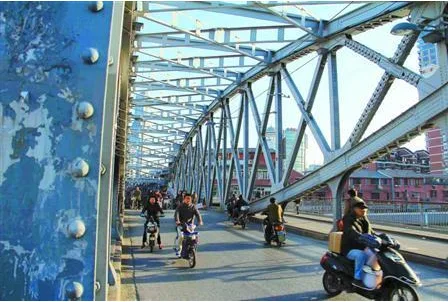
Vehicles and pedestrians crossing Zhejiang Road and Bridge
The historic Zhejiang Road and Bridge, over a century old, began its closure for major repairs on April 18th. The bridge’s steel structure framework is undergoing a comprehensive overhaul. During the process of relocating the bridge, the design team utilized BIM technology to create a detailed 3D simulation of the entire procedure. Moving forward, the team plans to use BIM’s 3D scanning capabilities to systematically collect data and establish a comprehensive database for future maintenance and repairs.
BIM technology has proven to be invaluable in road and bridge construction projects, with its effectiveness widely recognized.
For example, in 2014, several major projects—the Baishatuo Yangtze River Grand Bridge, the Jinan Yellow River Highway and Railway Dual-Use Bridge, and the Zhaoqing Yuejiang Bridge on the Chongqing-Guizhou Railway New Line—all heavily relied on BIM technology.
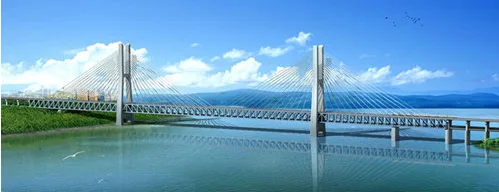
Rendering of the new Baishatuo Yangtze River Grand Bridge
During the construction of the Baishatuo Bridge, a dedicated BIM team was formed, involving multiple design institutes. Their mission was to develop a 3D information model covering the main bridge area, perform detailed simulations of the cable and steel beam components, conduct collision detection and other design validations, and optimize auxiliary functions such as maintenance and pedestrian access. They also simulated construction stages for key elements including the main structure, piles, tower bases, bridge towers, and steel beam installation.
Using virtual bridge models, the team was able to identify potential problems early in the design phase, allowing for proactive solutions. This approach also enabled precise planning to reduce waste and minimize rework through thorough collision checks.
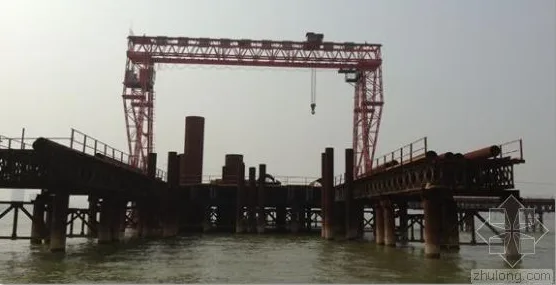
Construction site of the Zhaoqing Yuejiang Bridge
As a pilot project for large-scale bridge construction using BIM, the Zhaoqing Yuejiang Bridge integrated BIM technology mainly in the following areas:
1) Dynamic simulation of construction processes and plan comparison: The main bridge pier construction was the most complex and high-risk part of the substructure. By building BIM models of the steel platform and steel suspension box and incorporating the construction plans, the team simulated the entire construction process dynamically. These models were then used for technical communication and guidance.
2) Interference detection: Errors found in design drawings during the modeling process were clarified or corrected prior to construction. Additionally, thorough investigations were conducted to identify and resolve any conflicts between temporary and permanent structures, ensuring smooth workflow.
3) Material quantity analysis: The team compared quantities derived from detailed models with those from drawings to identify discrepancies and improve workload estimation for both permanent and temporary structures.
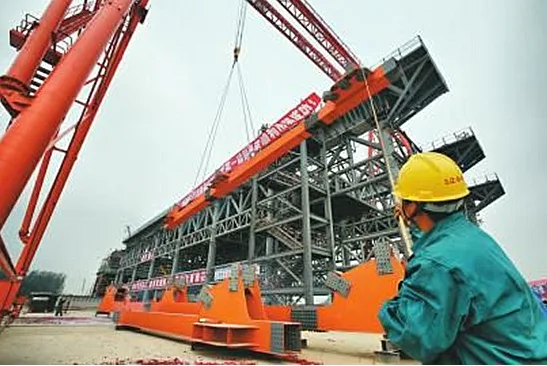
Assembly construction site of the Jinan Yellow River Highway and Railway Dual-Purpose Bridge
Subsequently, China Railway Fourth Bureau undertook the construction of the Shiji Railway project, featuring the Jinan Yellow River Highway and Railway Dual-Purpose Bridge. The project successfully completed the assembly of the front guide beam components for the main span’s top-push steel beam, marking the start of Asia’s largest steel beam top-push construction.
This project represented a pioneering use of the stiffening chord top-push steel truss beam construction method combined with BIM technology in China, applied to a large dual-purpose steel bridge serving both road and railway traffic. At the time, it was one of the few bridges under construction in China utilizing such advanced technologies.

Yesheng Yellow River Highway Bridge
On April 7, 2015, Ningxia Road and Bridge Company signed a BIM technology cooperation agreement with the BIM project team from Tsinghua University. This collaboration applied BIM technology to the construction of the Yesheng Yellow River Highway Bridge.
Throughout the project, BIM technology enabled effective control over construction quality, safety, and scheduling. By leveraging building information modeling and visual simulations, the construction processes and methods were clearly conveyed to workers, facilitating timely identification of design or construction issues and enhancing overall efficiency.
In summary, the adoption of BIM technology in road and bridge construction significantly improves engineering quality, construction efficiency, and project management.
Sources: Liberation Daily, Hualong Network, Shanghai Road and Bridge, Jinan Daily, Ningxia Daily














Must log in before commenting!
Sign Up