
On April 26th, Foshan welcomed a new landmark with the establishment of the Way Culture Center and the topping out of its main project, the Fangta Tower. Known as the “Fangta Project,” this tower was once described as a challenging architectural feat by Rong Bosheng, an academician of the Chinese Academy of Engineering (CAE). Its structural complexity rivals that of the CCTV building. Throughout construction, Building Information Modeling (BIM) technology was extensively utilized, resulting in smooth on-site operations and clear benefits.
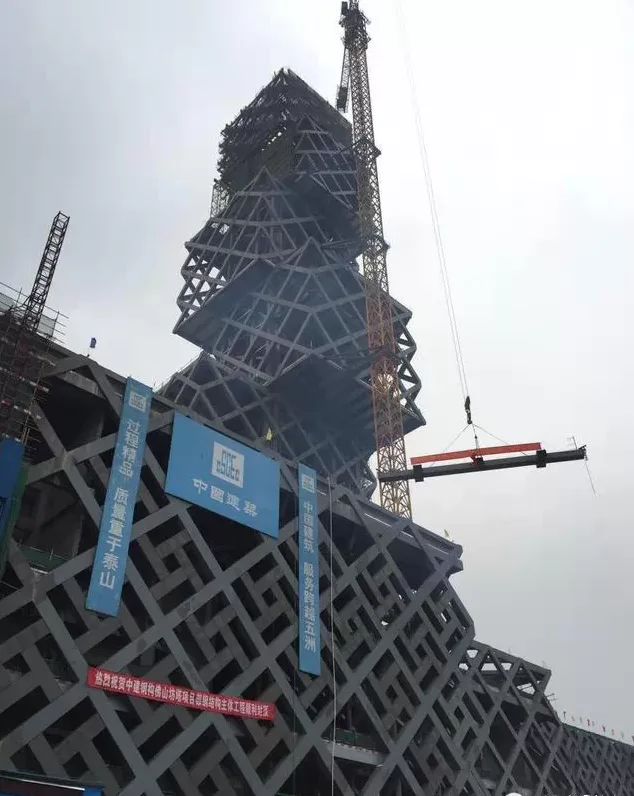
Foshan Fangta main project topping out
Visitors will soon be able to ride a sightseeing elevator directly to the tower’s premier observation deck.
The Fangta Tower, the core of the Fangcheng project, features an extremely irregular design composed of multiple stacked “square box” structures. Standing 153.6 meters tall, it is the tallest single building within the entire Foshan Cultural Center development. The tower consists of nine main “square box” units built with welded steel components. The total construction area spans 71,232 square meters and is being developed by China Construction Third Engineering Bureau. It will host various facilities, including Guangzhou’s “Little Waist” urban sightseeing functions and multiple exhibition halls, capped by a professional theater with 1,200 seats.
The Grand Theater, situated in the eastern podium, covers approximately 23,600 square meters with a maximum structural height of 33.6 meters. It houses a comprehensive professional theater seating about 1,200 and a multifunctional hall of roughly 500 square meters. This theater will serve as a high-end cultural and artistic performance venue for the city. On the west side, the Foshan City Exhibition Hall covers around 31,000 square meters with a maximum height of 28.3 meters. It includes major exhibition areas such as model displays, urban planning and construction, and exhibitions on city development history and architectural culture. The remaining tower sections are designed as cultural exhibition, leisure, and sightseeing spaces, offering Foshan’s largest art exhibition area.
The construction team aims to complete the main structure of the Foshan City Urban Exhibition Hall within this year, coordinating with the exhibition team for its upcoming opening. Meanwhile, the Grand Theater’s main construction is scheduled for completion by May 2016, followed by preparations with the theater management team for its grand opening later that year.
According to Xia Yangjie, head of the technical department for the Fangta project at China Construction Third Engineering Bureau, “The best viewing spot in Fangta Tower will be at the base of the ninth tower, 135 meters above ground. From there, residents will enjoy a bird’s-eye view of Fangcheng’s ‘Building a City with Fang’ and panoramic vistas of Dongping Waterway and Foshan Park.” Currently, a temporary construction elevator allows access to this scenic spot in about five minutes. Once completed, a dedicated sightseeing elevator will provide direct access to the observation deck.
Double Safety Measures for Wind and Earthquake Resistance
The Fangta Tower’s structure consists of a base formed by four flat-arranged cuboid blocks, topped by five staggered cuboids that create an elegant tower shape. The tallest of the four base cubes is 33.6 meters high, the central fifth cube also reaches 33.6 meters, the three cubes above stand at 24 meters, and the ninth cube at the top is 19.2 meters tall.
Rong Bosheng, a CAE academician, noted during an early structural review, “The structural design complexity of the Fangta Tower far exceeds that of the Guangzhou West Tower and is comparable to the complexity of the CCTV Building.”
To address these challenges, the design team adopted a “diagonal grid steel frame with a steel support core tube,” a dual lateral force-resistant structural system that acts as a double safeguard. This ensures the tower’s stability against strong winds and earthquakes.
Xia Yangjie also highlighted the internal complexity of the Foshan Grand Theater, particularly the irregular spherical auditorium, which posed challenges in elevation and coordinate control. To overcome this, the construction team performed computer-based model analysis and positioning, optimizing pipeline and wiring layouts accordingly.
Using BIM Technology to Simulate Construction
Early in the construction phase, the project team set up a safety display area along the main site passages. This showcased safety installations such as construction electrical boxes and wiring, adjacent tool edges, protective railings around openings, mobile welding machines, oxygen and acetylene cylinder racks, fire-fighting equipment, as well as personal protective gear like helmets, safety belts, and nets.
A safety experience zone was also created on-site to educate workers before each shift. This area simulated scenarios where steel pipes, fasteners, or wooden objects might fall and impact helmets. It also demonstrated the protective effects of edge guards and fall arrest safety belts, simulating common injury risks on construction sites. These immersive experiences heightened safety awareness among personnel and produced notable improvements.
Throughout construction, the Fangta project team applied BIM technology to address various challenges. For instance, the basement area features a dense network of nearly 30 local pipelines—including air, water, and multiple cable trays—interwoven like a “spider web” vertically and horizontally. Previously, construction issues required costly rework and delayed progress.
By using BIM to simulate the entire construction process digitally, potential conflicts and clashes among different systems were identified and resolved during the design phase. This proactive approach minimized rework, reduced material waste, and kept the project on schedule.
Source: Guangdong Construction Daily, Jinyang.com, Southern Metropolis Daily












Must log in before commenting!
Sign Up