
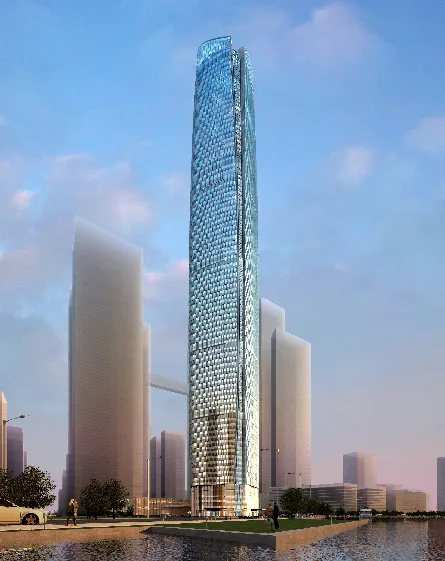
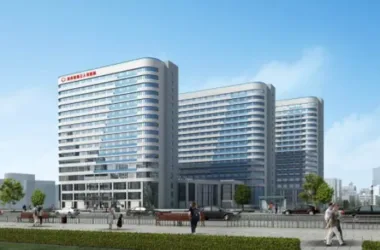
Rendering of Wuhan Central Building after completion
On April 16th, the Wuhan Central Building in the Wangjiadun Central Business District officially topped out. Standing at 438 meters tall, it has become the tallest building in Wuhan and Central China, surpassing the previous record of 333.3 meters. The building features 4 underground floors and 88 floors above ground, with a total construction area of 360,000 square meters.
This landmark international 5A-grade business complex integrates multiple functions, including intelligent office spaces, a global conference center, a platinum five-star hotel, high-end commercial areas, and a 360-degree high-altitude observation deck.
During construction, the project team established a dedicated Building Information Modeling (BIM) working group to support on-site operations. BIM technology was successfully applied throughout the construction process, delivering significant benefits.
BIM (Building Information Modeling) creates a digital representation of a building’s physical and functional characteristics using detailed project data. It offers five key features: visualization, coordination, simulation, optimization, and documentation.
Main BIM applications in Wuhan Center include:
First, 3D modeling was completed for equipment floors (5F, 18F, 31F, 47F, 63F) and major mechanical rooms such as refrigeration, water supply, drainage pump, and power distribution rooms. This facilitated pipeline network integration with the design team, guided on-site construction, and helped reduce clashes and rework, ultimately saving project costs.
Second, a standard tower floor was modeled in 3D and converted into assembly drawings using software. Components were prefabricated offsite and directly assembled onsite, enabling segmented, node-based construction that streamlined project operations during later stages.
Third, BIM technology promotion was supported through regular training and knowledge exchange sessions to enhance skills across the project team.
Fourth, the project aimed to maximize BIM utilization to establish the Wuhan Central Installation Project as a high-quality BIM pilot.
Project Overview
Wuhan Center is situated in the southwest corner of Wangjiadun Central Business District’s core area, adjacent to major city facilities and the planned Mengze Lake, surrounded by beautiful natural landscapes. The site covers approximately 2.81 hectares, with a total construction area of 321,400 square meters—256,400 square meters above ground and 65,000 square meters underground. It includes 1,300 mechanical parking spaces, rises to 428 meters tall, and consists of 88 floors.
Functional Positioning
The Wuhan Center complex combines intelligent office space, a global conference center, VIP hotel-style apartments, a platinum five-star hotel, and a 360-degree observation deck. This iconic 5A-level business complex also houses high-end international retail and commercial areas. It is designed to serve as a modern service industry hub in Central China, reflecting Wuhan’s economic and cultural development while meeting the needs of high-level business activities and visitors.
Building Energy Efficiency
The design of Wuhan Center emphasizes a vibrant, towering urban environment filled with natural light, open space, greenery, and scenic views. It features a breathable curtain wall system that maximizes sunlight absorption while minimizing energy consumption.
Solar panels are integrated into the glass curtain walls to provide photovoltaic power and solar hot water for the building. An intelligent environmental monitoring system and induction fans automatically supply fresh air, ensuring a comfortable and healthy indoor atmosphere.
Fire safety is maintained by a gravity-based fire water supply system. Water resources are efficiently managed by directly sourcing lake water for cooling and recycling. Additional sustainable features include sunken plaza water elements, terrace greenery, courtyard spaces, and the pursuit of LEED and green building certifications, allowing occupants to fully experience the harmony between architecture and nature.
Collaboration Structure
Core Urban Design: SOM Company
Project Concept Design Solicitation: SOM Company, China Academy of Architectural Design and Research, Shanghai Huadong Architectural Design and Research Institute Co., Ltd.
Architectural Scheme and MEP Design: Shanghai Huadong Architectural Design and Research Institute Co., Ltd.
Vertical Transportation Consultant: Baicheng Engineering Technology Co., Ltd.
External Transportation Consultant: Wuhan Urban Comprehensive Transportation Planning and Design Institute
Survey and Design Unit: Third Survey and Design Institute of Machinery Industry, Panhai Construction Group
Source: China News Network, Tall Building Fans Forum, Sogou Encyclopedia












Must log in before commenting!
Sign Up