
Project Background
The Houjie Sports Center is situated within Longge Mountain Sports Park, covering an area of 160 acres with a total investment of 120 million yuan. It is a key project managed by Dongguan City and serves as an important public welfare facility for Houjie Town. The center features a steel dome roof supported by a chord structure, while the rest of the building utilizes a reinforced concrete frame. The total construction area spans approximately 22,861.26 square meters, with a basement area of about 2,947.16 square meters.
This comprehensive sports center primarily accommodates indoor basketball, badminton, and other ball games, complemented by cultural activities.
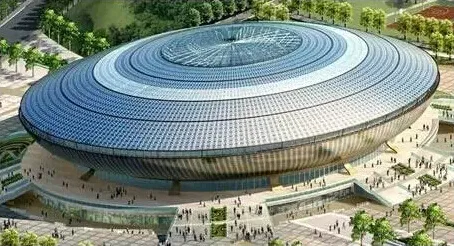
Houjie Sports Center
Software Selection
To develop the BIM model, the choice of modeling software was crucial. After careful evaluation, the Revit and Tekla software suites were selected. The architectural model of Houjie Sports Center was created using Revit Architecture, while the structural model was developed with Tekla Structures.
Tekla Structures was chosen over Revit Structure primarily because it offers specialized modules for precast concrete, making it more suitable for managing prefabricated construction. It also provides parameterized nodes that simplify modeling. For example, Revit was used to design systems for window sills and railings, whereas Tekla Structures included parameterized nodes for reinforcement, significantly boosting modeling efficiency.
After completing the professional models, the Tekla model was exported in IFC format and imported into Revit to assemble the final BIM model.
Tekla Structures integrates 3D solid structural modeling with structural analysis, detailed 3D steel and reinforced concrete design, and automatic generation of CAD drawings. As architectural designs become increasingly complex, Tekla’s multi-user collaboration capabilities offer a robust platform for teamwork during detailed drawing development. The DSTV layout diagrams exported from Tekla ensure precise alignment with main components, eliminating human errors in dimensions or cutting.
Tekla BIM provides an accurate and dynamic 3D environment that enables general contractors, structural engineers, steel structure engineers, and concrete manufacturers to collaborate seamlessly throughout the entire project lifecycle.
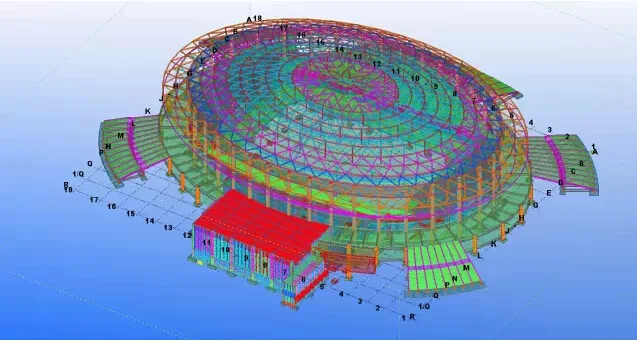
Tekla Model
Application Experience
1. Automated Node Modeling
By leveraging databases and custom programs, steel structure node models were created automatically in batches. These node models were then assembled with steel structure components to complete the steel structure BIM model.
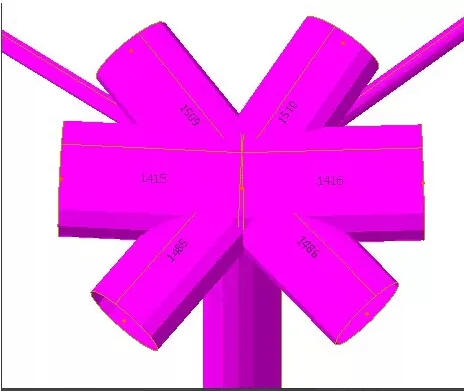
Node Member Diagram
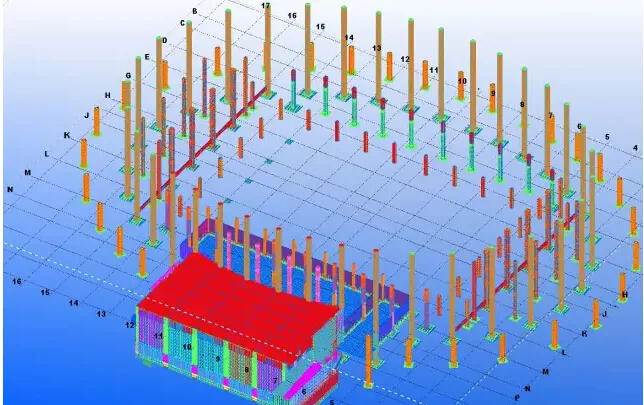
Structural Member Diagram
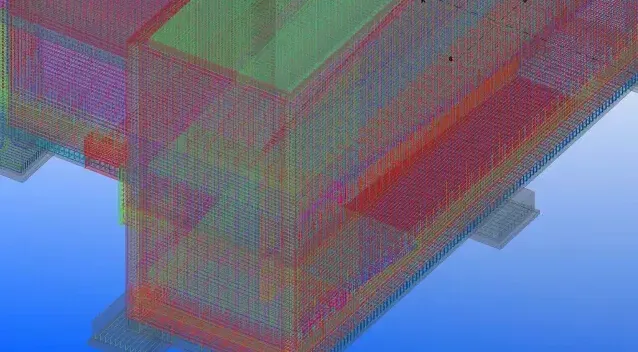
Enlarged View of Structural Members
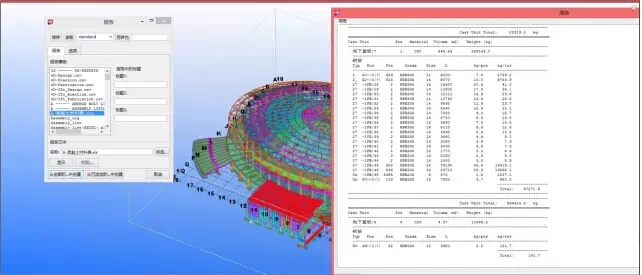
Bill of Materials
2. Construction Drawings
Although 3D modeling is widely used, final design submissions still rely on traditional 2D drawings. Therefore, it’s necessary to convert 3D models into 2D information. Software automatically generates most of the 2D graphics and dimension annotations, which are then fine-tuned to meet drawing standards.
While designers manually add annotation content, the automated generation of graphics and dimensions ensures higher accuracy and consistency, significantly enhancing both the quality and efficiency of the design process.
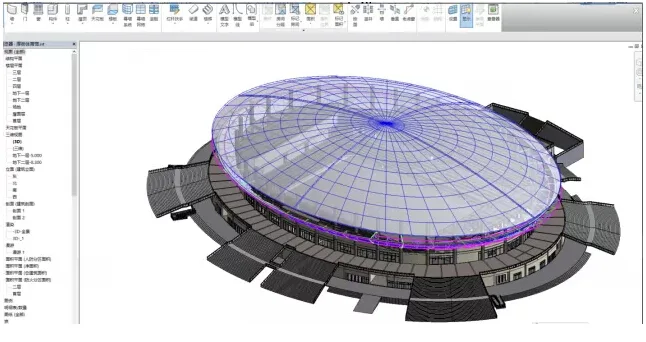
3D Model
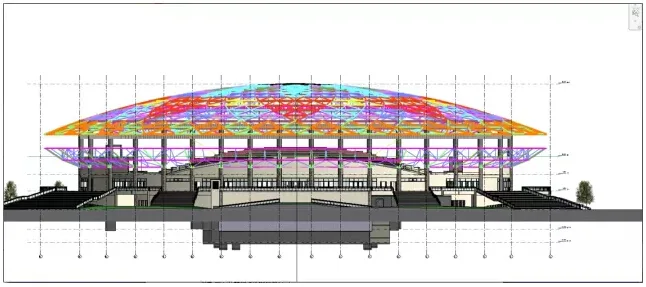
3D to 2D Conversion
3. Material Quantity Calculation
Traditionally, steel structure weight calculations rely on consumption data from structural analysis software, with node weights estimated between 5% and 15% of total steel consumption based on experience. However, the BIM structural model for Houjie Sports Center includes detailed steel nodes, allowing for accurate measurement of steel usage.
Authors and Affiliations:
Liu Bo, Xi’an Jiuhe Architectural Consulting Co., Ltd
Lu Congfeng, Guangdong Qiguang Group
Wang Jiahuan, China Construction Xinjiang Shaanxi Branch













Must log in before commenting!
Sign Up