
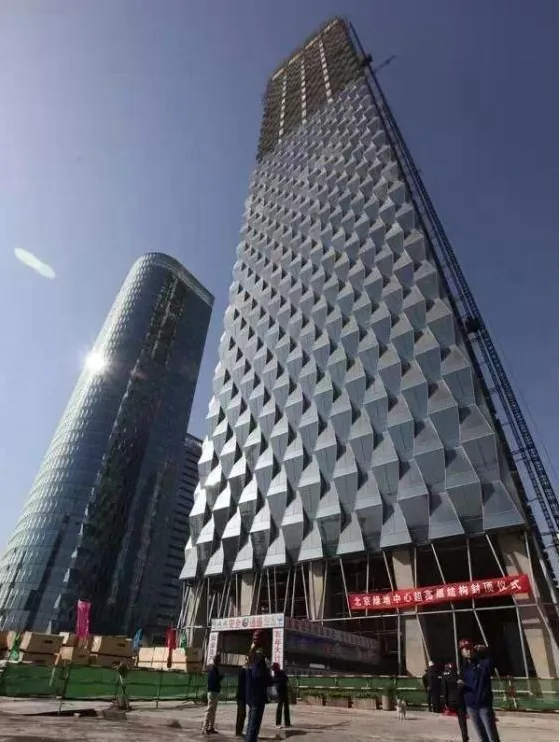
Landmark Buildings in the Capital Airport Area – The Tallest Steel Structure Within National Borders Successfully Topped Out
“Move left a little, a bit more, slow down… slow down… Okay, stop!” As the final steel column was carefully lifted into place, the team from Beijing Construction Sixth Construction marked a major milestone. The ultra-high steel structure of Building 4 at Beijing Greenland Center—the tallest within the country’s borders—has been successfully topped out. This building is set to become a prominent landmark for travelers arriving at and departing from the capital airport area.
Located at No. 3 Dawangjing in Chaoyang District, the Beijing Greenland Center covers approximately 352,000 square meters, with a contract value of 1.08 billion yuan. The project spans two plots, 625 and 627, and comprises five individual commercial office buildings. Notably, Building 4 is a super high-rise structure with 55 floors above ground and an eaves height of 260 meters. Construction began on October 1, 2011, and completion is scheduled for the end of 2015.
With the topping out of Building 4’s super tall steel structure, interior decoration work below the 28th floor is nearly complete. During construction, the projects on plots 625 and 627 earned the prestigious Beijing Structural Great Wall Cup Gold Award and were recognized as Green Construction Demonstration Projects by the Beijing Construction Industry. The site has welcomed over 40 visits, exchanges, and on-site meetings from the Municipal Construction Commission, China Construction, China Railway, District Construction Commission, and District Supervision Station, garnering unanimous praise from industry professionals both locally and nationwide.
Technological Innovations: BIM and Beyond
A building can become a city’s symbol and shape the development of its surrounding area. However, super high-rise structures come with complex designs and demanding construction requirements that present numerous challenges. Zhang Lili, the chief engineer of the Beijing Greenland Center project, led her team in continuous discussions and trials to develop their own expertise in super high-rise construction.
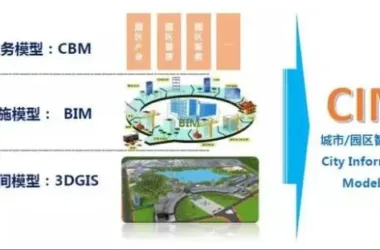
To address the complexity and technical difficulties, the project team adopted Building Information Modeling (BIM) technology to enhance management and boost efficiency. Using BIM models, they performed comprehensive analyses of spatial, temporal, and cost factors. They simulated key construction processes such as dismantling super high-rise tower cranes and lifting guide-rail self-climbing formwork to devise construction plans tailored to the project’s unique needs.
3D models facilitated detailed drawing reviews and collaboration among design, construction, and supervision teams. Electronic sand tables and promotional videos were used for project presentations and reporting. These innovative management approaches significantly improved coordination among all stakeholders, making communication, discussions, and decision-making more visual and efficient. This transformed the traditionally complex super high-rise project management into a faster and more streamlined process, marking a major advancement in BIM-based project management.
The project team also partnered with BIM research groups to explore additional applications, including vertical transportation organization, pre-assembly of large components, and advancing the sustainable Green Center initiative through BIM technology.
Scientific Management Accelerates Construction
Spanning 350,000 square meters with five distinct projects—including a 260-meter super high-rise building—and employing over a thousand workers, the project manager faced numerous challenges: managing the site effectively, maintaining rapid progress, and ensuring quality, safety, and orderly construction.
To meet these challenges, the project department established 12 permanent divisions along with a contract procurement office. These included production management, mechanical and electrical management, steel structure management, financial accounting, budgeting and contracts, material management, design coordination, research and development, technical management, surveying and layout, quality control, safety, and a comprehensive office. Responsibilities were clearly defined and management was strengthened from the outset.
The team emphasized standardization, institutionalization, refinement, procedural adherence, and normalization of management practices. They developed the “Five Modernizations” management standards and launched the “Implementation Rules for Planning and Management of Beijing Greenland Center Project.” To better control costs, a procurement fund management office was created, staffed by the project secretary, deputy public relations manager, deputy production manager, and business manager. This office oversees material procurement above set thresholds, subcontract bidding, and fund disbursement.
A weekly economic analysis meeting system was established, involving department heads and project members, to review and decide on all cost-related issues promptly. Additionally, material management policies require bulk materials to be centrally tendered and purchased through the Material Management Branch of Beijing Construction Sixth Construction Group.
Overcoming Site Constraints Through Scientific Construction
Plot 627 posed particular challenges due to its narrow construction site. The project team held multiple discussions to develop vertical transportation plans for each construction phase, ultimately devising a phased site layout adjustment strategy. During the foundational phase, the material yard was divided into two zones: one surrounding the building, with designated areas for steel structures, formwork, and turnover materials on the east and north sides; the second located 300 meters north, requiring cranes for secondary transport.
During the main structure phase, the technical department relocated the steel structure stacking area within the tower crane’s lifting radius, reducing secondary transport and greatly improving the efficiency of lifting large steel components—thus accelerating main structure construction.
Close cooperation with specialized branches further ensured rapid progress. The greatest challenge was Building 4, standing 260 meters tall. Its steel structure, comprising nearly 20 floors underground and above ground, demanded larger volumes and heavier loads than conventional buildings. The extremely limited site size meant ordinary tower cranes could not meet the lifting height, weight, and turning radius requirements.
To resolve this, the project department collaborated extensively with the group’s mechanical construction branch, developing eight different crane plans for review with the client. Ultimately, the mechanical construction branch selected two STL720 boom tower cranes, which proved best suited for constructing super high-rise buildings.












Must log in before commenting!
Sign Up