
The century-old Zhejiang Road Bridge will undergo a major closure for repairs starting April 18th. The bridge’s steel structure will be fully integrated and relocated temporarily—moved 100 meters north to the Suzhou River’s bank for restoration before being returned to its original location. This intricate process will utilize advanced BIM technology.
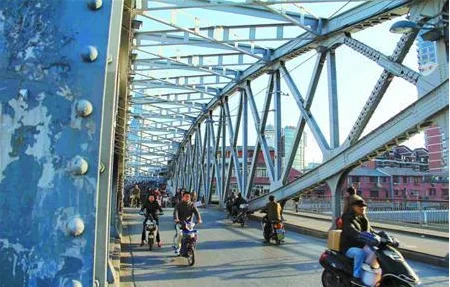
On March 25th, vehicles and pedestrians crossed the historic Zhejiang Road Bridge for the last time before its upcoming overhaul. Preparations for this significant restoration are well underway.
The Municipal Road Administration Bureau announced that the bridge will be temporarily closed during this repair period, with traffic and pedestrians redirected to nearby bridges. The project is expected to be completed by early next year, with an estimated budget of 100 million yuan.
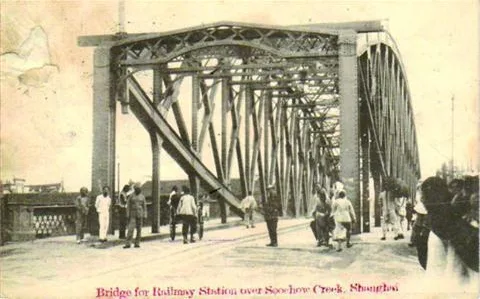
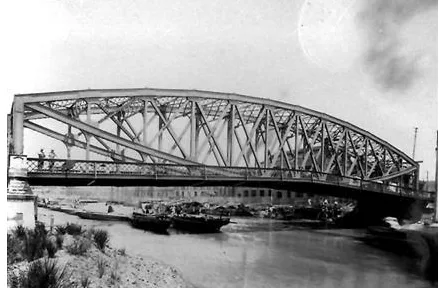
Constructed in 1908, Zhejiang Road Bridge is now 107 years old—just one year younger than Shanghai’s Garden Bridge. It is the only remaining fishbelly steel truss bridge in both China and Asia. Originally, the bridge carried a monorail that supported Yingdian trams 5 and 6.
Historical Background
The Zhejiang Road Bridge has a long and rich history.
By the 19th century, many residents lived along the north bank of the Suzhou River, while the south bank consisted mainly of concessions with frequent economic interactions between the two sides. This is reflected in the dense network of bridges over the river—there are about ten between Shanghai’s Garden Bridge and Changshou Road.
Zhejiang Road Bridge originally began as a wooden pedestrian bridge. In 1880, the Shanghai Ministry of Works built this wooden bridge at the request of foreign residents near Zhejiang Road. At the time, the nearby British concessions disposed of waste in docks near the bridge, earning the bridge the nickname “Old Garbage Bridge.”
Due to deterioration, the original wooden bridge was demolished in 1887 and replaced with a new wooden bridge 5.19 meters wide.
In 1908, the wooden bridge was replaced with a steel structure. The Ministry of Works adopted a British design, purchasing British steel to construct a fishbelly simply supported beam steel truss bridge. The foundation consisted of wooden pile abutments with a gravity bridge design. A monorail track was laid, serving the Yingdian 5th and 6th trams. The Zhejiang Road Bridge is the seventh bridge on the Suzhou Creek and one of only two remaining old steel-structure bridges in the area, and the only fishbelly steel truss bridge left in China and Asia.
Shang Guoping, Deputy Director of the Road Construction Department of the Municipal Road Administration Bureau, noted, “At the beginning of the 20th century, single-span bridges spanning about 60 meters were technologically advanced. Apart from large arch bridges, such spans were rare in China at the time.”
He explained that steel structure bridges like Zhejiang Road Bridge could bear heavier loads than concrete bridges, and unlike other bridges with piers in the river such as Sichuan Road Bridge and Henan Road Bridge, its design offered both functionality and aesthetic appeal. The bridge’s appearance was intentionally made to look more lightweight, inspiring later steel bridge designs.
Why the Repair is Necessary
The main reason for this major repair is the bridge’s advanced age.
Built in 1908, the fishbelly steel structure has been in use for over 100 years. Since its completion, it has only undergone one major overhaul in 1976. In comparison, Shanghai’s Garden Bridge was overhauled in 2008, while Zhejiang Road Bridge only received anti-corrosion repainting at that time. Though minor repairs have been ongoing, the steel’s bearing capacity has gradually weakened due to corrosion and fatigue, necessitating a comprehensive overhaul.
Given its unique status as the only fishbelly steel structure bridge in Asia, its historical value is significant. The restoration aims to preserve its original 1908 appearance, removing later additions like sidewalks and non-motorized lanes added during the 1976 renovation.
Shang Guoping emphasized that rust removal is a critical part of the renovation. Since rust diminishes the steel’s cross-section and load capacity, this step is essential. To avoid environmental pollution from sandblasting, all rust removal and repairs will take place in a closed factory building being constructed about 150 meters from the north bank of the Suzhou River.
The project is led by the Shanghai Municipal Engineering Institute. Qian Cheng, the site project leader, described the temporary facility as a five- to six-story high steel structure designed to house the entire bridge’s steel skeleton during repairs.
“Our goal is to extend the life of this century-old bridge for another 50 years,” Shang Guoping said. More than a decade ago, the city’s road administration partnered with Tongji University to study the bridge’s lifespan and functionality, earning a Shanghai Science and Technology Progress Third Prize. Further testing inside the factory will assess each component’s remaining life and determine which parts must be replaced.
Senior engineer Chen Liang explained that the new steel used must closely match the chemical composition of the original early 20th-century steel to ensure structural compatibility and performance. After dismantling, stress and traction analysis will guide steel selection for repairs.
How the Repair Will Be Conducted
Moving the entire bridge structure for repair is a complex task.
Unlike the Garden Bridge, which was moved to a distant shipyard, the narrow Suzhou River limits such options. Instead, a temporary factory building will be constructed nearby to accommodate repairs.
First, the entire bridge will be lifted and moved approximately 150 meters to this factory building. A 600-ton crane on the north bank will lift one end, while a carrying vessel will raise the southern end by utilizing buoyancy during high tide, after removing the concrete and asphalt deck to reduce weight to around 400 tons.
The bridge will then be transported on two vehicles to the repair site.
The move is scheduled for May 10th.
Chen Liang explained that precise positioning is critical during this move. BIM technology has been used to simulate the entire process in 3D, calculating angles, heights, and potential collision points to prevent errors and rework.
Advanced 3D scanning will also be employed to capture exact dimensions and rivet locations. This data will be compared with construction drawings to ensure accuracy during reassembly. Previous repairs scattered crucial information about materials and components, but the BIM-based scans will establish a comprehensive database for future maintenance.
Traffic Diversion and Project Timeline
The project aims for completion by the end of this year.
During the closure, bus routes and vehicle traffic will be rerouted. Bus No. 14 will divert to Henan Road Bridge, and Bus No. 15 will reroute to Xizang Road Bridge. Motor vehicles will be advised to use Xizang Road Bridge and Henan Road Bridge, approximately 300 meters detour. Pedestrians and cyclists will be guided to Fujian Road Bridge and Shanxi Road Bridge.
Captain Tao Li, who has driven Bus Route 15 for over 30 years, recalled that this route was originally a tram line on Zhejiang Road Bridge in the early 20th century, with tracks similar to railways.
Bus Route 15 drivers welcomed the return to Xizang Road Bridge, the historic route. Shi Jianhua, a driver since 1985, shared that current buses are upgraded, electric vehicles running between Shanghai Sports Stadium and Zhejiang Road Tianmu Road with 17 stops each way.
Shi noted that passengers are mostly white-collar workers and elderly commuters, with moderate peak-hour ridership. Passengers appreciate the air conditioning and onboard TV, often finding seats readily available.
After the bridge closure, Bus 15 stops will be adjusted, with station names updated to reflect new locations. Despite around 10,000 daily passengers, the proximity of new stops minimizes inconvenience. Both outbound and inbound routes will now use Xizang Middle Road, which may reduce travel time.
Tao Li confirmed that notices will be posted at all bus stops and on vehicles five days before the closure to inform passengers of the changes.
Timeline of Zhejiang Road Bridge
The bridge has undergone numerous changes over its lifetime:
- 1880: Wooden pedestrian bridge erected at current site.
- 1887: Original wooden bridge replaced with new wooden structure, 5.19 meters wide.
- 1908: Wooden bridge replaced by fishbelly steel truss bridge using British steel, with a single tram track.
- 1924: Single track converted to double; deck upgraded to cement concrete; sidewalks replaced with prefabricated concrete slabs.
- 1946: Paint maintenance performed.
- 1954: Bridge pier widened.
- 1955: Crossbeam reinforced.
- 1965: General repairs and reinforcement.
- 1976: Major overhaul adding pedestrian walkways and altering gantry appearance.
- 1993: Non-motorized vehicle lanes reinforced.
- 1997: Further bridge reinforcement and design improvements.
- 2008: Rust removal, component replacement, repainting, and asphalt paving.
Today, Zhejiang Road Bridge operates as a one-way bridge for vehicles traveling north to south and serves tram routes 14 and 15.














Must log in before commenting!
Sign Up