
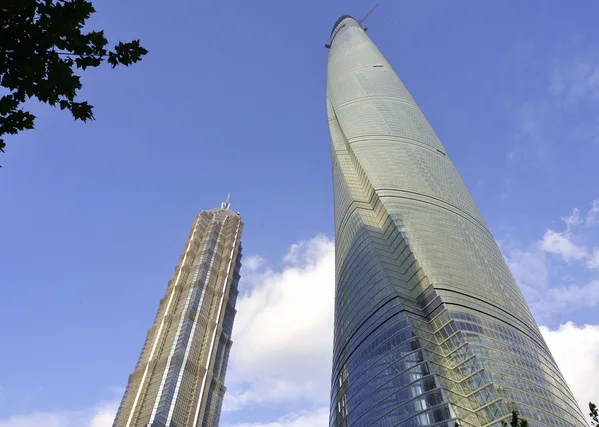
“Shanghai Center Building won the bid!” The Huading Decoration team was ecstatic, with employees eagerly sharing the news and celebrating their success. Situated in the financial core of Lujiazui, the Shanghai Center is a new landmark skyscraper, neighbored by the Shanghai World Financial Center to the east and the Jinmao Tower to the north. Standing at 632 meters, it is currently the tallest building in Shanghai, the second tallest in China, and ranks fourth worldwide.
Due to the building’s prominence, once the interior decoration bidding information was released, over 100 decoration companies registered their interest. Huading Decoration participated in bidding for four sections and emerged victorious among 15 well-known domestic competitors. The team’s excitement was overwhelming—they cheered and celebrated their hard-earned victory.
Challenges Loom Like Mountains
Winning the bid for such a prestigious project was thrilling, but the construction challenges proved daunting. Huading Decoration secured the E section, which encompasses the commercial public areas from floors 1 to 4, the office lobby, and the underground elevator halls from B3 to B5—covering roughly 20,000 square meters.
This section posed the highest technical demands and complexity of any interior decoration within the skyscraper. Key features included seven large stainless steel components: the Tongtian and giant elliptical pillars measuring 7.2 meters in length, 6.1 meters in width, inclined inward at 87.5 degrees, and soaring 25 meters to the floor above.
The hyperbolic curved ceiling stretching from the second to fifth floors required exceptional precision. Built with triangular perforated aluminum plates radiating out from the core tube on the second floor to the slab edges and extending up to the fifth floor ceiling connected to the outer curtain wall, the design comprised over 13,000 triangular plates with varying curved surfaces. The radius of curvature ranged from 25 to 37 meters, meaning even a one-millimeter error in a single plate could translate into meters of misalignment at the ends. Given the project team’s lack of prior experience with such complex decoration, the construction challenge was immense.
The unique and intricate design of the office and commercial lobbies in such a world-class building, involving numerous disciplines working in close coordination, presented formidable obstacles. The difficulties seemed insurmountable, blocking the team’s path forward. As the saying goes, “Difficulties are like mountains; only by climbing can one become a hero.” The project team, facing no alternatives, embraced this mindset. They believed that courage and wisdom would lead them to success, determined to become leaders in the interior decoration industry of Shanghai’s tallest building and to reach new heights.
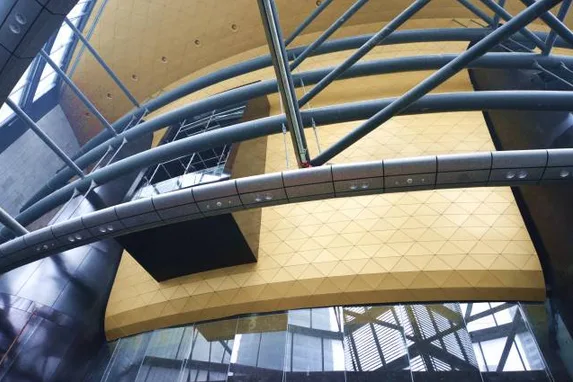
(Interior facade decoration of Shanghai Center Building)
Adopting BIM Technology to Overcome Challenges
Where should the team begin to tackle these challenges? After careful analysis, they concluded that BIM (Building Information Modeling) technology, an advanced 3D digital design solution for creating visual building models, offered the best chance to overcome obstacles. BIM is widely used in architecture, mechanical, electrical, and structural engineering. Although interior decoration industry standards for BIM are still evolving and practical applications remain exploratory, leveraging BIM’s strengths was the only viable technical approach.
The company promptly appointed a BIM specialist and formed a dedicated BIM team to explore and apply the technology to the project.
Creating a comprehensive information model and achieving three-dimensional reconstruction for detailed construction is challenging, especially with complex indoor structures and diverse forms. The BIM team carefully examined the project’s characteristics and selected appropriate modeling software after thorough comparison.
They chose REVIT for its robust capabilities in conventional building modeling and integration, and RHINO (commonly used in industrial design) for handling free-form surfaces. By combining the strengths of both, they maximized BIM’s effectiveness and efficiency for the project.
During the BIM modeling phase, the team considered both general and specific needs, building a detailed information model that included components, materials, dimensions, and costs. This model not only supported detailed design and construction drawings but also facilitated precise positioning and layout during construction. It was also useful for later quantity calculations.
They made timely adjustments based on real-world challenges. For example, modeling the entire region at once generated an overwhelming amount of data that hindered computer performance. To resolve this, the team divided the model into smaller sections, then reorganized them as needed, effectively managing the complexity. With BIM, the project’s difficulties became manageable and achievable.
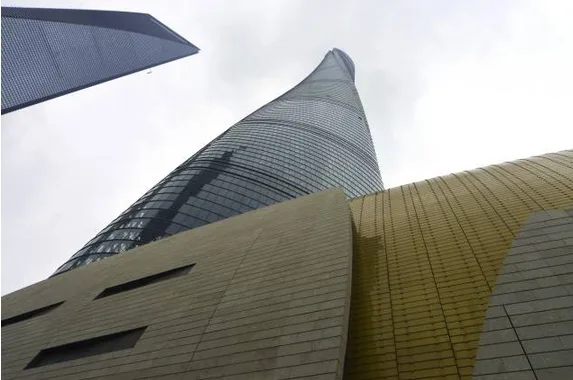
(Exterior view of Shanghai Center Building)
Leveraging BIM’s Benefits and Achieving Success
At the early construction stage, Huading Decoration’s project department focused on using BIM’s features to predict and resolve potential issues. This innovation brought immediate benefits, including:
- Visual Modeling: BIM provided a clear, detailed visual representation of decorative semi-finished and finished products. This enabled construction teams to verify if design details met owner requirements and aligned with the original design concept, improving understanding and communication.
- Collision Detection: The interconnected BIM models allowed computer-based clash detection, identifying potential conflicts between systems before construction. This saved time and avoided costly rework or delays. For instance, after modeling the large arched roof space, the project team detected a previously unnoticed collision between steel cables and the triangular aluminum plate ceiling. Early detection allowed prompt resolution, preventing major construction issues.
- Factory Processing and On-site Installation: The hyperbolic curved ceiling posed significant challenges due to the unique size and angles of each triangular plate. Using real-time BIM modeling combined with on-site data verification, the team identified problems and made precise adjustments. The large space was segmented into triangular plates via the 3D model, enabling accurate factory fabrication and rapid pre-assembly.
The Shanghai Center project serves as a prime example of high-level BIM application. In an interview, the BIM lead expressed that the technology genuinely delivered tangible benefits and proved its value through innovation. They pledged to carefully review and learn from the project’s successes and shortcomings, aiming to unlock even greater potential for BIM in future interior decoration projects.














Must log in before commenting!
Sign Up