
One Island East opened in April 2008. Despite its impressive 70 floors and height of 308 meters, it is not the tallest building in Hong Kong. However, it stands out for its pioneering use of advanced Building Information Modeling (BIM) technology, as illustrated in the image below. The diagram showcases the building’s comprehensive mechanical and electrical systems.
Swire Properties, the owner, partnered with Gehry Technologies to establish a BIM office adjacent to the construction site. From the conceptual design phase onward, contractor Gammon Construction and specialized subcontractors collaborated closely with the design team to create and maintain BIM models on-site. Additionally, the Construction Virtual Prototyping Laboratory at The Hong Kong Polytechnic University contributed by simulating the construction processes.
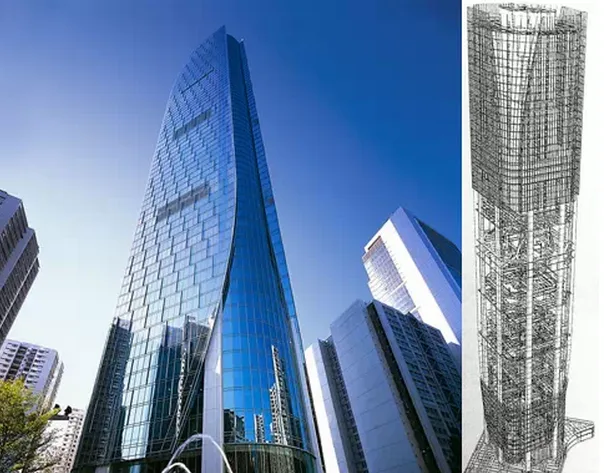
Founded in 2002, Gehry Technologies initially focused on developing and promoting Dassault Systèmes’ CATIA 3D CAD system. This system had previously been instrumental in designing iconic structures like the Guggenheim Museum Bilbao. Originally, CATIA provided advanced curve and surface modeling primarily for the aerospace and automotive industries. In 1998, it released a fully functional fifth edition compatible with personal computers.
Embracing the challenges of the 1990s, Gehry Technologies introduced the concept of designing “organic building forms.” Gehry Partners adopted CATIA from the outset to meet these demands. As Gehry gained confidence in the technology, he developed an integrated engineering information management system named Digital Project. This system combined CATIA’s fifth edition capabilities with Product Lifecycle Management (PLM).
In 2004, Gehry Technologies showcased their innovations at The Hong Kong Polytechnic University. By early 2005, Swire Pacific had adopted Digital Project as its internal BIM platform, applying it to the One Island East project. Previously, Wong and Ouyang and their design team relied on 2D CAD for architectural work. After training from Gehry Technologies, the design team collaborated closely with Golden Gate Architecture and other consultants using Digital Project.
Over two years, nearly 500 people contributed to producing BIM models, with the investment amounting to roughly 1% of the total project cost. While Swire Properties has not officially confirmed this, the industry generally targets cost savings of around 10% through BIM implementation. The use of BIM on this project demonstrated clear benefits throughout all phases, from design to on-site construction.
Collision Detection
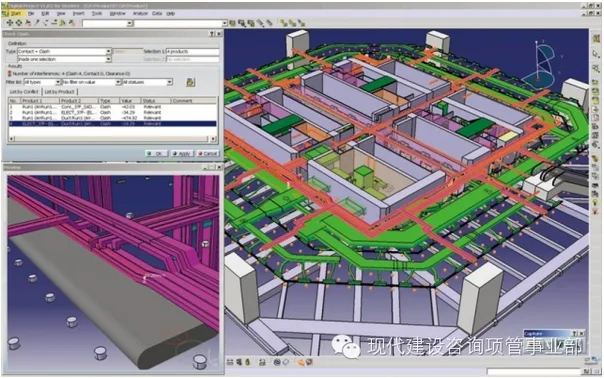
The complexity of high-rise buildings often results in numerous potential clashes between systems that require resolution during construction. Before site work began, Digital Project identified over 200 clashes between equipment systems and structural components (see Figure 1). This process is especially critical for mechanical and electrical systems. The contractor Balfour Beatty worked closely with the BIM team throughout the project. During construction, ongoing modeling detected an average of 150 clashes per week, enabling proactive problem-solving.
Creating Parameterized Objects
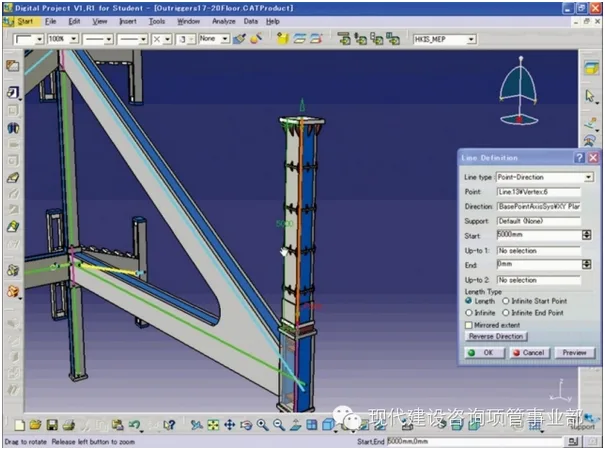
Rather than modeling repetitive components individually, simple rules were applied to generate elements such as steel trusses. These parameterized objects can be stored and reused in future projects, facilitating efficient knowledge management. Figure 2 illustrates repetitive structural elements generated through parameter settings.
Cost Planning
BIM enables direct extraction of quantities from the model using local measurement standards. As the design evolves, these calculations update automatically. This allows quantity surveyors to focus on market analysis for cost estimation and provide faster budget feedback.
Virtual Prototyping
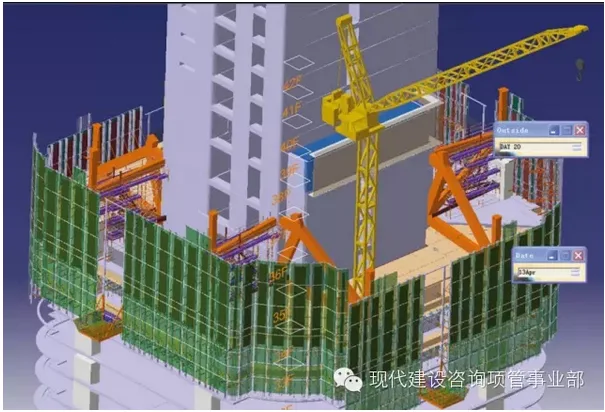
Using 4D scheduling with Primavera, complex construction tasks such as formwork collision detection can be simulated in advance. Many tasks in high-rise construction repeat floor by floor, and virtual prototypes help create detailed schedules within a four-day construction cycle. This approach leverages virtual prototyping technology developed by Dassault Systèmes for manufacturing processes. It also generates parameter models for temporary engineering components during installation.
Figure 3 presents a virtual prototype for a four-day-per-floor construction cycle. This visualization instills confidence in contractors and owners by demonstrating the feasibility of the schedule. The irregular upper cantilever truss posed significant challenges and was given special attention in the BIM model, resulting in a time saving of 21 days in the pre-construction schedule.
Safety
High-rise construction is inherently hazardous, especially in confined spaces like those at One Island East. BIM was used to analyze material storage and construction elevator areas before work commenced to ensure safety throughout the project.
Bidding Process
Professional subcontractors invited to bid received bills of quantities automatically generated in Excel format via BIM. Bidders used 4D models to analyze alternative construction methods. The comprehensive BIM model enhanced confidence among users, allowing subcontractors to offer lower prices due to reduced contingency requirements—particularly for equipment systems. Besides lower bids, BIM significantly helped avoid costly claims.
Drawing Coordination
Digital Project coordinated the submission of 2D paper drawings to the design team, ensuring consistency across all production versions. Importantly, these drawings were always outputs from the BIM model, never inputs.
Project External Network
The project’s external network complemented BIM by providing offsite access to information not stored within the BIM system, supporting the design team when away from the site.
Since Digital Project was adopted from the conceptual design stage, the Hong Kong Island East Centre project did not fully utilize some of BIM’s more advanced features. Nevertheless, BIM played a critical role in the project’s successful completion. Swire Properties plans to continue using Digital Project early in future projects, and Kinmen Construction has also integrated Digital Project into other construction endeavors.














Must log in before commenting!
Sign Up