
The project site covers a total area of 215,549 square meters, featuring terrain that is elevated in the center and slopes downward towards the edges. To the west, the plot borders a planned urban road, while the east side faces the South China Sea, accompanied by a public green belt approximately 25 meters wide along the coastline. Both the northern and southern boundaries are designated as public green spaces. With abundant landscape resources, this location is ideal for a combination of commercial and leisure hotel development.
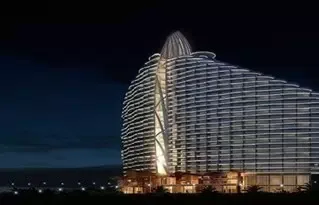
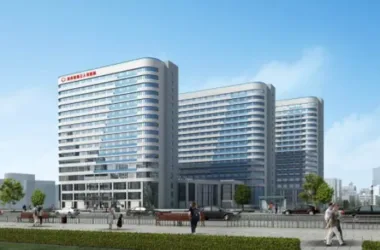
The project comprises three interconnected buildings—the main hotel building, the main banquet hall, and a smaller banquet hall—along with a standalone boiler room. The total construction area spans 160,563 square meters. The main complex (including the hotel and banquet halls) accounts for 160,329 square meters, featuring 30 floors above ground and 4 below. The building’s height reaches 120.2 meters, with the highest point at 148.18 meters. Equipped with comprehensive facilities, the project is poised to become a prominent landmark upon completion.
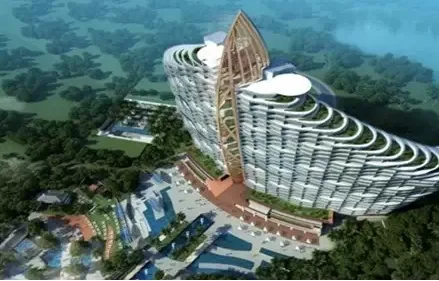
This project utilizes BIM technology throughout the design process, revolutionizing workflows, boosting efficiency, and enhancing service quality. Architectural and structural designs are based on BIM models, while mechanical and electrical systems collaborate through DWG files for data extraction and reverse engineering, establishing a combined 3D-2D workflow.
It is important to note that BIM is more than simple modeling or renderings. Renderings are created from linear data and lack interactivity, whereas BIM enables dynamic interaction and feedback between components. This interactive visualization can be used not only for presentations but also for generating 2D design drawings and reports. Most importantly, project communication, discussions, and decision-making during design, construction, and operation all occur within this visualized framework.
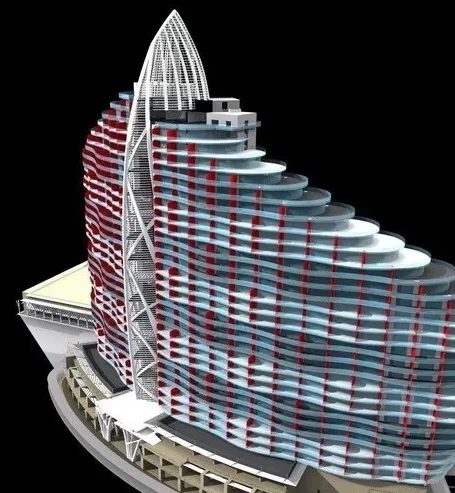
Building structural model
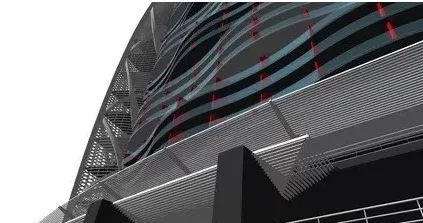
The exterior facade of the podium features numerous decorative elements, characterized by intricate and well-structured designs. These components primarily consist of wooden grilles.
There are two key considerations when integrating a large number of wooden grilles on the facade. First, the scale and arrangement of the grilles must harmonize with the architectural form and surrounding environment. Second, the size specifications of the wooden grilles should be minimized and standardized wherever possible. To address these challenges, designers are employing parametric design to control the grille specifications.
The parametric control of the wooden grille facade is structured into three levels:
1. The fundamental unit is the wooden strip itself, with parameters for length, width, and height forming the first level of control.
2. The second level governs the layout of the wooden strips, including spacing, angles, and hierarchical relationships.
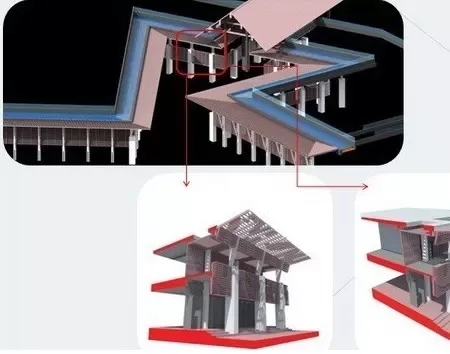
The arrangement of the wooden grilles is constrained by the shape of the facade, necessitating precise control over boundaries and turning points in the grille design.
Design Challenges
Double Curved Surface Design of the Tower Atrium
The atrium structure within the main building presents exceptional complexity. Throughout the design process, the scheme was developed and refined using the Revit model, which assisted in structural calculations and validation. Complex components like these are designed using 3D models, from which 2D design drawings can be generated. Additionally, it is possible to directly export component parameters to manufacturers, eliminating the need for traditional 2D drawings.
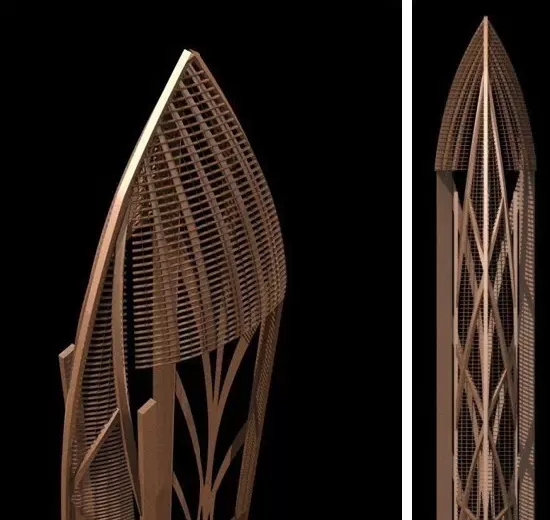
Hyperbolic model diagram of tower atrium












Must log in before commenting!
Sign Up