
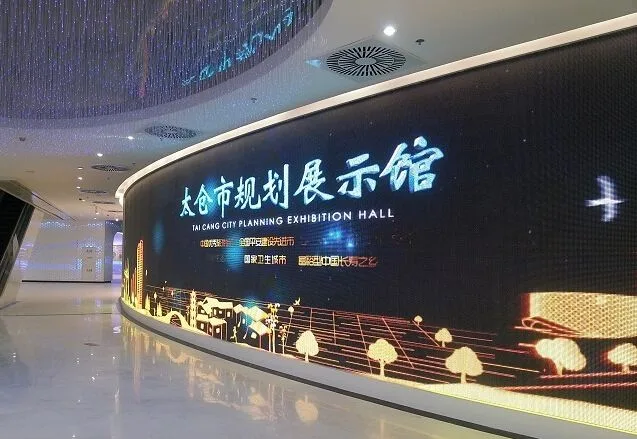
Indoor photos after completion
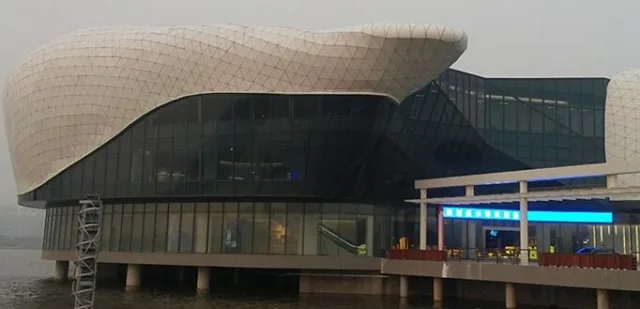
Exterior view after completion
1. Project Overview
The Taicang City Planning Exhibition Hall is a multi-story building located in the southern suburban new city area of Taicang, Jiangsu Province. Designed primarily for urban planning exhibitions, the building covers approximately 14,765 square meters. Its distinctive form resembles two fish chasing each other.
The structure includes one underground floor and three floors above ground, each with a height of 6 meters. The concrete structural height reaches 18 meters, while the top of the single-layer steel mesh shell, shaped like a fish, rises to about 28 meters.
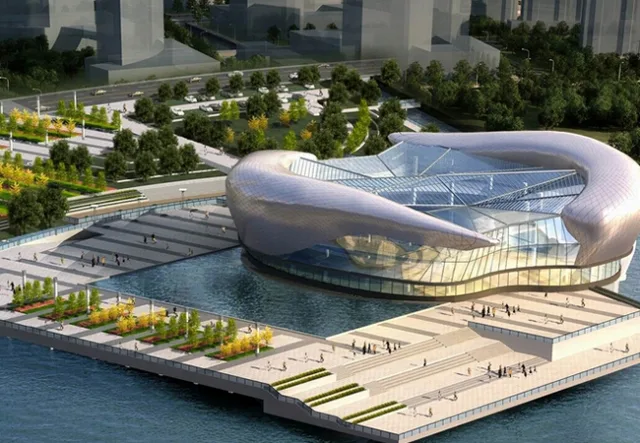
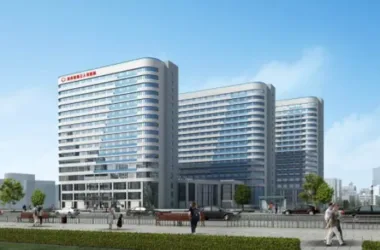
Architectural rendering
2. Main Structural Design
The main structure of the exhibition hall is divided into three parts: below the third floor is a reinforced concrete structure; above it are two fish-shaped, single-layer mesh shell steel structures and a prestressed tension chord beam steel skylight spanning 66.3 meters.
2.1 Concrete Structural System
The upper fish-shaped portion of the building is an abstract form without geometric composition rules. The reinforced concrete base has a plan shape derived from a 3D model, essentially forming an elliptical ring.
The main concrete structure employs a frame shear wall system, with some seismic walls integrated near the elevator lobby for added stability.
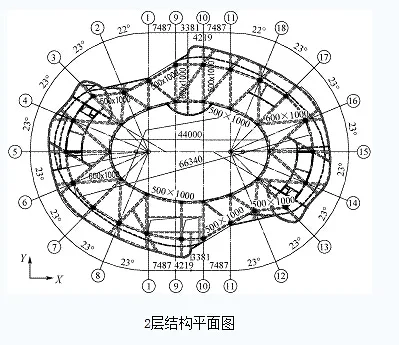
2.2 Fish-Shaped Single-Layer Mesh Shell
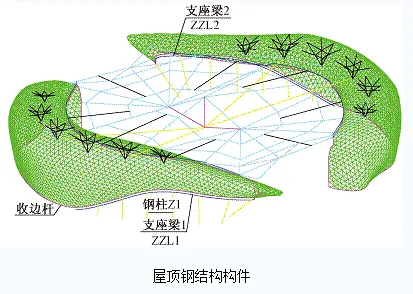
The fish-shaped enclosure utilizes a single-layer mesh shell composed entirely of rectangular tube members. The lower edge of the mesh shell rests on reinforced concrete cantilever floor beams and transitions to the skylight through Support Beam 1. The upper edge is supported by steel beams of the central skylight via Support Beam 2.
Midway, the mesh shell is supported by secondary umbrella-shaped supports atop concrete columns. The fish tail, which is cantilevered outward, is supported at the junction of Support Beams 1 and 2. Support Beam 1 connects to the concrete structure through steel columns, while Support Beam 2 is supported on the skylight.
The mesh employs a triangular pattern with approximately 1-meter side lengths. All support nodes are hinged, allowing for flexible movement.
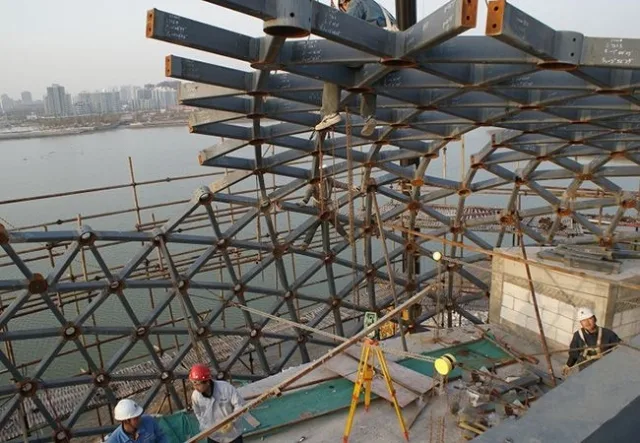
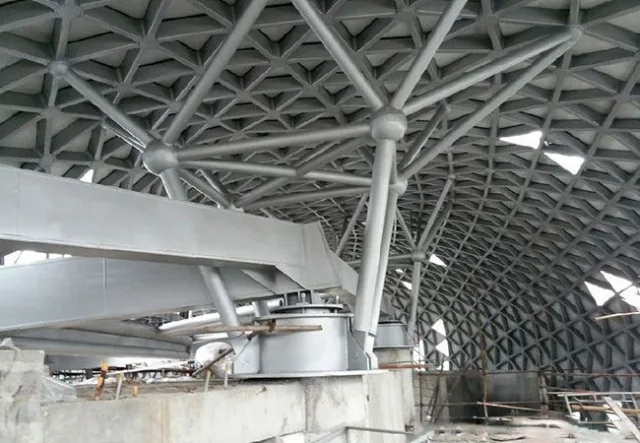
Construction site of the single-layer mesh shell
2.3 String Beam Skylight Roof
The skylight roof above the exhibition hall’s atrium features overlapping elevations with a large span. The structural system consists of two diagonal chord beams and multiple radial beams.
When loaded, the radial steel beams transfer vertical loads to cast steel nodes 1 and 3, which then transmit forces to four pot-type rubber bearings via the chord beams.
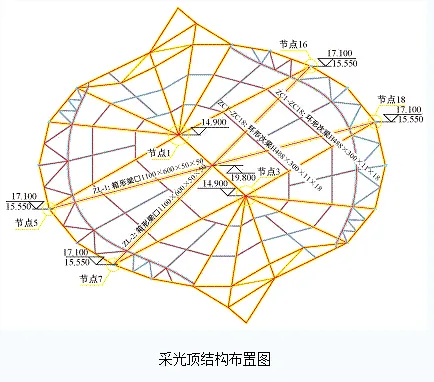
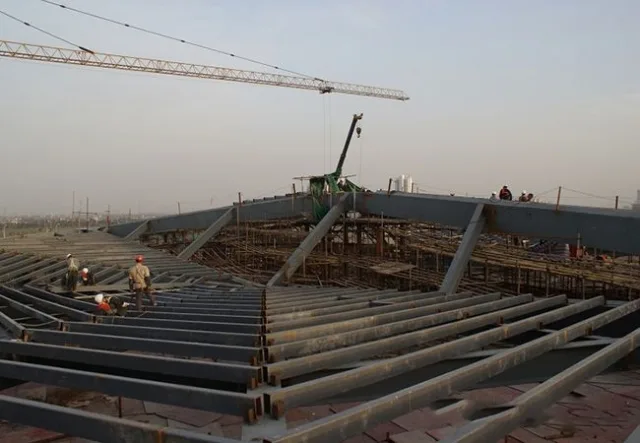
Construction site of the large-span roof truss beam
3. Introduction to BIM Design in Engineering
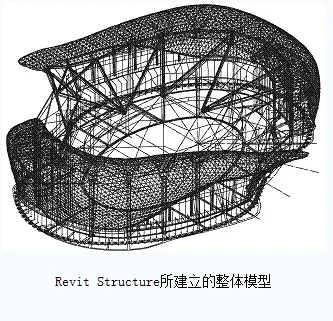
Due to the building’s many irregular spatial structures lacking geometric composition rules, traditional 2D graphics are insufficient for accurate representation. However, Revit excels in curve modeling, allowing precise modeling of complex shapes.
By grouping complex roof forms into simpler work sets, each building component—such as roof panels, edge beams, primary and secondary beams, columns, and walls—is modeled separately before being combined into the final spatial model.
This approach ensures precise spatial positioning of beams, walls, and columns. Especially for components on the fish-shaped mesh shell, it clearly identifies any potential clashes with other elements or equipment pipelines.
4. Structural Calculation and Analysis
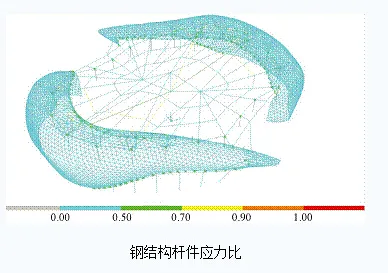
Structural static analysis was performed using SAP2000 software. Stress ratios for various members were maintained below 0.9, while critical components such as prestressed cables and braces were kept below 0.6 to ensure safety.
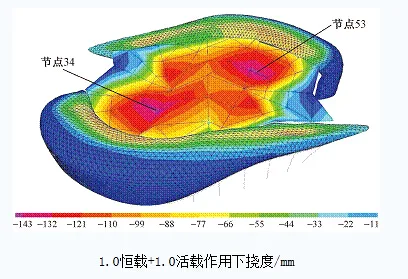
Under a load combination of 1.0 constant load and 1.0 live load, the maximum displacements occurred at nodes 34 and 53, measuring 146.95 mm, 146.92 mm, and 146.92 mm respectively, all within code requirements.
Seismic response spectrum analysis was conducted considering earthquake loads, calculating the first 120 modes. Results confirmed that internal forces within structural members comply with earthquake design standards.
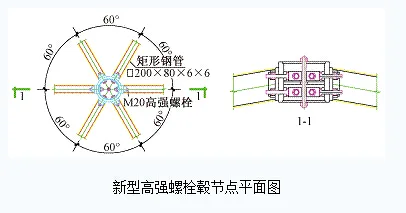
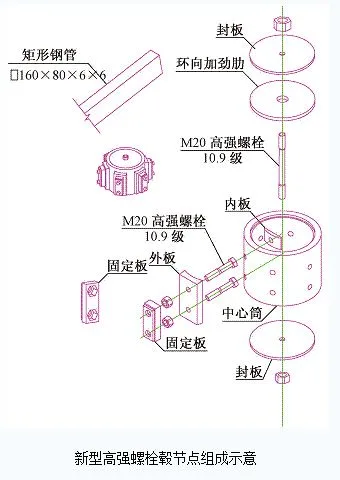
5. Design of New High-Strength Bolt Hub Nodes for Fish-Shaped Single-Layer Mesh Shell
The design incorporates new high-strength bolt hub nodes, replacing traditional welding connections. By applying torque to these bolts, a pre-tension force is induced, pressing the arc-shaped end faces of members tightly against the hub node sides.
This creates sufficient friction at the contact surfaces to resist end shear forces, thereby ensuring node stiffness and structural integrity.












Must log in before commenting!
Sign Up