
1. Project Introduction
Wangfujing Hotel, established in 1986, is located in the bustling business district of Wangfujing Street, Dongcheng District, Beijing. As a nationally renowned brand positioned in Beijing’s traditional commercial center, this hotel has undergone a renovation to elevate the quality of its accommodations, meeting facilities, dining, and banquet services. The renovation aims to maximize impact while minimizing structural changes.
The project involves the renovation and expansion of the existing main structure, which originally featured a frame shear wall design. The northwest and southwest facades were extended outward by 1.3 meters starting from the third floor, while the east facade was expanded by 1.6 meters from the sixth floor. Room layouts on standard floors were redesigned, and the new extension was constructed using steel beams, steel columns, and concrete slabs. Coordination with mechanical, electrical, and decoration teams ensured precise integration, including opening and sealing holes in structural beams and slabs.
The semi-basement parking area in the original courtyard was partially demolished and reconstructed within the original footprint. Additionally, a new quadrangle courtyard building was added on the basement roof, harmonizing with the surrounding cultural environment and highlighting the unique cultural significance of the hotel’s location.
The project covers a base area of 9,857.9 square meters. After renovation, the total construction area reached 44,381 square meters, with 33,100 square meters above ground and 11,281 square meters underground. The building comprises 14 floors and stands 45 meters tall.
2. Introduction to BIM Technology
In July 2013, Shaanxi Construction Engineering Installation Group Co., Ltd. (Shaan An Group) secured the contract to renovate and install mechanical and electrical systems at Beijing Wangfujing Hotel, with a budget of 60 million yuan.
Shaan An Group has strategically focused on industrial projects while expanding into high-tech, precision, and specialized fields, leveraging advanced information technology to boost competitiveness. Building Information Modeling (BIM) is a key technology in construction industry informatization, recognized by China’s Ministry of Housing and Urban-Rural Development as a core technology for 2011-2015.
BIM offers five core features: visualization, coordination, simulation, optimization, and graphical representation. It represents a major advancement beyond traditional CAD tools. With BIM adoption growing rapidly in large-scale Chinese construction projects, it has become an essential skill for construction enterprises.
After evaluating several BIM vendors and consulting firms, Shaan An Group partnered with Luban Software, a leading BIM application provider during construction, to implement BIM technology on this project.
3. Application of BIM in the Mechanical and Electrical Installation of Wangfujing Hotel Renovation
3.1 BIM Modeling
This secondary renovation project faced challenges as some concealed engineering data from the initial renovation was lost. Original completion drawings no longer fully represented the current building structure, and on-site inspections by the design team risked missing details. Structural reinforcement was necessary, with steel reinforcement plans included in the structural drawings.
The Luban BIM team used reinforcement plans to create civil engineering models and mechanical and electrical design drawings to build MEP models. Due to discrepancies between original drawings and actual dismantled structures, the team meticulously compared models with on-site conditions to ensure accuracy. The civil BIM modeling took 7 person-days, while the mechanical and electrical BIM modeling required 15 person-days, reflecting the project’s complexity and advanced systems.
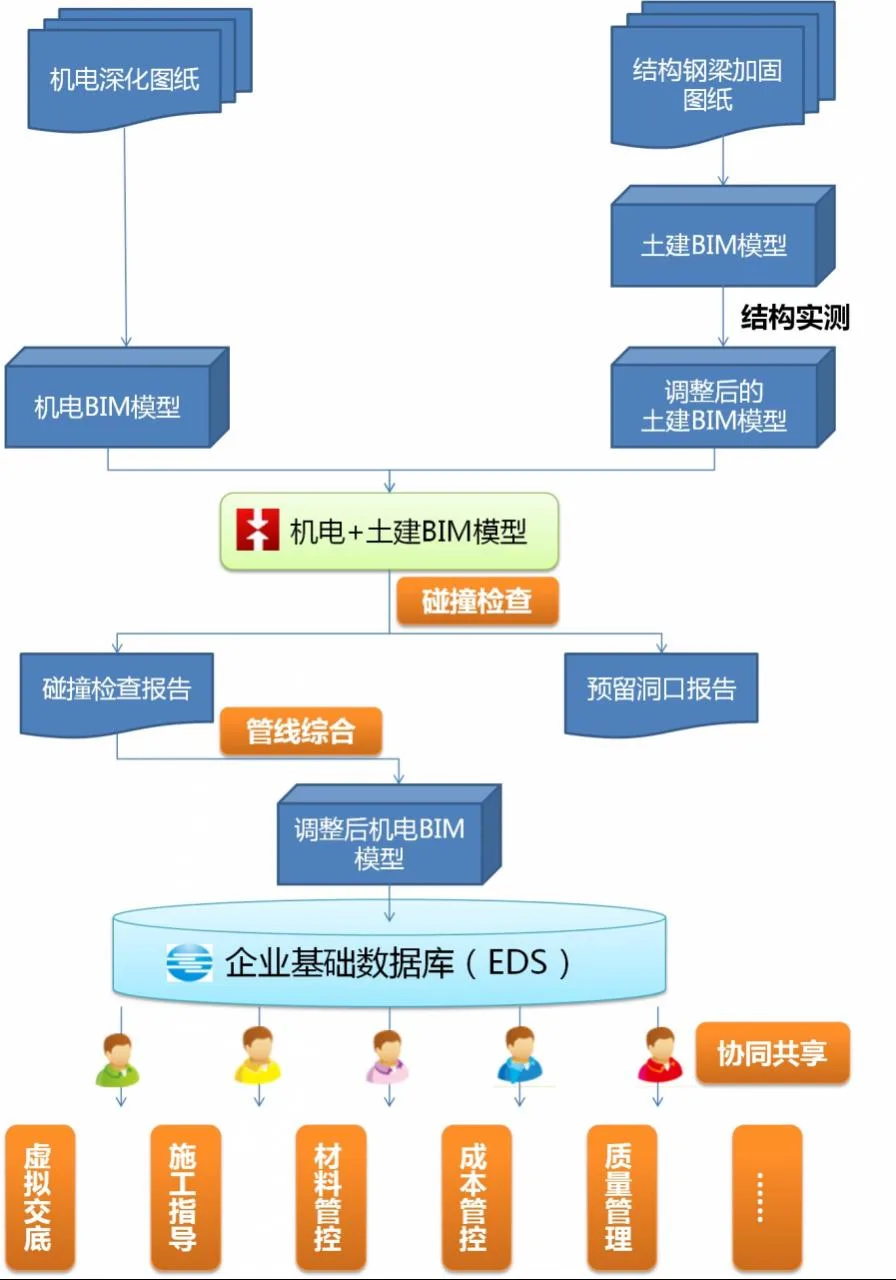
BIM application process diagram for the mechanical and electrical installation project at Wangfujing Hotel renovation
3.2 BIM Technology in Construction Management
3.2.1 Collision Detection and Reserved Openings
The civil and mechanical-electrical BIM models were integrated using Luban BIMWorks for collision detection. Given the hotel’s limited floor height of 2.975 meters and densely packed pipelines in public corridors, precise pipeline layout was critical. The original building design included beam openings, which the new MEP system sought to reuse to ensure structural safety and durability.
Luban BIMWorks quickly identified collision points and generated detailed reports on them as well as on reserved openings. For instance, each standard guest floor (floors 4-14) had 146 collision points. Unresolved collisions would cause project delays and material waste—each collision could cost labor and materials exceeding 300 yuan. On a single floor, collisions could result in a material loss valued at 43,800 yuan.
BIM technology intelligently determined reserved hole locations, with over 2,000 holes reserved in steel beams and more than 3,000 in structural beams. Precise hole positioning information was provided to guide steel beam processing.
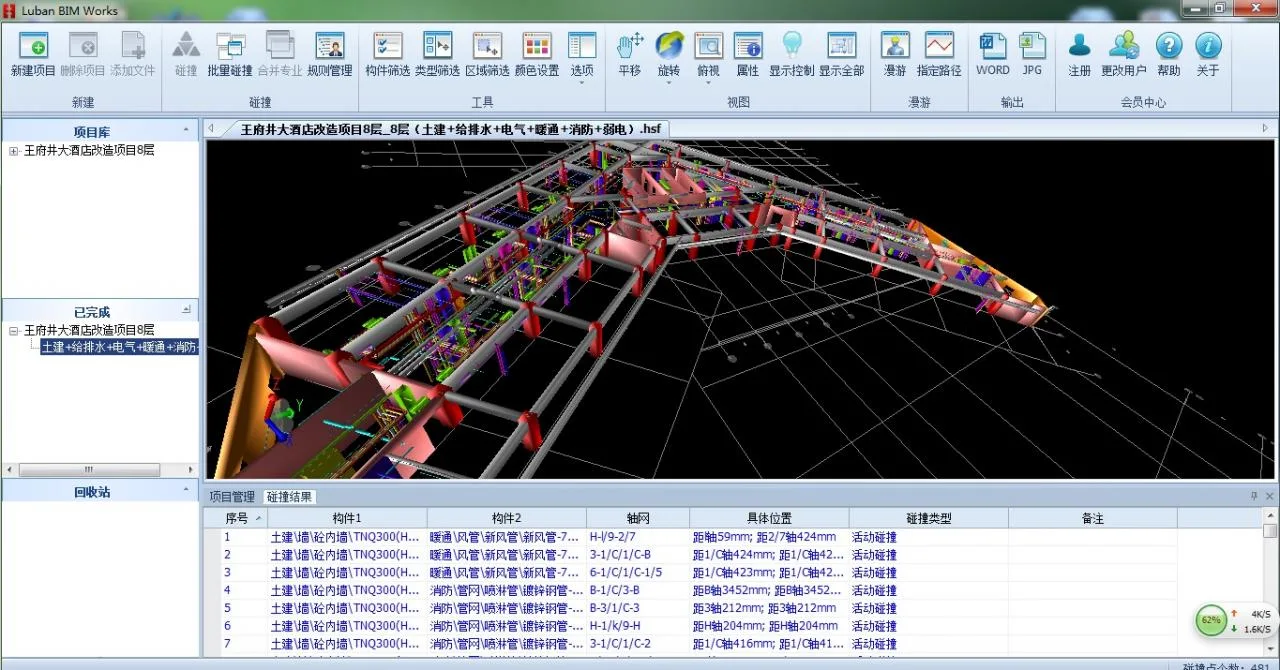
8-layer collision model
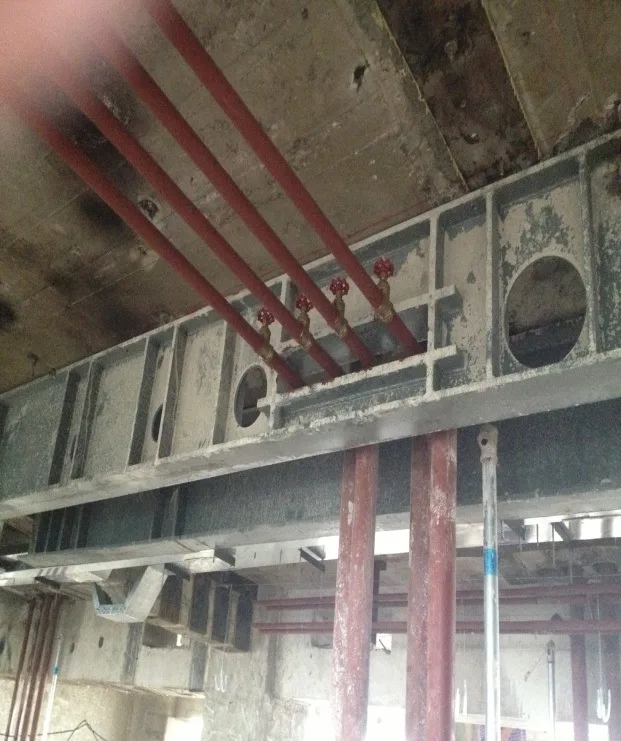
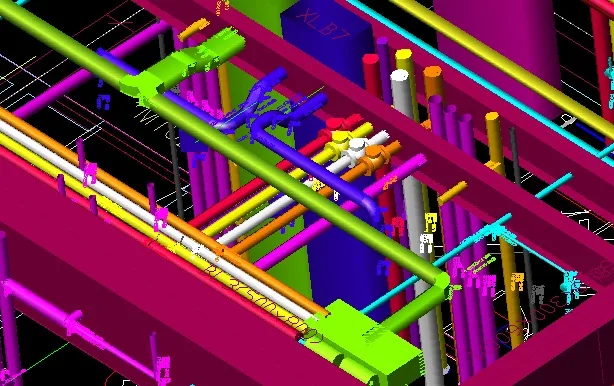
Comparison of detailed reserved openings on site and in BIM models
3.2.2 Pipeline Integration and Optimization
Using collision reports, pipeline layout priorities, and construction plans, the Luban BIM team refined the model to systematically resolve conflicts. The hotel’s original design featured low floors but dense, complex pipelines requiring ample clearance. The team optimized pipeline routes and developed support layouts that balanced aesthetics, clearance, and constructability. Once reviewed and approved by the project technical lead and Shaanxi Group’s design unit, these plans became the construction basis.
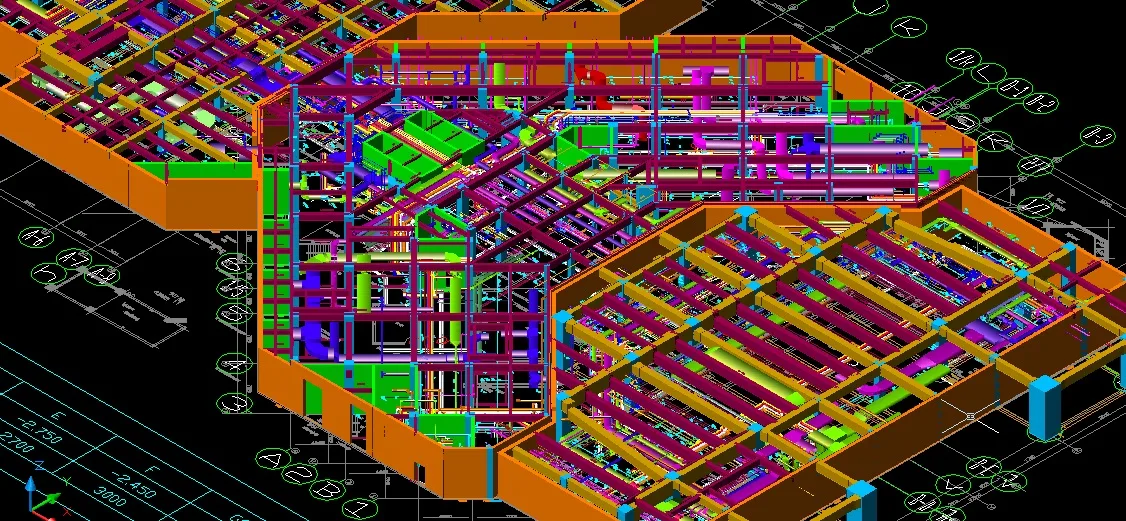
Comprehensive model of underground pipelines on the first floor
3.2.3 Virtual Visualization and Intuitive Understanding
Traditional briefings rely on 2D blueprints and human spatial imagination, which can be limited. With 4D visualization models, virtual construction sequences, and 3D pipeline disclosures, construction teams gain a clear, intuitive understanding of complex routes and nodes. Roaming animations further improve coordination and communication among departments.
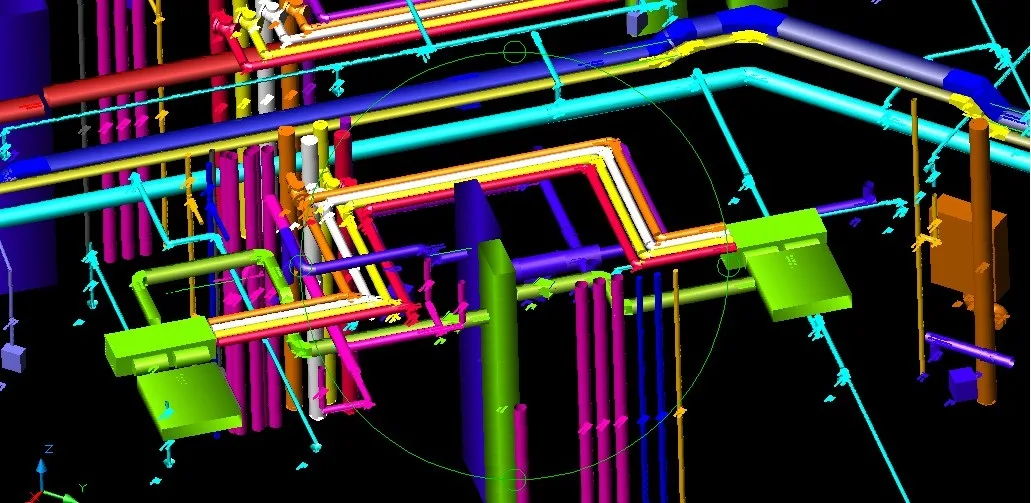
Virtual visualization of complex pipeline routing at the 8th-floor corridor
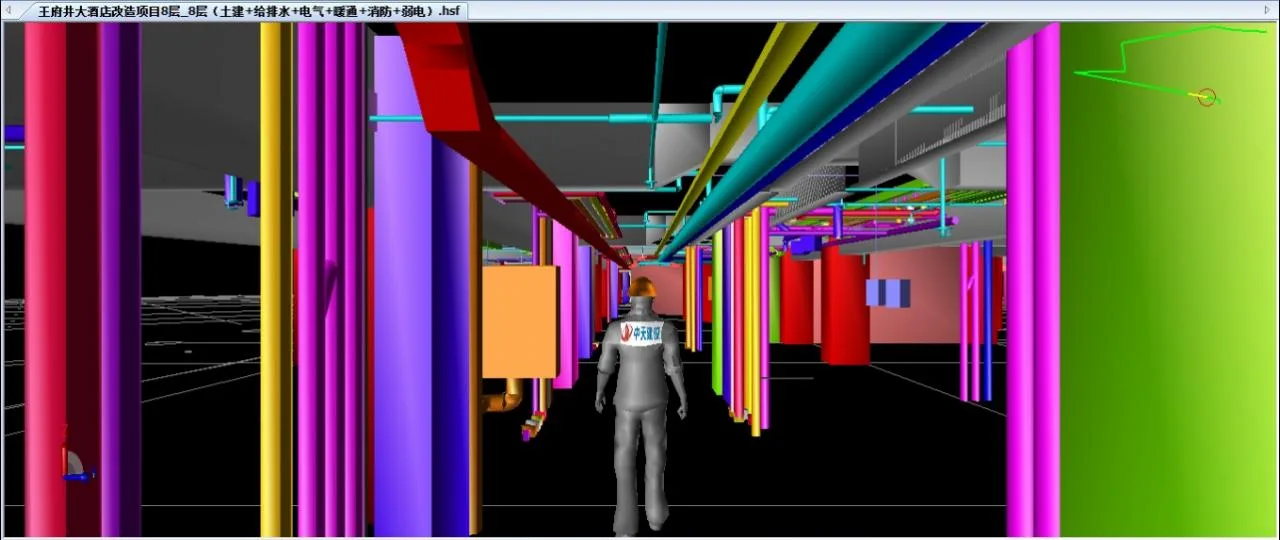
Roaming animation
3.2.4 Automated Drawing Generation and Construction Guidance
Following pipeline optimization, plan and section drawings were automatically generated using Luban’s system, providing clear guidance for construction teams. Project technicians praised the section drawing feature for its speed and convenience, significantly reducing time spent on drawing tasks.
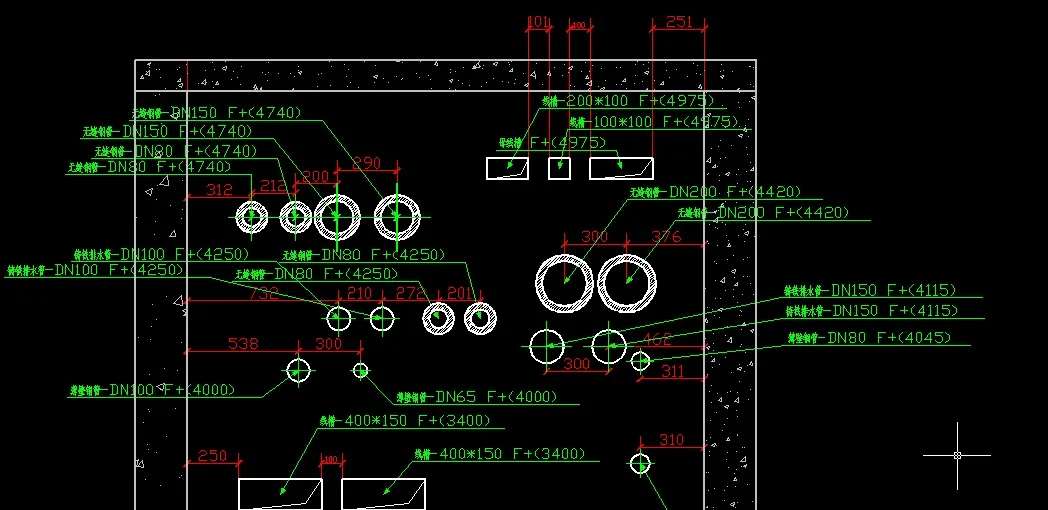
Sectional view along the g-h axis on the first floor
3.3 BIM Technology in Cost Management
By uploading the optimized BIM model to the enterprise basic data analysis system (Luban EDS), a unified BIM collaboration platform was established. Luban PDS, a BIM-based engineering cost data platform, automatically parses uploaded BIM models containing cost and quantity data. It organizes this information into a multi-dimensional, 6D structured database with visual 3D graphics, enabling efficient cost management.
3.3.1 Fast Quantity Calculation and Accurate Planning
Once the BIM model is complete, quantities can be quickly and accurately calculated at the component level. Reports can be generated based on floor, area, progress, discipline, or construction team, providing essential data to plan labor and resources effectively. In practice, construction workers access Luban BE monthly to formulate procurement plans aligned with actual progress. Business personnel review these plans before submitting them for material procurement, minimizing waste and ensuring timely deliveries. This process helps the company manage funds efficiently and reduces capital tied up in inventory.
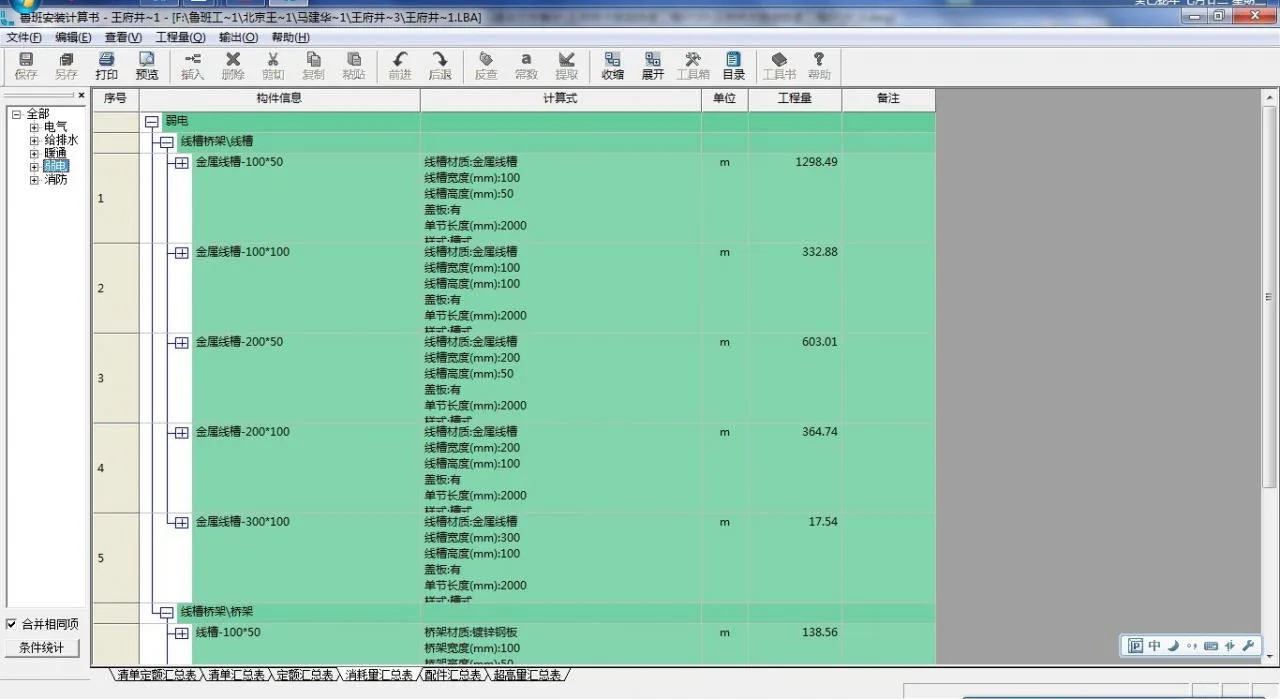
Quantity statistics for weak current engineering
3.3.2 Cost Comparison and Control
During mechanical and electrical construction, material quantities delivered to the site are promptly updated to BIM technicians. They prepare comparison tables between planned and actual quantities, which are submitted to the project department for analysis. This allows identification of discrepancies and preparation of summary reports to support cost control.

Comparison of planned versus actual project costs
3.3.3 Data Collaboration and Efficient Sharing
Engineering data is crucial for project management. Timely data sharing enables managers to make informed decisions quickly. Previously, budget officers centrally controlled data access, limiting managerial oversight. The BIM-based Luban data management system uploads completed model quantities to the MC system, allowing authorized managers to access and review construction material plans. This establishes an enterprise-wide database that supports data sharing, monitoring, and analysis.
Shaan An Group leaders can now query and manage project data anytime through Luban BE, utilizing MC for management, viewing, statistics, and multi-stage comparison. This consolidated data repository supports enterprise-wide decision-making across various roles.
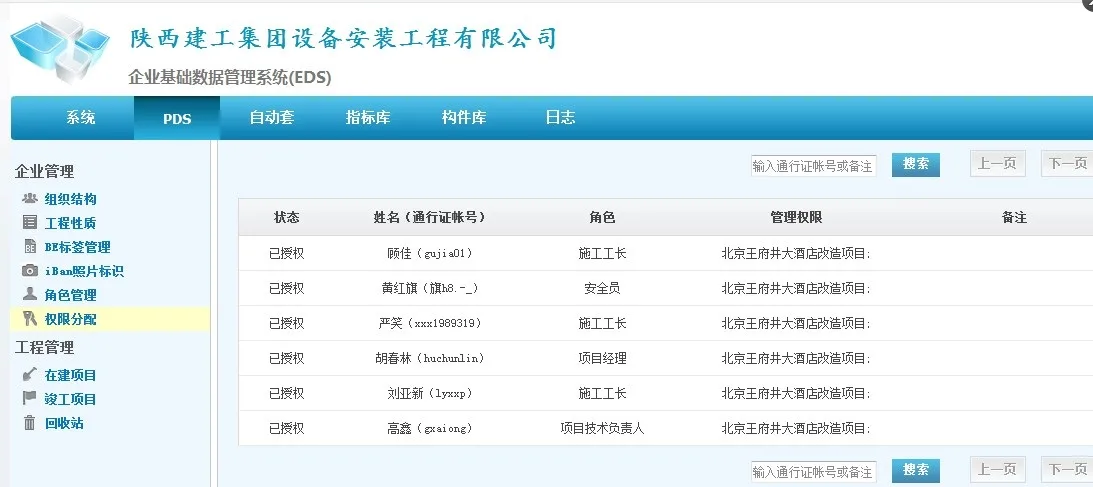
Opening and allocation of EDS accounts
3.4 BIM Technology in Quality and Safety Management
iBan is primarily used for managing quality defects on-site by quickly reporting quality and safety issues to the project management team, preventing hazards. On-site personnel capture photos of issues and select relevant parameters such as options, axes, and project details within the system. These photos are uploaded via Wi-Fi or 3G.
Project managers can access the system from anywhere and quickly review real-time issues via the “Push Pin” feature. This significantly reduces feedback time and creates a historical photo database, enhancing collaboration and speeding up problem resolution.
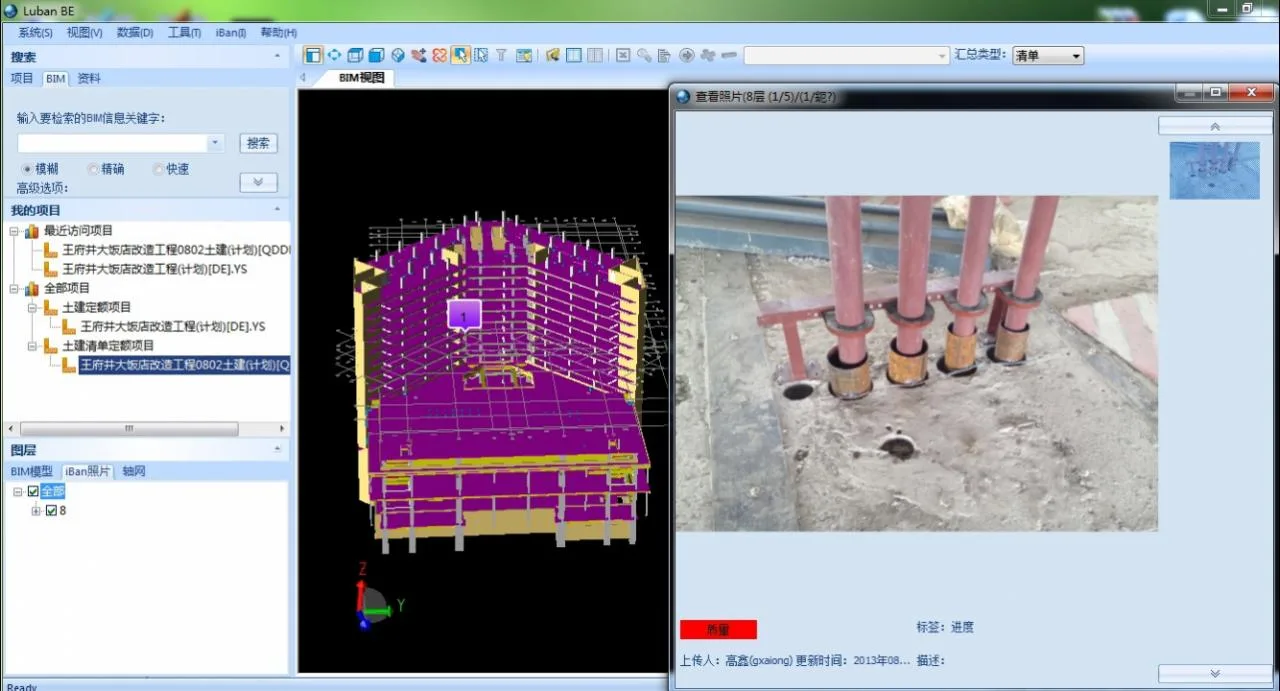
Viewing iBan-uploaded photos in Luban BE system
4. BIM Team Training and Development
Throughout the project, the Luban BIM team designed a comprehensive training plan for Shaan An Group, delivering phased sessions to help build internal BIM capabilities. Over three rounds of training—including modeling, system operation, and pipeline integration—more than 80 participants gained proficiency. Project team members successfully passed assessments, demonstrating solid BIM skills.
5. Effectiveness and Outcomes
According to Gao Xin, project technical leader at Shaan An Group, BIM technology greatly enhanced work efficiency. The 3D models provided practical guidance for construction and pipeline layout. The general contractor, China Construction First Engineering Bureau, and the owner, Xin Real Estate, praised BIM’s application in mechanical and electrical installation, highlighting its importance in boosting Shaan An Group’s competitiveness and brand image.
Senior leaders, including Liu Yaohua (Chairman), Meng Jian (Chairman of Shaanxi An Second Branch), Zhang Baoan (General Manager), Ren Huimin (Deputy General Manager), and Hu Chunlin (Chief Engineer), visited the project site to observe BIM implementation and commended its significant value. Shaan An Group plans to continue expanding BIM applications to strengthen its core competitiveness.














Must log in before commenting!
Sign Up