
China Construction Second Engineering Bureau Third Construction Engineering Co., Ltd. (formerly known as China Construction Second Engineering Bureau Third Construction Company) is a Fortune Global 500 enterprise specializing in Chinese architecture and housing construction. Established in 1952, the company has successfully completed over 1,400 large and medium-sized industrial and civil construction projects, including more than 300 key national and local projects. In 2008, the company achieved an average annual construction area of nearly 4 million square meters, with an annual contract value exceeding 6 billion yuan and a 100% one-time acceptance rate for completed projects. Notably, in 2008, new contracts worth over 10 billion yuan were signed, and in 2009, the construction area reached a record 4.55 million square meters.
Today, BIM (Building Information Modeling) technology is increasingly gaining public attention, especially for its design innovations. However, its application in construction, integrated with design, remains less recognized. The role of BIM in construction should not be underestimated—seamless integration between design and construction is essential to fully realize architectural concepts. In the construction field, BIM acts as an unsung hero, significantly enhancing the productivity of construction companies and improving the cohesion of engineering projects.
A prime example is the trial renovation and expansion project of the experimental building by China Construction Second Engineering Bureau Third Construction Engineering Co., Ltd., showcasing BIM’s application throughout the building lifecycle, with particular excellence during construction. Through the advanced use of BIM technology, this project marks a new chapter in the company’s construction practices.
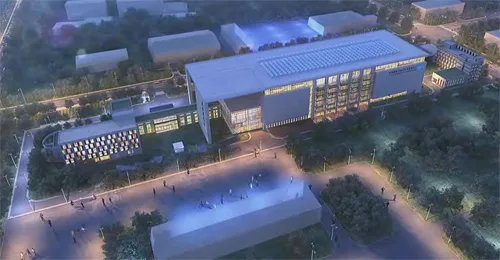
Rendering of China State Construction Engineering Corporation’s Technical Center Test Building
Software Used:
- Autodesk® Revit®
- Autodesk® Navisworks®
- AutoCAD®
Customer Feedback:
The greatest advantage of BIM technology in construction lies in its visualization capabilities. Especially for complex projects, BIM effectively identifies on-site conflicts and optimizes processes, providing invaluable guidance.
— Li Jing, Chief Engineer, Technology Center Experimental Building Renovation and Expansion Project, China Construction Second Engineering Bureau Third Construction Engineering Co., Ltd.
BIM is an emerging technology destined to become a cornerstone of the construction industry in the future.
— Li Jing, Chief Engineer, Technology Center Experimental Building Renovation and Expansion Project, China Construction Second Engineering Bureau Third Construction Engineering Co., Ltd.
Project Overview:
BIM Enables Seamless Integration Between Design and Construction
The China Construction R&D Base represents the first BIM application demonstration project by China State Construction Engineering Corporation. It spans the entire lifecycle of the project, from planning and design through construction to operation and maintenance. The construction was undertaken by China Construction Second Engineering Bureau Third Construction Engineering Co., Ltd., with design by China Construction Design Group Co., Ltd.
“The concept of a full project lifecycle was introduced by the owner. From initial planning and design to construction and final operation and maintenance, the construction phase is just one segment of the overall lifecycle,” explained Li Jing, Chief Engineer of the Experimental Building Renovation and Expansion Project. “This project is a self-developed initiative by China State Construction Engineering Corporation Limited, with all parties committed to making it a benchmark for BIM application. BIM is employed throughout—from design, through construction, to operation and maintenance.”
Given that the project covers the entire lifecycle, BIM is applied at every stage, making integration—especially between design and construction—critical. Li Jing noted, “The challenge is not so much integration as the varying levels of depth between design and construction. Construction requires a deeper, more detailed model than design provides. This necessitates enhanced and refined models based on the original design.”
“The key to overcoming this is communication and coordination, working collaboratively on a BIM platform,” he added.
BIM technology digitally simulates construction challenges, reducing the need for physical prototypes on-site, conserving resources, and allowing simulation of critical construction stages to improve efficiency, achieve first-time success, and minimize material waste.

Night Rendering of China State Construction Engineering Corporation’s Technical Center Experimental Building
To facilitate this, the design and construction teams jointly developed a BIM model, establishing unified modeling standards to define model depth and detail. They created BIM construction model guidelines outlining overall principles and specifics, enabling the transformation of design models into two-dimensional drawings and the development of construction models based on upstream data. This process helps detect errors, omissions, and defects.
The teams also addressed integration issues by creating a unified component library, ensuring that overlapping parts are properly deducted when combining different materials, clarifying logical relationships between components, and maintaining consistent, accurate naming and data. The model is structured layer-by-layer, with components built systematically.
Despite resolving many challenges, ongoing construction site changes and evolving owner requirements mean new issues continue to arise.
“For the long-term development of enterprises, adopting BIM technology is essential. As an emerging technology, BIM will play a vital role in the future of the construction industry—it is the inevitable trend,” Li Jing emphasized.
Detailed Analysis Through BIM Visualization
Historically, design has always set requirements for construction, but how can upstream design accommodate construction needs? Visualization offers a solution.
Li Jing explained, “Our project is unique and complex. The main challenge is the reaction wall and reaction floor—experimental facilities used for seismic load tests. Their internal structure is very complex, and two-dimensional drawings cannot fully capture this. Therefore, we use Autodesk Revit 3D software to visualize all internal steel bars and components, including over 10,000 elements like prestressed and ordinary steel bars, with high positioning accuracy. BIM allows us to detect collisions between components and steel bars, showing exact collision points and resolving conflicts smoothly—something impossible with 2D software.”
Under BIM visualization, construction organization simulation is possible, allowing design models to be segmented, construction zones to be defined, and workflows to be mapped. For green construction management, BIM entity simulations can replace physical project templates, reducing on-site samples and saving resources. Simulating key construction nodes and conducting construction disclosures further improve efficiency, increase first-time success rates, and reduce material waste.
Currently, BIM software generates 3D graphics, but 2D drawings are still necessary for sectional views. Li Jing, with extensive frontline experience, believes data exchange and compatibility are manageable. “Autodesk Revit’s 3D-to-2D conversion is mature. There may be challenges integrating with other software brands, like data loss in certain formats, but this is an ongoing process requiring collaboration across manufacturers. This will help avoid redundant work and significantly boost efficiency.”
The Importance of Developing BIM Professionals
When asked about the biggest challenge in applying BIM technology, Li Jing pointed to personnel issues. High staff turnover and instability in construction teams hinder long-term BIM adoption. Since BIM is still emerging in construction, many professionals lack deep understanding or sustained commitment.
From a technical standpoint, software selection is critical—both the choice of software and its performance matter. Ultimately, success depends on personnel who are proficient with the software and deeply understand the project requirements.
“Currently, we use Autodesk Revit because it is widely adopted by BIM companies and has a broad application range. This choice is partly due to limited alternatives,” Li Jing shared with a smile.
Looking ahead, BIM technology could revolutionize energy conservation by simulating model rooms digitally and generating multiple design solutions instantly. This contrasts with current practices where developers build static model rooms that do not fulfill all homeowners’ needs. BIM-enabled renovation through software could greatly reduce overall waste.
However, realizing these benefits requires concerted efforts, especially in training BIM professionals. Engineering and technical staff must become BIM experts. Through sustained training, we hope to profoundly impact future projects,” Li Jing concluded.














Must log in before commenting!
Sign Up