
On June 30th, the Ministry of Commerce and the Shanghai Municipal People’s Government jointly completed the world’s largest China Expo complex — the National Convention and Exhibition Center (Shanghai). The exhibition halls A and B, constructed by Shanghai Construction Engineering Group, have officially been completed and handed over. This October, the China International Automobile Products Fair will take place in Halls A and B.
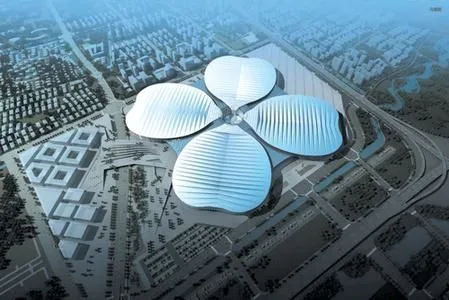
Situated west of the Xujing and Hongqiao transport hubs in Qingpu, Shanghai, the National Convention and Exhibition Center is conveniently close to Hongqiao Airport and Hongqiao Railway Station. Designed in the shape of a four-leaf clover, it covers an area of 860,000 square meters, with a total built-up space of 1.47 million square meters. The center offers 400,000 square meters of indoor exhibition space and 100,000 square meters of outdoor exhibition space. It is not only the largest integrated building of its kind worldwide but also features the world’s first large-scale columnless indoor exhibition hall: 32 meters high with an indoor area of 28,000 square meters.
Four Strategies to Overcome Challenges
The project is divided into two main sections, with Shanghai Construction Engineering Group responsible for Section 1, covering 870,000 square meters. This section includes three exhibition halls (A, B, and D), office buildings AO and BO, commercial centers E1 and E2, and smaller exhibition halls F1 and F3 — representing three leaves and one stamen of the four-leaf clover design — accounting for approximately 75% of the entire project.
During construction, Shanghai Construction Engineering faced four major challenges:
First, the project involved numerous large-scale individual construction tasks. The center features 13 exhibition halls, each roughly equivalent to four standard football fields. The steel structure roofing covers 260,000 square meters, curtain walls span 170,000 square meters, earth excavation totaled 930,000 cubic meters, concrete pouring exceeded 500,000 cubic meters, steel reinforcement reached 140,000 tons, steel components weighed nearly 90,000 tons, and the metal roofing covered 340,000 square meters.
Second, the construction timeline was tight. Shanghai Construction Engineering Group began work in February 2013 and aimed to deliver Buildings A and B by June 30, 2014, allowing just 15 months for completion.
Third, organizing construction was complex. Tens of thousands of workers were on-site daily, requiring careful coordination to maintain smooth operation of Shanghai Metro Line 2 and ensure uninterrupted flow of vehicles and pedestrians.
Fourth, the project demanded high construction standards. Goals included meeting the Shanghai Municipal Government’s Magnolia Award criteria, achieving national recognitions such as the Luban Award, and earning the China Three Star Green Building Design and Evaluation certificates. Additionally, the project prioritized zero major equipment incidents or personal injury accidents.
To ensure high-quality, efficient progress, Shanghai Construction Engineering Group implemented four key measures: strengthening organizational structure and project management; careful pre-construction planning and preparation; scientifically developing schedules and workflows; and rigorous quality control to meet all targets. A dedicated safety team was led by President Hang Yingwei, alongside general managers from subsidiaries. An expert committee chaired by Chief Engineer Gong Jian and CAE academician Ye Keming advised on major technical issues. Vice President Lin Jinsheng served as Project Commander, with experienced mega-project manager Chen Anmin as Deputy Commander and senior project manager Xu Jun as the General Manager. Subsidiaries including Second Construction, Seventh Construction, Machinery Construction, and Installation were mobilized as main contractors.
After over a year of intense effort, Shanghai Construction Engineering Group completed 930,000 square meters of earth excavation, poured and compacted more than 500,000 cubic meters of concrete, produced and installed nearly 90,000 tons of steel structures, erected 60,000 tons of steel pipe high-support formwork, finished civil engineering structures, and installed 80% of mechanical and electrical equipment, successfully meeting all project milestones.
BIM for Detailed Modeling
The complex project includes civil engineering, steel structures, curtain walls, roofing, mechanical and electrical installations, and decoration. To enhance precision management, Shanghai Construction Engineering Group introduced Building Information Modeling (BIM) technology to create detailed models of the main structures, enabling integrated design development and construction management.
Shanghai Construction Machinery Construction Group handled the largest single steel structure contract, responsible for 92,000 tons of steel, with 70,000 tons to be completed within five months. The scale and precision required for manufacturing, processing, and installing diverse steel components and large-span trusses were unprecedented. To meet these demands, the Machinery Construction Group adopted BIM technology — originally used in the Shanghai center steel structure construction — to plan and manage steel structure assembly.
Using BIM, the project team built a 3D model resembling a four-leaf clover, accurately reflecting the relationships among systems and demonstrating actual component dimensions and construction sequences through virtual rehearsals. This approach solved the challenges of pre-assembling complex steel structures, saving time compared to traditional factory pre-assembly and reducing assembly and disassembly costs on-site.
Eco-Friendly, Low-Carbon Exhibition Hall
The four-leaf clover design symbolizes the center’s global, ecological, and iconic character. It is not only the largest exhibition complex worldwide but also leads in technological innovation and human-centered features.
Firstly, the design clusters the four exhibition halls around a central plaza, providing a more balanced layout compared to traditional exhibition centers. This reduces walking distances for visitors and enhances standardization and convenience for exhibitors.
Secondly, the center utilizes a distributed energy system for power supply, following Shanghai Disneyland’s example. It employs natural gas internal combustion units for cooling, heating, and electricity supply. Excess power is fed back into the grid, easing electricity demand on the large exhibition halls.
Thirdly, the venue is the first in the industry to use full LED lighting. Over 200 elevators incorporate supercapacitor energy-saving technology, making it the world’s largest centralized demonstration area for capacitor-based energy-saving elevators. Fourthly, a closed vertical pipeline waste collection system has been adopted for the first time, facilitating recycling of exhibition waste and improving environmental quality on-site and nearby.
The Shanghai National Convention and Exhibition Center is expected to be fully completed by the end of 2014.












Must log in before commenting!
Sign Up