
1 Introduction
Information technology in the construction industry involves applying IT to improve both technical and management processes within the sector. It encompasses managing the entire lifecycle of physical buildings, including planning, surveying, design, construction and installation, operations management, maintenance, and associated regulatory, consulting, and intermediary services.
Since the early 2000s, the critical role of information in driving economic growth has become increasingly evident. Promoting informatization across the national economy and society has become a core part of national development strategies. As a fundamental sector of the economy, the construction industry urgently requires researchers to leverage emerging technologies such as computers, networks, and artificial intelligence. By optimizing construction processes and enhancing productivity, the industry can establish an information development path aligned with China’s unique characteristics.
To support this objective, in October 2007, the former Ministry of Construction launched the “Key Technologies Research and Application of Informationization in the Construction Industry” project under the Eleventh Five-Year Plan National Science and Technology Support Program. A major achievement of this project was the development of the “Basic Terminology Standards for Information Technology Application in the Construction Industry” (hereafter the “Terminology Standards”), created as part of the subproject focused on standard systems and general standards for IT application in construction.
2 Research Status of Informationization-Related Standards in the Construction Industry
2.1 International Standards Development Overview
International organizations leading the development of construction informatization standards include the International Organization for Standardization (ISO) and the International Alliance for Interoperability (IAI). These bodies have made significant progress in promoting standardized frameworks that many countries reference when creating their own standards.
The Industry Foundation Classes (IFC), published by IAI, have quickly become the key data standard for Building Information Modeling (BIM), serving as the foundation for international software interoperability and information exchange in construction engineering. Additionally, the Green Building XML (gbXML), sponsored and developed by the California Energy Commission, has emerged as another major BIM data standard in recent years.
Since the 1990s, developed countries have advanced construction informatization rapidly through projects such as FIAPP in the United States, CALS/EC in Japan, and ELSEWISE in Europe. Each country has developed models tailored to its context, emphasizing the formulation of related standards and specifications. For example, the American Institute of Building Standards (CSI) and the Canadian Institute of Building Standards (CSC) jointly developed the MasterFormat, a standardized coding system for building product information widely adopted across North America. Meanwhile, Japan’s CALS/EC initiative produced classification coding standards, application data standards, and information exchange/service standards, including the “Construction Information Classification and Coding Standards” and “CAD Data Exchange Standards.”
2.2 Domestic Standards Development Overview
China has been advancing research on construction industry informatization standards since the 15th Five-Year Plan period. This included the “Digital Engineering of Urban Planning, Construction, Management, and Services” project, which focused on developing standards for construction informatization. In 2003, the former Ministry of Construction issued the “Engineering Construction Standard System,” laying out initial plans for a construction informatization standard system.
Under the National Eleventh Five-Year Plan Science and Technology Support Program, key projects such as “Research and Application of Key Technologies in Construction Industry Informatization” generated standards including the “Construction Industry Informatization Standard System Framework,” “Construction Enterprise Information Coding Standard,” “Construction Enterprise Management Basic Data Standard,” “Construction Enterprise Data Center Construction Technical Specification,” and the “Construction Industry Information Technology Application Basic Terminology Standard” discussed here.
|
|
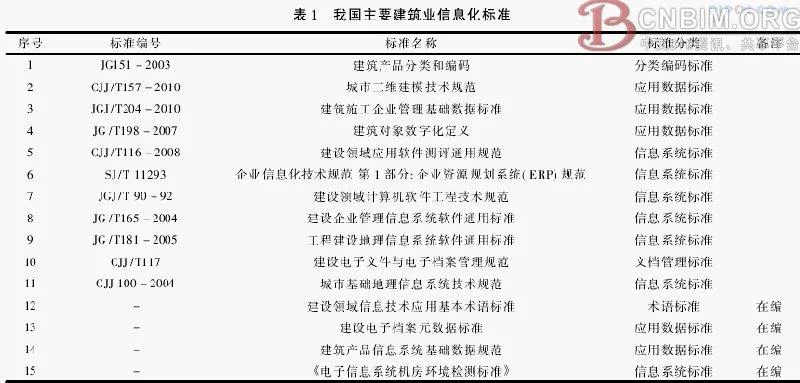
3 Basic Terminology Standards for Information Technology Application in the Construction Industry
3.1 Origin and Purpose of the Terminology Standards
After nearly two decades of development, the use of information technology in China’s construction industry has expanded greatly. However, issues such as inconsistent data descriptions, lack of software and system standardization, and non-standard business requirements have led to information silos and reduced management efficiency, impeding effective information sharing. The fundamental cause is a significant shortage of IT standards within the sector.
To address this, in October 2007, the former Ministry of Construction initiated the “Research and Application of Key Technologies for Information Technology in the Construction Industry” project under the National Eleventh Five-Year Plan Science and Technology Support Program (2007BAF23B01). The “Basic Terminology Standards for Information Technology Application in the Construction Industry” arose as a key deliverable. This engineering terminology standard closely integrates with various technical fields including building surveying, design, construction, operation and maintenance, e-government, and enterprise management in construction.
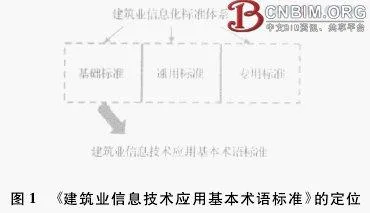
The Terminology Standards form the foundational layer of the industry’s IT standard system, establishing a basis for all informatization standardization efforts. They compile and standardize the terminology used throughout the information construction process in construction, supporting all IT application activities within the sector. Figure 1 illustrates the role of the construction industry informatization terminology standard within the overall standard system.
3.2 Meaning and Significance of Terminology Standards
Terminology consists of specialized language used within disciplines to express or constrain scientific concepts through speech or text. It functions as a tool for exchanging ideas and knowledge and is essential for disseminating skills and enabling social, cultural, and economic interactions.
Terminology standards are developed by researching specialized terms, collecting representative vocabulary, and establishing unified definitions (or explanatory notes) along with corresponding foreign language terms. Standardizing terminology clarifies professional boundaries and conceptual levels, facilitating the smooth development and revision of other standards.
The Construction Industry Information Technology Basic Terminology Standards underpin the entire informatization standard system. By standardizing terminology related to the construction industry’s informatization process, these standards define the scope of informatization, distinguish it from traditional construction and pure IT fields, and lay a foundation for successful informatization efforts.
3.3 Principles for Developing Terminology Standards
3.3.1 Classification Principles for Basic Terms
The classification of terminology follows the full lifecycle stages of physical buildings, including planning, surveying, design, construction and installation, and operation and maintenance. Accordingly, terminology is categorized into:
- General terms
- Architectural surveying informatization terms
- Architectural design informatization terms
- Construction informatization terms
- Building operation and maintenance information technology terms
- E-government terminology in construction
- Construction enterprise management IT terminology
During compilation, some terms may relate to multiple categories. Each term is classified under the category with the strongest association, though cross-references may exist.
3.3.2 Principles for Terminology Selection
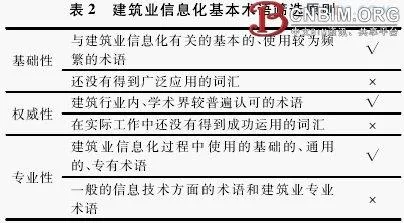
Given the broad scope and volume of terminology in construction informatization, careful selection is essential to relate construction industry terms to general construction and IT terminology. The research team selected terms based on foundation, authority, and professionalism, as summarized in Table 2.
The terminology standards aim to form a comprehensive, interconnected system. Although terms are divided into parts for clarity, these parts complement each other. The standards are designed to be extensible and updateable in response to ongoing IT developments and improvements in international, national, and industry standards.
3.4 Design of the Terminology Standards
3.4.1 Sources of Basic Terminology
Construction informatization covers a wide range of fields, intersecting construction disciplines (survey, design, construction, operation, maintenance, and management) with information technology (computer science, networking, databases, artificial intelligence, etc.). These interrelated fields jointly promote the advancement of construction informatization.
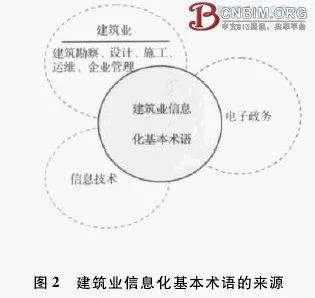
As illustrated in Figure 2, fundamental terms derive from the intersection of construction disciplines with IT, e-government, and related fields. Mature IT-related standards from various construction sectors can be adopted or adapted. E-government also plays a critical role, with many terms directly referenced in the terminology standards.
3.4.2 Structure and Content
Based on extensive research into new technologies and theories emerging in China’s construction informatization process, the Terminology Standards summarize the meaning, scope, and development direction of construction informatization tailored to China’s context.
The standards cover six major professional informatization domains within construction: surveying, design, construction, operation and maintenance, e-government, and enterprise management. Divided into eight chapters, their detailed structure is shown in Figure 3.
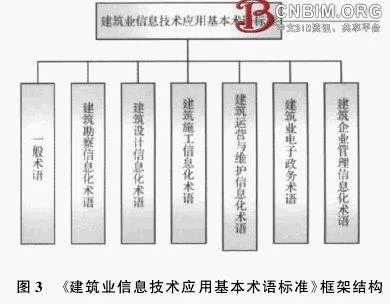
Main content of each chapter:
- General Terms
Terminology relevant across the entire construction industry chain, focusing on themes such as building lifecycle, information technology, digitalization, and intelligent technologies. - Architectural Survey Informatization
Terms related to IT applications in surveying and survey processes during early engineering stages, emphasizing engineering survey and surveying. - Architectural Design IT Terms
Terminology related to IT used in architectural design and planning. - Construction Informatization
Terms concerning IT applications in construction, with a current focus in China on virtual construction and computer-automated control. - Building Operation and Maintenance Informatization
Terms related to IT applications in building operation, management, and maintenance post-completion, focusing on intelligent buildings and facility management. - E-Government in Construction
Terms associated with e-government activities involved in construction industry management. - Construction Enterprise Management Informatization
Terminology related to IT adoption in construction enterprise management, primarily covering enterprise resource planning and virtual enterprise concepts.
4 Summary and Outlook
The Basic Terminology Standards for Information Technology Application in the Construction Industry clearly define the scope of construction informatization and standardize emerging terminology. Establishing these terminology standards promotes effective information and technology exchange throughout the construction informatization process, supporting the development and refinement of the broader informatization standard system.
Given the construction industry’s broad scope and the involvement of advanced IT fields such as artificial intelligence, communication, coding, and digital keys, developing terminology standards for such a complex and emerging area is rare internationally. This effort represents a bold and necessary step. As China’s construction informatization deepens, these terminology standards will continue to evolve and improve.
References
- Japanese Style Industrial Informatization: CALS/EC. Informatization, 2009, JSXX11:18-21.
- Ma Zhiliang. Historical Review and Enlightenment of Informationization in China’s Construction Industry [J]. Informatization, 2009, JSXX09:22-23.
- Standard Quota Institute of the Ministry of Housing and Urban-Rural Development. Research Report on the Construction Industry Informatization Standard System Project.
- Shang Chunjing. Research on Informationization of Construction Industry Management Based on Building Life Cycle [D]. Beijing Jiaotong University, 2007.
- Gong Yi. Terminology, Terminology, and Standardization of Terminology. Retrieved from the Internet: __AI_ST_URL_0__
- Li Jiancheng, Luo Zhihua, Wang Ling. Computer-Aided Architectural Design Tutorial [M]. Beijing: China Architecture & Building Press, 2009.
- Zhang Xiqian, Huang Shengxiang. New Technologies in Construction [M]. Beijing: China Architecture & Building Press, 2005.
Source: Construction Comprehensive Survey and Research Design Institute Co., Ltd.
Authors: Zhao Mingze, Li Jinye, Wang Dan














Must log in before commenting!
Sign Up