
Introduction
With the rapid advancement of the construction industry, the demand for tall and super-tall buildings continues to rise, along with the requirements for their foundations. However, waterproofing the pile foundation base plates and pile heads remains one of the most challenging and vulnerable aspects of construction.

1. Current Practices
(1) Apply a cement-based permeable crystalline waterproof coating to the surface of the pile top, the exposed pile body, and the surrounding cushion layer.
(2) Apply polymer cement waterproof mortar over the cement-based permeable crystalline waterproof coating.
(3) Install waterproof rolls on the polymer cement waterproof mortar around the pile body.
(4) Add a protective layer made of cement mortar or fine aggregate concrete over the waterproof membrane.
(5) Install water-swelling waterstops at the joints between the pile and the concrete cushion layer, as well as at the base of the exposed steel bars.
While this layered waterproofing method is widely used, it remains a weak point due to the corrosion risk posed by multiple exposed steel bars. Generally, a water-swelling waterstop is placed at the root of the exposed steel bars, but this provides unsatisfactory protection. Insufficient waterproofing can lead to groundwater seepage into the basement, compromising building functionality and increasing waterproofing maintenance costs.

2. Improvement Methods
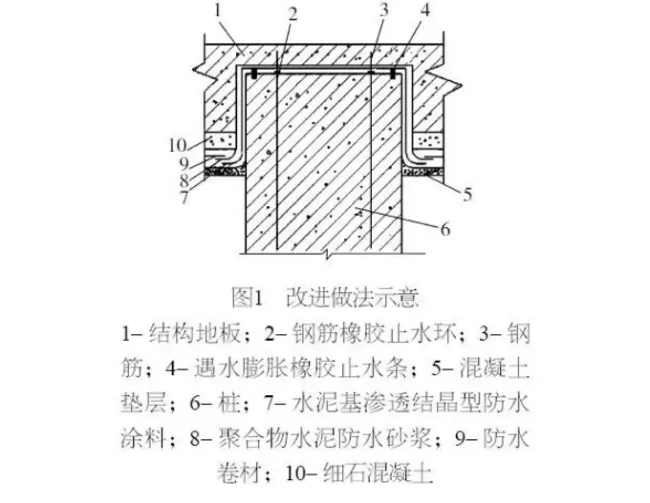
To address these challenges, a new waterproof structure for pile foundation bottom plates and pile heads has been developed through practical research. This design includes installing a steel expansion waterstop ring at the base of the exposed steel bars, placing a water-swelling rubber waterstop strip in a groove around the pile top, and applying multiple waterproof layers to the pile top, pile body, and surrounding areas. This approach delivers optimal waterproofing performance for pile foundations.
The waterproof structure consists of a structural bottom plate, cushion layer, piles, and several exposed steel bars arranged along the pile’s axis. The structural bottom plate rests on the cushion layer, with the roots of exposed steel bars encased in steel bar expansion waterstop rings. Around the pile top, water-swelling rubber waterstop strips are set within grooves. The surfaces of the pile top, exposed pile body, and surrounding cushion layer are coated with cement-based permeable crystalline waterproof coating, followed by polymer cement waterproof mortar. Waterproof rolls cover the polymer cement waterproof mortar around the pile body, and a protective layer of cement mortar or fine aggregate concrete is applied over the waterproof membrane (see Figure 1).
Grooves are chiseled around the pile top to install water-swelling rubber waterstops.
This structure features a steel rubber waterstop ring at the base of the exposed steel bars and a water-swelling rubber waterstop strip set in the groove around the pile top. The pile top, exposed pile body, and surrounding cushion layer are coated with cement-based permeable crystalline waterproof coating, followed by polymer cement waterproof mortar. Waterproof rolls are then installed over the polymer cement mortar around the pile body, topped with a protective layer of cement mortar or fine aggregate concrete to provide multi-layer protection.
The steel rubber waterstop ring is simple and user-friendly, making it especially effective for waterproofing at the steel bar roots. The water-swelling rubber waterstop strip placed in the groove enhances the waterproofing effect. Together, the steel expansion waterstop ring and the water-swelling rubber waterstop strip provide superior waterproofing performance.

3. Construction Steps
(1) Surface Preparation: Begin by removing loose concrete blocks, stones, and debris from the pile head during chiseling. Use a wire brush to clean soil from the exposed pile body and remove any laitance on the exposed steel bars. Finally, clean the concrete cushion layer surface within 300mm around the pile head.
(2) Installing Waterstops: Cover the exposed steel bar roots with steel bar rubber waterstop rings. Chisel a groove approximately 10mm wide and 10mm deep around the pile top, then install a continuous water-swelling rubber waterstop strip inside the groove. Ensure the strip forms a complete loop around the pile top without any fractures or gaps.
(3) Waterproof Coating Application: Apply cement-based permeable crystalline waterproof coating on the surface of the prefabricated concrete pad layer within 250mm of the pile top, exposed pile body, and surrounding areas. Apply two layers: the first no thicker than 1.2mm, and the second as a concentrated agent. The coating’s crystallization requires the concrete to be moist, so ensure the concrete cushion layer surface is cleaned with visible water.
(4) Polymer Cement Waterproof Mortar: After curing the cement-based coating for 2 days, apply polymer cement waterproof mortar to the pile top, pile head, and surrounding areas. The mortar is prepared from finished dry materials mixed with a liquid agent. Spread a 20mm thick layer evenly over the pile top, then apply a 20mm thick layer within 500mm around the pile body. At the intersection of the pile body and cushion layer, create a circular arc with a radius no greater than 20mm. Next, use polymer cement waterproof mortar to form a gentle slope towards the concrete cushion layer within a 500-700mm radius around the pile body.
(5) Waterproof Roll Installation: Lay waterproof rolls with appropriate lap joints based on the selected roll width. Mark reference lines for accurate placement. Follow the manufacturer’s installation methods and comply with relevant standards. The base layer for the roll must be firm, clean, and flat, with no hollowing or looseness. Corner treatments must meet specification requirements. Use the prepared adhesive within 4 hours, strictly avoiding expired materials.
This waterproof structure significantly enhances protection for exposed steel bars. Compared to traditional methods, it offers superior waterproofing performance. Additionally, it features a simple design, requires less machinery and excavation, reduces labor, accelerates construction speed, saves materials, lowers costs, and delivers excellent economic benefits. It is especially suitable for pile foundation buildings with high groundwater levels and basements, particularly those with columns resting on the pile foundation.
Article source: China Construction Seventh Engineering Bureau Co., Ltd













Must log in before commenting!
Sign Up