
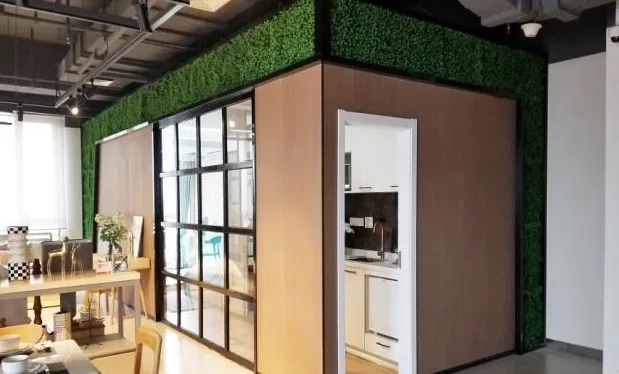
In recent years, China has witnessed a revolution in the industrialization of fully furnished residential buildings. Both construction and interior decoration have embraced industrialized processes. This transformation involves the complete house design lifecycle — from architectural planning and construction to prefabricated interior decoration, standardized components, and customized software solutions. By 2018, prefabricated interior decoration had become one of the hottest topics in this industry.
Prefabricated decoration enterprises typically operate under three main models: research and development, production, and on-site installation. Due to the high costs and lengthy timelines associated with industrial production, few companies currently possess full production capabilities. Most focus primarily on technology research and development, creating a market characterized by high demand but limited production capacity. As a newcomer to the prefabrication sector in 2018, Zhongyu Assembly chose the most challenging path — establishing its own factory and research institute while simultaneously conducting product development and manufacturing.
The Technological Edge of Assembly Is Fading; the Battle for Channels Has Begun
The current prefabricated market can be described as a blue ocean, with expanding application scenarios and growing user adoption. As demand outpaces supply, Wu Tangxiang, CEO of Zhongyu Assembly, observed in an interview: “The industry is currently facing a supply shortage; companies with production capabilities will survive. However, the technology-driven advantage will not last long. Over the next two to three years, new entrants will join the market, shifting competition away from technology and scale toward channels and brand strength.”
Wu Tangxiang outlines four stages in the development of prefabricated manufacturing:
Phase One: Competition in Technology and Scale. Initially, companies that master prefabricated decoration technology and operate large-scale production can generate profits. Prefabrication addresses the challenge of mass-producing interior decoration through industrial processes. Today, enterprises compete primarily on the total cost of bringing products to market.
Phase Two: Competition Between Channels and Brands. As the technological advantage diminishes, success depends on expanding distribution channels and building strong brand recognition.
Phase Three: Competition in Industrial Layout, Logistics Reach, and Service Quality. Companies reaching this phase have undergone industry consolidation, possess mature brand positioning, and maintain stable channels. Here, brand awareness and customer service become key evaluation criteria.
Phase Four: Competition in Industrial Chain Control and Capital Operation. This stage involves competition among industry giants. The prefabricated decoration sector is expected to produce unicorn companies unlike any seen before in home decoration — firms with strong capital backing for R&D that can influence both upstream and downstream parts of the industry chain.
Wu predicts that within two years, four key players will enter the prefabricated decoration field: real estate companies, building material conglomerates, whole-house customization firms, and publicly listed decoration companies. He warns that industry conflicts will intensify, likening this period to a new “Spring and Autumn” era of competition. Early optimization of competitive strategies will be crucial for survival.
High Industry Barriers Demand Systematic Competence
Traditional decoration has a low entry threshold, resulting in a fragmented and often chaotic market. In contrast, prefabricated decoration requires a higher level of expertise and capability. While new companies continue to enter the space, execution remains a significant challenge. True prefabricated decoration enterprises must possess comprehensive operational capabilities, centered around structural technology R&D and intelligent manufacturing.
Customers don’t pay extra simply for prefabrication; they expect equal performance at lower overall costs. To achieve this, companies must build their own factories and offer B2B clients end-to-end solutions—from product design and manufacturing to packaging, transportation, on-site installation, and maintenance. Production costs account for approximately 80% of the entire delivery chain.
According to Wu Tangxiang, prefabricated interior decoration companies cannot rely solely on construction services. Instead, manufacturing must be their primary focus. Parts and components constitute 90% of prefabrication costs, with labor expenses being relatively low. Construction-only companies have limited value. Without control over parts research and production, the touted advantages of prefabrication remain hollow. Zhongyu Assembly positions itself as an “intelligent manufacturer of prefabricated interior components.” Beyond providing EPC services to B2B customers, it delivers comprehensive product solutions and technical support for supply chain integration enterprises.
Since its founding, intelligent manufacturing has been Zhongyu Assembly’s core focus and will remain its strategic priority. Industrialization is at the heart of prefabricated decoration, and in the future, a company’s industrialization capability will be measured by its intelligent manufacturing level. Established in 2018, Zhongyu Assembly adheres firmly to this principle, treating product implementation as a critical first step. Its intelligent manufacturing facility in Jiangsu is now operational, capable of producing components for 5,000 housing units per month.
Alongside intelligent manufacturing, product research and development is essential for all prefabricated companies. Chinese prefabrication technology remains in an exploratory phase and has yet to reach the maturity seen in developed countries. Continuous innovation is required to develop new products tailored to Chinese consumer needs. Zhongyu Assembly recently launched an assembly research institute, led by a partner with 15 years of industry experience. As of December 2018, the institute holds 16 independent intellectual property rights and provides technical support for enterprises using L+data+Al manufacturing processes, facilitating the transition from design concepts to intelligent manufacturing and significantly boosting production efficiency.
Packaging and transportation significantly impact the entire delivery chain, making the geographic layout of prefabrication production bases vital for rapid response to nationwide demand. Following the establishment of its first factory in East China, Zhongyu Assembly plans to launch intelligent manufacturing facilities covering North and South China within three years.
The Rise of Prefabricated Construction Will Foster a New Decoration Ecosystem
Decoration industrialization is accelerating, driven by national policies and advances in prefabricated interior technologies. The industry agrees that prefabrication will capture an increasingly large market share. However, early development faced challenges due to the high cost of personalized hard decoration, limiting initial prefabrication targets to large-scale residential projects.
Expanding prefabrication into the retail sector will take time and require building a new decoration ecosystem. This ecosystem will revolve around an online platform connecting scenarios, data, and intelligent manufacturing, enabling all industry players to collaborate effectively. In the future, consumers will be able to customize their homes online using product libraries from various assembly companies. Once an order is placed, the system will break it down into numerous SKUs and distribute them to parts manufacturers. After production, logistics providers will handle delivery, while trained professionals manage installation.
Looking ahead, Wu Tangxiang shared that Zhongyu Assembly plans to develop a worker training platform and a comprehensive IT system, collaborate further with its research institute, and create a new empowering ecosystem. This will provide more comprehensive, systematic, and market-driven technology and intelligent services, positioning Zhongyu Assembly as a leader in intelligent assembly services across the entire industry chain—combining intelligent industrialization, construction assembly, and IoT-enabled information management.












Must log in before commenting!
Sign Up