
A comprehensive analysis of construction costs, market trends, and management practices is essential for creating an effective model for building and operating cloud computing data centers. Drawing from both domestic and international experiences, this article provides recommendations for enterprises, governments, and telecom operators on the establishment and operation of cloud computing data centers.
Definition of Cloud Computing Data Centers
1.1 Cloud Computing and Cloud Computing Data Centers
Cloud computing and cloud computing data centers are closely related yet distinct concepts, and their advancements are not always directly linked. Many industry professionals remain unclear about the differences. While cloud computing technologies and business models can be implemented in traditional data centers and networks, adoption is often slow, and the benefits are not fully realized. Conversely, cloud computing data centers are specifically designed with cloud architecture to maximize efficiency. A clear understanding of the relationship between cloud computing and its data centers is crucial in today’s digital environment.
At its core, cloud computing involves the allocation and distribution of resources such as computing power, storage, and bandwidth, fundamentally transforming how services are delivered to customers.
From a technical perspective, cloud computing revolutionizes resource management. In traditional IT setups, resources like computing and storage are isolated within individual systems, even within the same data center. Each device operates independently, without resource sharing. Cloud computing enables resource sharing, increasing efficiency across applications, customers, and operator networks.
From a customer service standpoint, cloud computing offers automated, precise, and personalized services. Traditional IT services are typically standardized and require additional costs for customization. While concerns about data security and confidentiality exist, these should be reconsidered; for example, just as people trust banks with their money, it is reasonable to trust operators with their data.
For enterprises adopting cloud computing, information service providers may prioritize technological innovation, while customer service providers focus on service value—this distinction embodies the essence of cloud services.
1.2 Cloud Services and Cloud Computing Data Centers
Deploying cloud services is more complex than simply implementing cloud computing technologies. Both service providers and clients must meet specific requirements. Clients need basic IT infrastructure, adequate readiness, and a willingness to rely on IT systems.
The scale and enthusiasm for cloud service deployment directly affect the requirements and size of cloud computing data centers built by operators. These data centers usually develop along two paths: public cloud services (targeting external customers and generating revenue) and private internal clouds (focused on cost savings for the enterprise). Both approaches require effective construction and operation, as internal private clouds also provide significant value.
In summary, cloud computing data centers form the essential foundation for delivering cloud services.
1.3 Key Characteristics of Cloud Computing Data Centers
What distinguishes a true cloud computing data center? At the current stage, a cloud computing data center represents the next generation of data centers, built on cloud architecture. It features loosely coupled computing, storage, and network resources, broad virtualization, modularity, automation, and advanced energy-saving capabilities.
Key characteristics include:
- Virtualization: Virtualization of servers, networks, and storage components.
- Loose Coupling: Computing, storage, and network resources are independently used, not restricted to bundled services.
- Modularity: Hardware and software are separated, with a modular internal structure.
- Automated Management: Automated management of both physical and virtual servers, business processes, and customer billing.
- Green Energy Saving: Adherence to green standards, typically with PUE (Power Usage Effectiveness) not exceeding 1.5.
Analysis of Cloud Computing Data Center Construction
2.1 Differences Between Cloud Computing and Traditional Data Centers
The main distinctions are reflected in the features above. Traditional data centers usually lack virtualization, while cloud computing data centers are built on virtualization across all servers and storage, raising IT equipment utilization rates by more than 60% compared to traditional centers.
Traditional centers tightly couple computing, storage, and network resources, leading to isolated construction for each project and requiring redesigns for expansion. Cloud computing centers, conversely, use loosely coupled resources, offering greater flexibility and optimized allocation based on customer needs.
Cloud computing data centers also resolve expansion challenges common to traditional centers—such as system, network, and space limitations—that can make expansion difficult or impossible. In cloud computing centers, rack capacity can be increased and PUE reduced, supporting expansion without additional land or power requirements, which is a significant advantage in urban environments.
Automated management is another core feature of cloud computing data centers. This enables efficient operation with fewer staff, even at large scales, thus reducing manual maintenance costs, improving efficiency, and enhancing the customer experience.
Regarding energy efficiency, traditional data centers typically have a PUE between 1.8 and 2.5, while cloud computing data centers achieve values below 1.6, with advanced centers reaching 1.1 or lower. For large-scale centers, energy costs are a major concern.
2.2 Construction Cost Elements of Cloud Computing Data Centers
Construction costs for cloud computing data centers differ from those for traditional centers. The key cost components for a traditional data center (IDC, excluding enterprise self-built centers) include:
- Land: Acquisition costs, considering location, accessibility, environment, and future growth.
- Civil Engineering: High construction standards, including seismic resistance, fire protection, waterproofing, and wind resistance.
- Power Supply: Electricity is a significant cost, including purchase and facility installation.
- Network and Security Infrastructure: Network access is essential, often near backbone telecom nodes, plus security facilities.
- Air Conditioning and Fire Protection: Critical for continuous operation and operating costs.
- Interior, Cabling, and Rack Construction: Important for energy consumption and operational efficiency.
- Customer, Monitoring, and Peripheral Zones: Key areas for data center security.
These seven components are essential for any data center. For cloud computing data centers, there are additional aspects:
- IT Equipment Procurement and Integration: All IT (including network) equipment must be integrated and customized, which increases costs.
- Virtualization Software and Systems: System-level construction, testing, and integration add to the time and expenses.
However, the total cost for a cloud computing data center is not simply the sum of traditional costs plus these additional items. For the same capacity, cloud computing data centers are not necessarily more expensive than traditional ones.
2.3 Cost Model for Domestic Cloud Computing Data Center Construction
To establish a basic construction cost model, several assumptions are made regarding floor space, number of stories, PUE, land prices, city factors, cooling rates, power and network infrastructure, national and operator factors, average temperatures, fire protection, IT procurement, virtualization, rack construction, density, random factors, interest rates, depreciation periods, and construction timelines.
Using these parameters, costs are calculated for land, civil engineering, power supply, network infrastructure, air conditioning, fire protection, interior and rack construction, customer/monitoring/peripheral zones, IT procurement, and virtualization systems. The overall construction cost formula is:
E = Σ Bi + Σ Hj (i ≤ 8, j ≤ 2)
Operational Analysis of Domestic Cloud Computing Data Centers
3.1 Key Operational Factors
Key operational factors include:
- Operating Costs: Such as electricity, bandwidth, labor, marketing, promotion, management, and other indirect expenses.
- Business Revenue: Generated from cloud hosting, cloud storage, elastic private clouds, and potential SaaS application income.
Although the types of operational costs are generally similar for both cloud and traditional data centers, their scale and impact can differ significantly.
3.2 Analysis of Operation Models
The operation analysis involves factors such as location, electricity and bandwidth prices, failure rates, labor costs, revenue per core and per terabyte, bandwidth allocation, and business development influences like regional economic conditions, network quality, and pricing. Business development is assessed using city and network quality factors, with weightings adjusted over time. Network quality is measured by distance to backbone nodes and the number of hops.
The operation model includes the following:
- Operating Costs: Electricity costs are proportional to business utilization (with adjustments for testing and actual use). Bandwidth costs depend on whether the operator manages the center. Labor costs cover management and technical support staff. Marketing and promotion costs are generally stable, with promotion expenses declining as occupancy increases. Management and other indirect costs are also included.
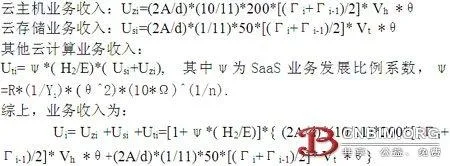
- Business Revenue: Calculated based on revenue per core and per terabyte, with bandwidth allocation.
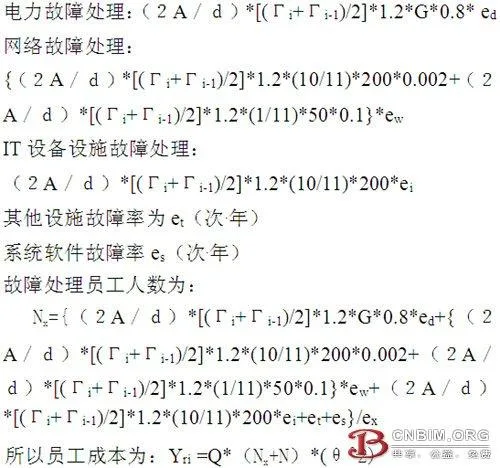
Marketing and promotional costs: Marketing expenses remain stable each year, while promotion costs decrease as occupancy rises.
Marketing cost: Yyi = E * 5%
Promotion cost: Yxi = E * (2%) / Gamma(i-1) (i > 1), generally Yx1 = E * (3%)
Management and implicit costs: Ygi = E * 2%
4 Suggestions for the Construction and Operation of Domestic Cloud Computing Data Centers
4.1 Comprehensive Analysis of Construction and Operation
Based on the models and analysis above, the following profit model for cloud computing data centers can be established:
Comprehensive construction cost model:
Ec = {B1*(1+r)^6 + B2 + B3 + B4 + B5 + B6 + B7 + B8 + H1 + H2} * (1+r)^(12*10)
Annual comprehensive construction cost:
Eci = {[B1*(1+r)^6 + B2] * (1+r)^(12*10)}/50 + [(B3+B4+B5+B6+B7+B8+H1) * (1+r)^(12*10)]/10 + [H2*(1+r)^(12*10)]/5
Comprehensive operating costs for year i:
Yci = Ydi + Yki + Yri + Yyi + Yxi + Ygi
Business revenue for year i:
Ui = Uzi + Usi + Uti
Profit model:
Pro(i) = Ui – Eci – Yci = [1 + ψ*(H2/E)] * {(2A/d)*(10/11)*200*[(Γi+Γi-1)/2]*Vh*θ + (2A/d)*(1/11)*50*[(Γi+Γi-1)/2]*Vt*θ} – {[B1*(1+r)^6 + B2]*(1+r)^(12*10)}/50 + [(B3+B4+B5+B6+B7+B8+H1)*(1+r)^(12*10)]/10 + [H2*(1+r)^(12*10)]/5 – (2A/d)*[(Γi+Γi-1)/2]*1.2*G*0.8*24*365*f*θ – {(2A/d)*[(Γi+Γi-1)/2]*1.2*200*(10/11)*0.002 + (2A/d)*[(Γi+Γi-1)/2]*1.2*(1/11)*50*0.1}*k*(θ^2) – Q*(Nx+N)*(θ^2) – E*5% – E*(2%)/Γi-1 – E*2%
4.2 Recommendations for Construction and Operation
- Site Selection: Choosing a suitable location for a cloud computing data center is a complex process that involves government policies, telecom operators, land costs, network quality, and business expectations. While the model provides a basic framework, practical experience and additional considerations are essential for final decisions.
- Electricity Costs: As data centers mature, electricity costs become the dominant operational expense. Optimizing these is crucial. The number of broadband users within the center’s coverage area impacts listing rates and pricing. In areas with more broadband users, network factors become less significant. Operators, particularly telecom companies, should pay close attention to this during planning.
- Operational Differences: Cloud computing data centers differ in operation from traditional centers. Marketing and promotion costs are high initially but decrease as occupancy increases, showing an inverse correlation with occupancy rates.
- Labor Costs and Automation: Labor costs are lower in cloud computing data centers due to increased automation, but this raises the need for more highly skilled staff. Employee training is therefore vital for efficient operations.
- Network Quality: Cloud computing data centers are more dependent on network quality, closely related to the number of network hops. If the hop count exceeds two, operations become economically infeasible.
5 Summary
The investment, construction, and daily operation of a cloud computing data center are highly systematic and complex. In China, this involves national policies, government actions, telecom operators, internet infrastructure, business development, land and price levels, management capability, and marketing strength. Careful planning is essential before investing in the construction and operation of a cloud computing data center.
Author: Cao Lu, China Unicom IDC Operations Center













Must log in before commenting!
Sign Up