
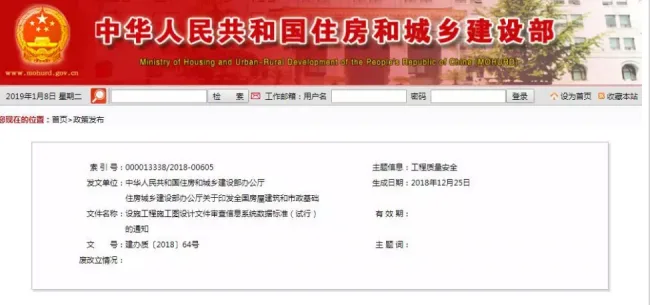
In recent efforts to advance the State Council’s reform initiative to “streamline administration, delegate powers, and improve services,” the Ministry of Housing and Urban-Rural Development has introduced the National Data Standard for Construction Drawing Design Document Review Information System for Housing Construction and Municipal Infrastructure Engineering (Trial). This initiative aims to reform the approval process for engineering projects, innovate quality supervision for survey and design, promote digital review of construction drawing documents, enable sharing of review information among housing and urban-rural development authorities at all levels, and enhance the efficiency of survey and design quality supervision.
The engineering project information is categorized into five key areas, detailed as follows.

1. Basic Information of Engineering Projects (18 Items)
This includes: project name, project number, project code, province, city, and county location; construction site; project approval number and level; project classification; construction nature; engineering type; design scale; construction land planning and project planning permit numbers; survey level; survey outline; and survey photos and images.
2. Information on New (Renovated and Expanded) Housing Construction Projects (34 Items)
Details include project name and number, building height, number of floors above and below ground, structural system, built-up area, foundation design grade, basic form, soil type, construction site type, ground treatment methods, foundation pit type, seismic fortification category and intensity, and whether it exceeds high-level limits. It also covers whether the building is a large public building, presence of civil air defense projects, use of beamless floor systems, high-strength steel bars, seismic isolation or shock absorption technologies, prefabricated buildings, BIM technology, fire resistance rating, water supply and heating methods, air conditioning and ventilation, lighting methods, green building design standards, utilization rates of renewable energy, non-traditional water sources, renewable and recycled building materials, and whether it qualifies as an ultra-low energy building.
3. Information on Renovation and Construction Projects (10 Items)
This section covers project name and number, proof of property ownership, types of decoration and renovation, structural inspection involvement, decoration area and number of floors, engineering purpose, and firefighting facilities.
4. Basic Information of Municipal Infrastructure Engineering Projects (32 Items)
Details include project name and number; water supply and drainage plant and station engineering base; technologies used; pipeline length and diameter; road and bridge engineering details such as road grade, interchange type, length, area, bridge route grade, bridge length, structure and span types, and area; urban tunnel engineering route classification, length, area; Bus Rapid Transit (BRT) system length; tram system length; dedicated public transport lanes; public transportation station and hub areas; environmental sanitation engineering processing capacity; gas engineering plant and pipeline network details including design pressure and pipe diameter; and thermal engineering plant and pipeline network specifications.
5. Information on the Executing Unit (Institution) of the Engineering Project (40 Items)
Includes the name of the construction unit, unified social credit codes, project leaders and their ID numbers for construction, survey, design, geotechnical engineering design, and review units; names and credentials of architects, structural engineers, main designers, technical leaders, reviewers, and approval authorities; and the names and social credit codes of survey, review, and design review agencies.

In construction projects, reviewing drawings is a critical step that precedes actual construction. This process helps identify and eliminate errors, ensures the feasibility of the design, and facilitates smooth execution.
The overall review strategy is to begin with broad elements before focusing on details, starting with plans, then elevations, and finally sections. This approach allows a comprehensive understanding of the project while verifying precise dimensions and design requirements. Identifying and resolving issues before construction reduces potential risks.
Common issues encountered during construction drawing reviews include:
1. Conflicts Between Architectural and Structural Drawings
Architectural drawings often do not align with structural drawings, leading to contradictory or unclear information. Examples include mismatched axis positions, inconsistent beam and column dimensions in frame structures, and wall thickness discrepancies in brick-concrete structures. The review process should prioritize examining architectural details first, followed by structural verification, focusing on elevations and axis numbers. Cross-checking from different perspectives helps prevent mismatches. Adherence to drawing specifications is essential, and copying or superficial work is strictly prohibited.
2. Unreasonable Detailing of Construction Elements
While macro plans may be accurate, detailed construction drawings can contain errors such as incorrect door and window opening directions, unclear material specifications, discrepancies between drawings and specifications, and impractical node designs. Detailed and precise construction drawings are crucial for guiding construction teams effectively. General atlas methods may be used for details, but must be carefully coordinated with overall design. For complex nodes, collaboration with the design department is necessary to discuss solutions and implement changes if required.
3. Issues with Pipeline Crossings
Conflicts among professional pipelines—such as water, electricity, and heating—occur frequently both indoors and outdoors, including on external engineering pipelines. These conflicts should be avoided during the design phase through enhanced communication and multi-party reviews among disciplines to prevent costly changes, construction delays, and increased expenses.
4. Errors or Omissions in Reserved Holes and Embedded Parts
Incorrect or missing reserved holes and embedded components can cause unnecessary costs during structural modifications. Coordination between civil engineering and specialties such as installation, water, electricity, and heating is essential to specify reserved positions clearly. A thorough re-inspection before construction helps prevent costly demolition and rework.

Key Points for Reviewing Various Construction Drawings
1. Overall Drawing Review
- Ensure the design basis uses the latest specifications and clearly indicate concrete strength and steel reinforcement grades in the general description, maintaining consistency with structural descriptions for each floor.
- Distinguish modified drawings by date to prevent confusion and check for consistency across professions.
- Verify that axis lines’ positioning and numbering correspond with architectural drawings; changes should be clearly defined for altered areas.
- Check coordination among specialties, such as water and electrical pipelines, embedded parts, and structural drawings.
2. Structural System Audit
- Confirm clear calculation diagrams and reasonable seismic transmission paths to prevent structural damage from uneven stress.
- Assess seismic capacity to meet usage requirements, especially in areas with seismic fortification standards, ensuring good deformation and energy dissipation capabilities.
- Avoid staggered masonry structures and mixed masonry-reinforced concrete wall systems; position doors and windows away from building corners to maintain structural integrity.
- For frame seismic wall buildings, masonry is not permitted at the base seismic wall; use reinforced concrete special-shaped column frame or special-shaped column frame seismic wall structures instead.
3. Foundation Review
- Review structural drawings to confirm appropriate seismic measures based on building and site categories.
- Evaluate foundation bearing capacity treatments for adverse geological conditions and their suitability.
- Check that foundation burial depth meets minimum specifications and that basic types and construction methods are safe.
- Determine seismic grade for basements, calculate internal forces and reinforcement for raft foundations, and verify compliance with post-pouring strip regulations.
4. Floor Section Review
- Verify elevations for special areas like bathrooms, kitchens, and balconies against architectural drawings.
- Ensure detailed drawings for surrounding board nodes align with architectural plans.
- Confirm that industrial reinforcement of floor slabs is detailed and consistent with calculation sheets.
- Check for clear marking of structural columns in slab reinforcement diagrams.
- Review the installation of additional steel bars at internal and external eave corners.
- Assess the economic and structural adequacy of beam stirrup configurations.
- Verify beam elevation at staircases corresponds with detailed staircase drawings.
- Check clarity and correctness of main and secondary beam positioning.
5. Stair and Elevator Audit
- Ensure no conflicts exist between elevators and other electrical equipment in prefabricated buildings for safe operation.
- Confirm the elevator power box is reasonably located, accessible from the machine room entrance.
- Verify correct selection of main switches to handle frequent peak currents during elevator startup, ensuring protective features.
- Check that stair clear heights comply with regulations and that plans, sections, and structural plans are consistent.
- Assess the economic and structural adequacy of elevator section board thickness and reinforcement; install structural columns if needed.
- Verify elevator foundation pit depth matches elevator specifications.

Key Points in Construction Drawing Review
1. Integrity Verification
- Check that the number and numbering of different professional construction drawings comply with drawing catalogs and that all drawings are signed and approved by the design unit.
- Compare drawings, specifications, and overall designs to identify any conflicts.
- Conduct on-site investigations to evaluate design rationality based on hydrogeological conditions.
- Perform detailed reviews from multiple angles to ensure plans, elevations, and profiles correspond.
- Verify engineering quantities and confirm that sub-project quantities have been fully calculated.
2. Normative Verification
- Confirm planning drawings have been approved by relevant supervisory departments and meet policy requirements.
- Ensure design basis and reference standards comply with technical requirements and are valid.
- Check accuracy of drawing indexes and annotations and ensure clear correspondence among drawings.
- Verify drawing numbers and codes correspond appropriately, and that professional types are complete.
3. Comprehensive Verification
- Coordinate with responsible professionals to review foundation design, treatment, structural design, and optimize according to actual construction conditions.
- Verify geometric dimensions and axis directions of building footprint, layout, and related projects for consistency.
- Identify locations of underground structures and pipelines to clarify positioning and avoid conflicts.
- Ensure key construction challenges are adequately explained, construction methods are detailed, and technical disclosures are provided.
4. Practical Verification
- Confirm that designs meet practical functionality and pose no safety hazards.
- Optimize construction methods and processes by adopting new technologies, materials, and processes through tripartite verification.
- Ensure construction drawings meet economic requirements, consider construction timelines, and avoid project delays.
- Assess whether selected decorative materials and green plants are appropriate, coordinated with the overall building, and avoid impractical choices.
Article source: Architectural Technology Magazine













Must log in before commenting!
Sign Up