
Abstract: BIM Technology is gradually and unconsciously transforming traditional approaches to architectural design, construction, and operations. Currently, BIM technology has been widely adopted in the design and construction phases of buildings, bringing significant economic benefits. However, the value of BIM Technology extends beyond these stages. During building operation and maintenance, BIM can provide substantial additional value. This article explores a BIM-based architectural space and facility operation and maintenance management system, aiming to identify solutions for applying BIM Technology in building operation and maintenance to achieve efficient, safe, comfortable, and economical management.
Authors: Guo Jun, Zhang Ying, Zhang Ning
Keywords: BIM, Building, Space, Equipment, Operation, Maintenance Management
BIM-based Space and Facility Management System Research Study
Guo Jun, Zhang Ying, Kang Jun, Zhang Ning
(CCDI, Shanghai 200433, China)
Abstract: BIM technology is unconsciously changing the way architects design, manage construction, and operate buildings. Today, BIM technologies have been heavily adopted in both design and construction phases, resulting in significant economic returns. However, the value of BIM extends far beyond these phases, creating substantial benefits during building operation. This article analyzes a BIM-based space and facility management system to identify solution paths for the adoption of BIM in building operation management, with the aim of achieving breakthroughs in efficiency, safety, comfort, and economic performance during operation.
Keywords: BIM, architect, space, facility, operation management
1. Overview
BIM (Building Information Modeling) is a digital representation of the physical and functional characteristics of a facility. With increasing government support, especially from the Ministry of Housing and Urban-Rural Development in China, there has been rapid progress in the adoption of BIM. Recent policies, such as the “2011-2015 Outline for the Development of Informationization in the Construction Industry,” have accelerated the popularization of information systems in construction enterprises, promoted the adoption of BIM and other advanced technologies like network-based collaborative work, and fostered the development of information standards and proprietary software.
Within this macro environment, the use of BIM technology in China has seen significant progress, particularly in design and construction. All project stakeholders, including owners, design institutes, and general contractors, have recognized the value of BIM, resulting in considerable economic benefits.
However, the value of BIM is not limited to the design and construction stages. In the operational phase, BIM continues to provide significant advantages. By simulating the construction and operation of a facility through computer software, BIM enables data-rich, goal-oriented, intelligent, and parameterized digital models. The 3D visualizations and diverse data outputs support better decision-making and enhance the overall construction and operation process for all stakeholders.
2. BIM-Based Building Space and Equipment Operation and Maintenance Management System
In recent years, building operation and maintenance management—often referred to as Facility Management (FM)—has become increasingly important in China. According to the International Facility Management Association (IFMA), FM integrates multidisciplinary expertise, people, spaces, processes, and technology to ensure efficient building operation. While traditional property management focuses on building facilities, modern FM targets the overall management and efficiency of enterprises.
Traditional property management relies heavily on data tables and forms, which are not intuitive or efficient for querying and retrieving relevant information. Data, parameters, and drawings are often siloed, and the system requires highly skilled personnel, resulting in inefficiencies, higher management difficulty, and increased costs.
With BIM’s growing adoption in design and construction, it is now feasible to extend its use throughout a building’s life cycle. By leveraging the as-built BIM model generated during earlier phases, and using BIM as the information carrier, fragmented and scattered data—such as equipment parameters and maintenance records—can be integrated into daily building operation and maintenance. This concept forms the foundation for BIM-based space and facility operation and maintenance management.
Currently, there is no mature building operation and maintenance management system on the market that fully integrates BIM models. Therefore, significant software development is required to accommodate the unique characteristics of BIM. After extensive research, a basic system architecture for BIM-based building space and equipment operation and maintenance has been designed (see Figure 1).
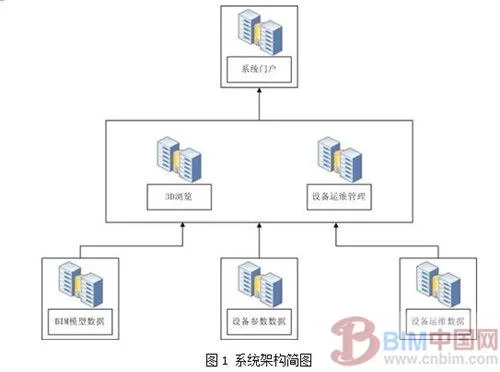
The system architecture consists of three layers:
- Data Layer: Stores various types of information, including BIM model data, equipment parameters, and maintenance data produced during operation.
- Function Layer: Offers system functionalities such as 3D BIM model viewing, component selection for equipment parameter display, initiation of maintenance processes, and development of maintenance plans.
- Portal Layer: Acts as the main entry point, centralizing important information and reminders, similar to portals used in office automation systems.
3. Data Integration
Unlike traditional building operation and maintenance systems, this system combines equipment parameters with a comprehensive BIM model database. Integrating BIM model data and equipment parameter data is crucial to the success of the system.
3.1 BIM Model Data
As discussed, BIM models from design and construction can be transferred to the operation and maintenance phase. However, these models often contain unnecessary details. For example, while steel structure models are important during construction, they may have limited value during operation and maintenance. Using complete design-phase models can slow down the system and reduce efficiency. Therefore, it is necessary to filter and streamline the models.
Given the diversity of mainstream BIM software (e.g., Dassault CATIA, Autodesk Revit), this article adopts Autodesk Revit as the standard for the operation and maintenance phase. Recommendations include:
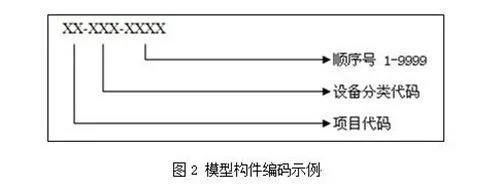
- All model components should have unique, identifiable codes (see Figure 2).
- Models should be split by discipline (architecture, structure, HVAC, fire protection, etc.), as well as by system (e.g., central air conditioning) and location (e.g., by floor or zone).
- Electromechanical equipment should be modeled with high accuracy to reflect real-world appearance.
- Use standard Revit components where possible.
- Establish a library of standard components for repetitive elements.
- Components that require independent selection or modification should be modeled separately; those that are operated as a group should be integrated.
- Exclude unnecessary components from the model.
- Mechanical and electrical equipment should be named according to actual usage.
3.2 Equipment Parameter Data
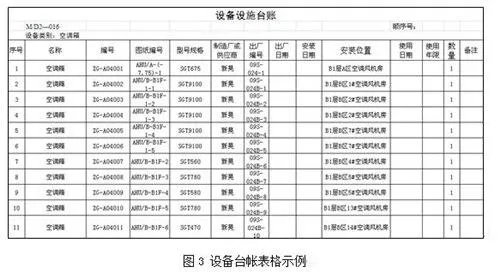
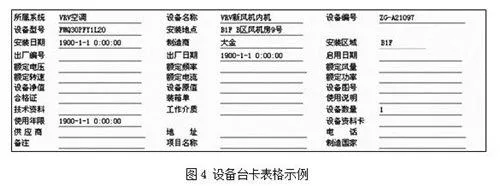
Based on multiple investigations, commonly used equipment parameter records in building operation and maintenance can be classified as either an equipment inventory or an equipment card:
- Equipment Inventory: Captures basic information about equipment assets, including a summary, model, specification, and location (see Figure 3).
- Equipment Card: Provides detailed operating parameters and reflects true equipment performance (see Figure 4). It should also include information on critical parts, accessories, and maintenance records.
4. System Functionality Overview
4.1 System Interface
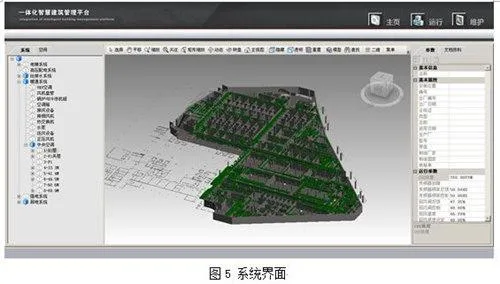
The system is built using a client-server (C/S) architecture and is divided into three primary functional pages (see Figure 5):
- Homepage: The main portal, aggregating important updates and pending tasks.
- Operation: Provides equipment browsing and search functionalities based on BIM models.
- Maintenance: Supports equipment operation and maintenance management, allowing users to initiate repair processes and create maintenance plans.
4.2 3D View Control
A core feature is the ability to browse and display BIM models. This requires third-party 3D view plugins. Given the use of Autodesk Revit for modeling, Autodesk’s Navisworks and Design Review platforms were evaluated. Design Review was selected due to its advantages:
- More realistic model browsing compared to Navisworks.
- Direct output of DWF files from Autodesk products, eliminating extra conversion steps.
- Free to use, which significantly lowers deployment costs compared to the licensed Navisworks Manager.
- Supports seamless switching between 2D and 3D views.
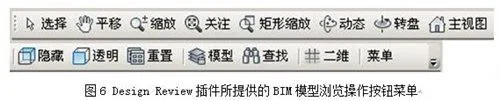
Design Review’s ECmposer control was integrated for BIM model browsing, despite the lack of a .NET API (only COM controls are available), requiring additional encapsulation during system development. Design Review also provides a comprehensive menu of BIM model navigation buttons (see Figure 6).
4.3 BIM Model Browsing
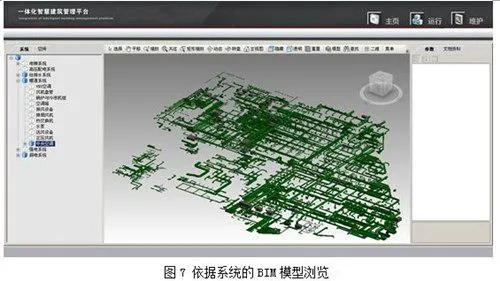
Continuous communication with frontline building operations and maintenance personnel revealed a preference for browsing BIM models by independent system rather than by architectural discipline. For example, users prefer to view the central air conditioning system as a whole, rather than as part of a larger HVAC model. Therefore, the BIM model browsing function was designed as a progressive directory tree based on independent systems.
4.3.1 First Level — System-Based Browsing
The first browsing level organizes BIM models by independent systems (e.g., central air conditioning under HVAC), displaying all related pipelines and equipment without unrelated models (see Figure 7).
4.3.2 Second Level — Floor-Based Browsing
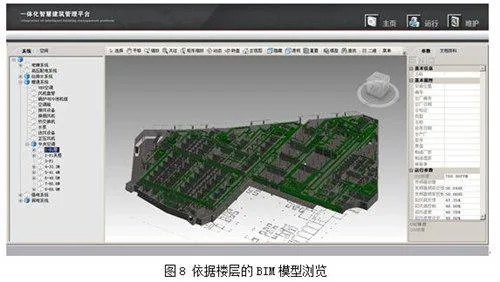
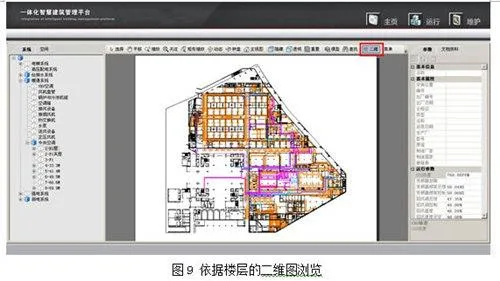
The second level organizes BIM models by system and floor, adding building and structural models to help users determine equipment locations (see Figure 8). Users can also view two-dimensional system diagrams as needed (see Figure 9).
4.3.3 Third Level — Equipment-Based Browsing
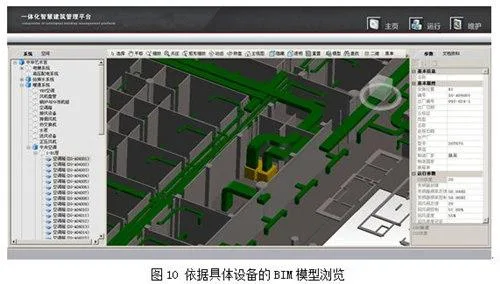
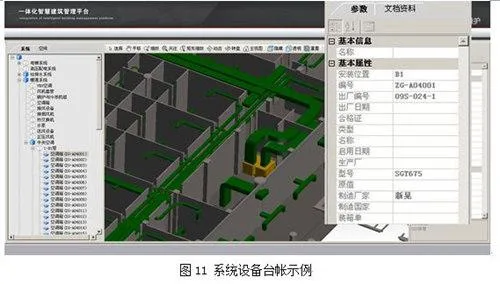
The third level allows users to browse and query specific equipment for detailed information (see Figure 10). Users can select equipment either within the model view or from the directory tree. Once selected, related device information appears, including equipment manuals, maintenance records, supplier information, and emergency plans (see Figure 11). Users can also right-click to view the equipment card and maintenance records.
4.4 Equipment Operation and Maintenance Management
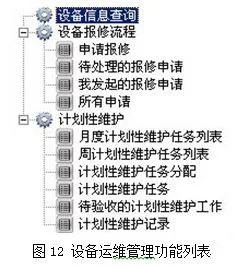
Beyond BIM model browsing, the system integrates equipment operation and maintenance management functions, such as equipment information queries, repair processes, and planned maintenance (see Figure 12).
4.4.1 Equipment Information Query
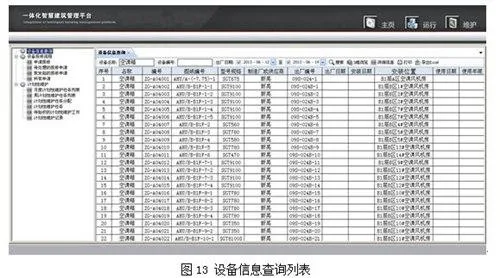
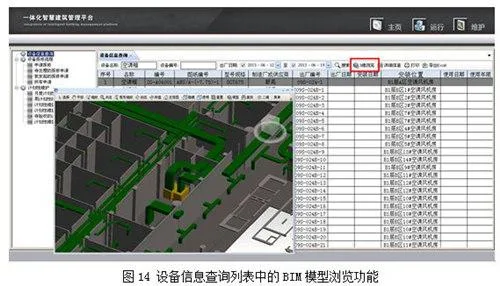
Feedback from users indicated that list-based equipment queries remain essential. The maintenance page retains keyword search functionality by device name or number (see Figure 13). Results can be printed or exported to Excel. Users can also select a record and launch a 3D BIM model browsing window (see Figure 14).
4.4.2 Equipment Repair Process
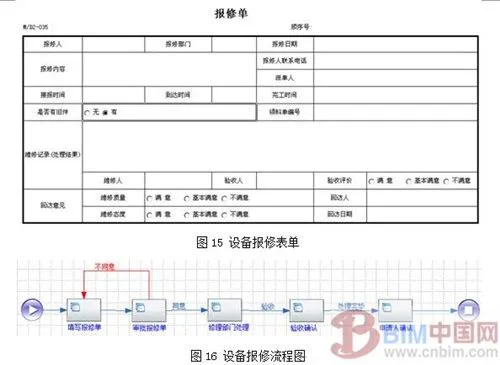
Equipment repair and maintenance is a vital function. The system supports online repair requests and approval workflows (see Figures 15 and 16). Users submit repair forms online, managers assign technicians, and after completion, feedback and inspection results are submitted and archived. All records are linked to the equipment card and can be accessed via the BIM model.
4.4.3 Planned Maintenance
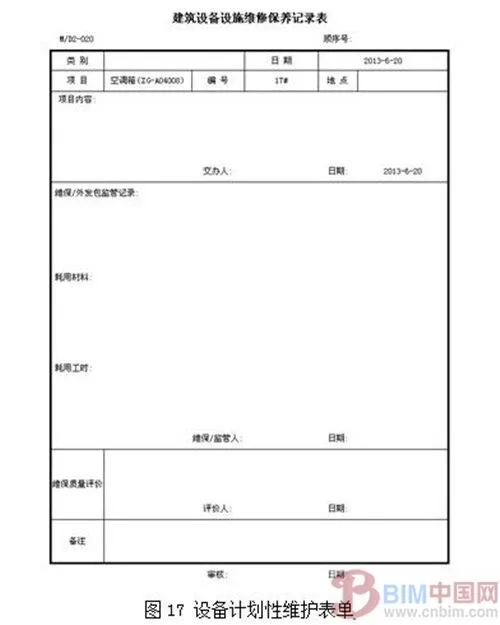
Planned maintenance allows users to schedule equipment maintenance by year, month, or week. The system reminds users when maintenance is due. Maintenance plans are allocated progressively—from system-level annual plans to floor- or zone-level monthly plans, down to weekly assignments for specific equipment and personnel. This flexible approach allows adjustments based on real-time conditions and unexpected events, ensuring a smooth maintenance workflow (see Figures 17 and 18).
5. Conclusion
Currently, the application of BIM technology in building operation and maintenance is still exploratory, and the development of this system represents a valuable attempt in this direction. Further exploration is needed, especially regarding integration with advanced technologies such as IoT, cloud computing, and building automation. Despite these challenges, BIM-based operation and maintenance management systems are showing clear advantages over traditional systems. Through this research, we hope to contribute to the advancement of BIM applications in building operation and maintenance management.
References:
[1] BuildingSMART (2008), International Alliance for Interoperability, available at: www.buildingsmartalliance.org (accessed April 2008).
Ministry of Housing and Urban Rural Development of the People’s Republic of China (2011). Outline for the Development of Informationization in the Construction Industry from 2011 to 2015.
[3] AGC (2006), The Contractors’ Guide to BIM, Associated General Contractors (AGC) of America, available at: www.agc.org (accessed April 2008).
[4] IFMA (2009). International Facility Management Association (IFMA) site. Accessed January 15, 2009. Available from: http://www.ifma.org/what_is_fm/index.cfm
He Guanpei (2011) BIM Technology Application Series – BIM Overview, China Architecture & Building Press, p.123.














Must log in before commenting!
Sign Up